





 Portuguese
  English
  Spanish
  5 min of reading
  0 comments


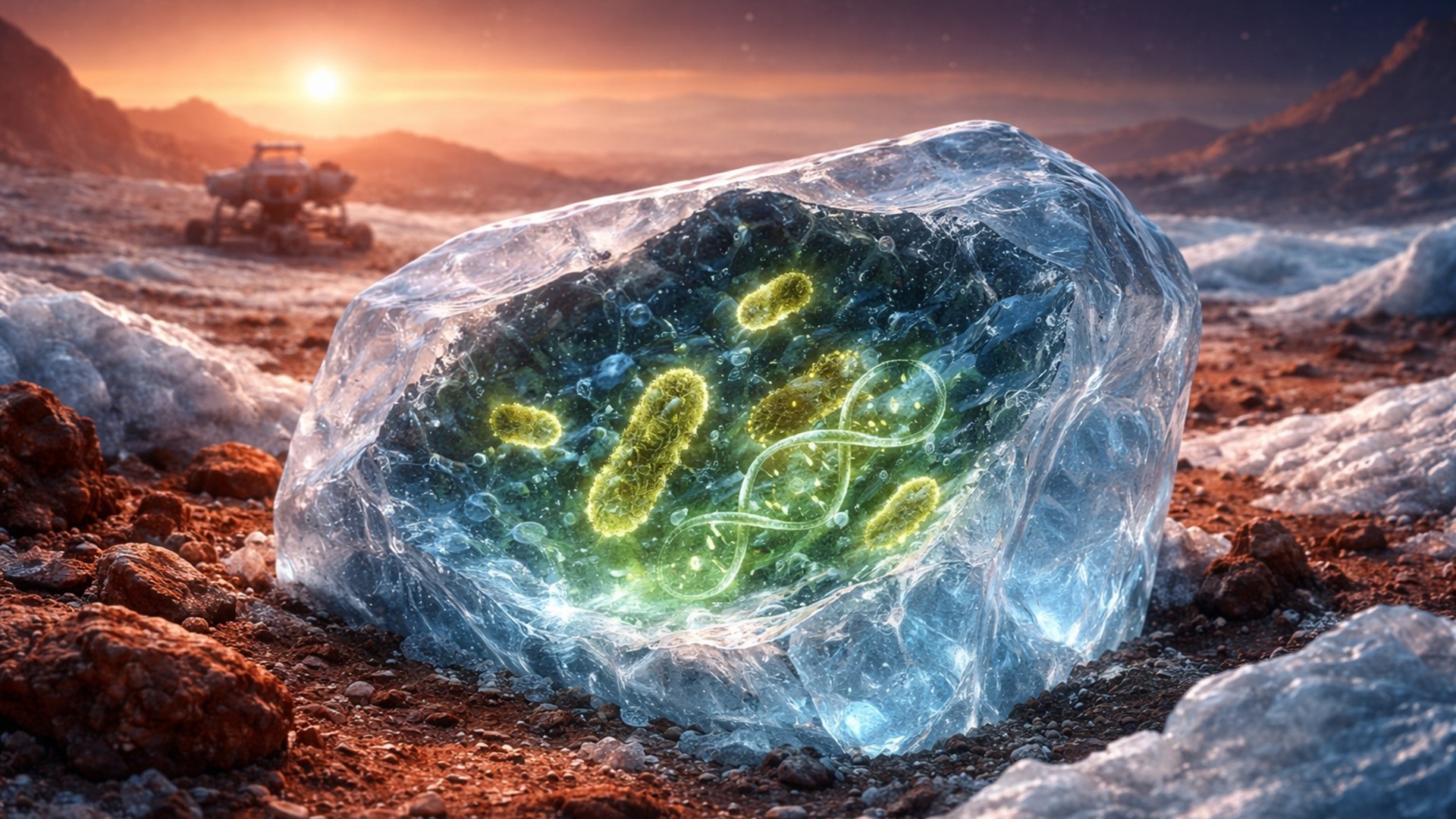
Laboratory Experiments Simulating Up to 50 Million Years of Cosmic Radiation Under Extreme Temperatures Indicate That Pure Ice on Mars May Preserve Biomolecules for Much Longer Than Soil, Clay, or Rocks, Redirecting Strategies for Searching for Life
A study conducted by NASA scientists and Pennsylvania State University indicates that intact biomolecules from dormant microorganisms decompose much more slowly when preserved in pure water ice, even under conditions similar to those on the Martian surface.
By reproducing extreme temperatures and continuous exposure to Martian cosmic radiation in the laboratory, researchers demonstrated that fragments of protein-forming molecules from the bacterium E. coli can survive for periods exceeding 50 million years when trapped in ice, especially in permafrost or Martian polar ice caps.
The results, published in the journal Astrobiology, reinforce the hypothesis that ancient microorganisms, or molecular traces of them, may still be preserved in Martian ice, awaiting detection by future scientific missions dedicated to the search for life on the Red Planet.
-
With a cost per shot close to zero, the DragonFire laser could change naval warfare in 2027 and provide British ships with nearly unlimited defense against drones.

-
A British startup creates tires that generate electricity in electric vehicles when passing over potholes, speed bumps, and cracks.

-
Scientists have created robots made with living cells that have their own nervous system, swim on their own, explore the environment, and self-organize without any genetic engineering, and now they want to do the same with human cells.
-
Students create a solar-powered ambulance that operates without a plug, without fuel, and still keeps medical equipment running in remote areas.


Ice as a Priority Environment in the Search for Martian Life
The study suggests a shift in focus for biological exploration strategies on Mars, indicating that regions dominated by pure ice or ice-rich permafrost offer greater potential for preserving organic compounds than areas composed of rocks, clay, or mixed soil.
According to the researchers, the rate of molecular decomposition observed in pure ice is significantly lower than in environments where water is mixed with mineral sediments.
This behavior contradicts previous hypotheses about the vulnerability of organic matter in ice under intense radiation.
Christopher House, co-author of the study and professor of geosciences at Penn State, highlighted that 50 million years far exceeds the estimated age of many ice deposits near the Martian surface, which are generally under two million years, increasing the chances of biological preservation.
According to House, if there are bacteria near the Martian surface, future missions equipped to access the ice may find them, provided they can reach these layers preserved under adequate conditions.
Rigorous Simulation of Martian Radiation and Cold
The team, led by space scientist Alexander Pavlov from NASA’s Goddard Space Flight Center, used E. coli bacteria as an experimental model to simulate the stability of biomolecules under extreme Martian conditions.
The samples were placed in sealed test tubes filled with pure water ice. Other samples were mixed with water and common materials found in Martian sediments, including silica-rich rocks and clay, for direct comparison between environments.
After freezing, the tubes were transferred to a gamma radiation chamber at Penn State’s Radiation Science and Engineering Center, maintained at -60 degrees Fahrenheit, a temperature similar to that of frozen regions on Mars.
The samples were exposed to a radiation dose equivalent to 20 million years of cosmic rays on the Martian surface. Subsequently, the researchers modeled an additional 30 million years of exposure, totaling a simulation of 50 million years under extreme conditions.
Results Indicate Much Slower Degradation in Pure Ice
The results showed that, in samples preserved exclusively in pure water ice, more than 10% of the amino acids from E. coli survived the simulated period of 50 million years, a rate considered significant by the researchers.
In contrast, samples mixed with Martian-like sediments showed degradation about ten times faster, with nearly total destruction of amino acids over the same time frame.
A prior study by the group, published in 2022, had already indicated that amino acids preserved in a mixture of 10% ice and 90% Martian soil were destroyed more rapidly than those found solely in sediments, reinforcing the role of pure ice as a protective element.
According to Pavlov, the new results were unexpected, as it was previously believed that organic matter in water or pure ice would be destroyed more quickly than in mixtures with soil.
The study revealed the opposite, changing the understanding of molecular degradation mechanisms in frozen environments.
Interaction Between Ice and Minerals May Accelerate Destruction
The researchers hypothesized that the faster degradation in samples containing sediments is related to the formation of a thin liquid film at the interfaces between the ice and the minerals present in the soil.
This film could allow harmful particles generated by radiation to more easily reach the amino acids, promoting their accelerated destruction. In solid ice, these particles would remain immobilized, reducing the impact on organic compounds.
According to Pavlov, in pure ice, the reactive chemical species created by radiation are frozen and may not be able to migrate to the organic compounds, significantly slowing down the processes of molecular degradation.
These findings reinforce the idea that regions dominated by pure ice represent ideal environments for the search for recent biological material on Mars, especially in areas near the surface where the ice is protected from mixing with minerals.
Implications for Icy Moons of the Solar System
In addition to Mars, scientists also tested the stability of organic material in temperatures similar to those found on Europa, Jupiter’s icy moon, and on Enceladus, Saturn’s icy moon.
In these even colder conditions, the rate of deterioration of organic compounds was even lower, indicating that icy environments in the outer Solar System may preserve biomolecules for extremely long periods.
The results are considered encouraging for the Europa Clipper mission, launched in 2024, which will travel 2.9 billion kilometers to Jupiter, with an expected arrival in 2030.
The mission will conduct 49 flybys close to Europa, aiming to assess whether there are locations below the frozen surface capable of harboring life, using instruments designed to investigate the structure of the ice and the composition of the subsurface ocean.
Technical Challenges in Exploring Ice on Mars
On Mars, direct exploration of ice has already begun with the Mars Phoenix mission, which in 2008 was the first to excavate and photograph ice in the Martian equivalent of the Arctic Circle.
According to House, there are large amounts of ice on Mars, but most is located just below the surface, requiring robust equipment for direct access to these preserved layers.
Future missions, according to the researcher, will need larger drills or more powerful shovels to effectively reach the ice, following principles similar to those adopted in the design and technical capabilities of Phoenix.
The study’s results provide a solid experimental basis to guide these missions, indicating where to search and which environments offer the greatest likelihood of preserving ancient biomolecules, even after millions of years under intense radiation.
The research was funded by NASA’s Internal Funding Program for Scientists of the Planetary Sciences Division and reinforces the role of ice as a natural archive of Mars’ potential biological history, broadening the prospects for future discoveries on the neighboring planet in the Solar System.







-

-

2 pessoas reagiram a isso.