





 Portuguese
  English
  Spanish
  3 min of reading
  0 comments


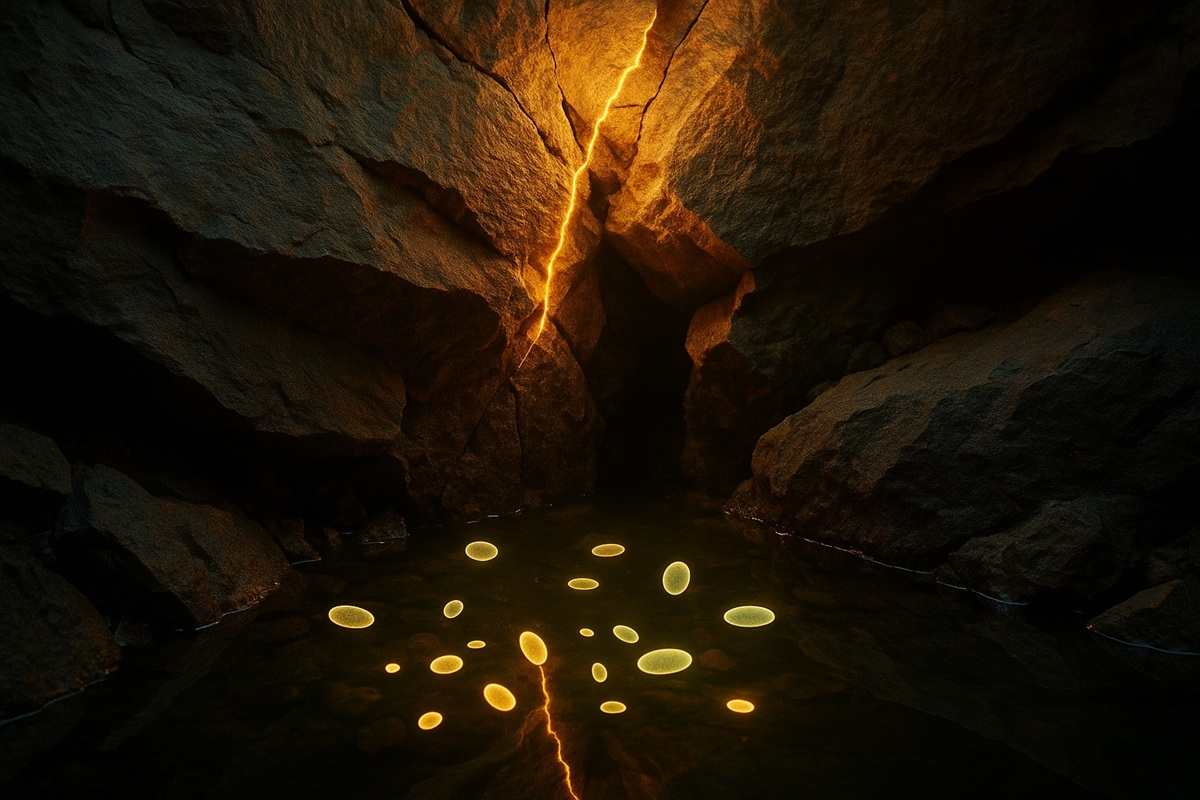
A New Study Done in China Challenges Everything We Thought About Life on Earth. Scientists Discovered That Microorganisms Can Survive in Environments Without Solar Light, Using Only the Energy Generated by Fractured Rocks in the Depths of the Planet.
For centuries, science believed that solar light was the basis of all life on Earth. But a recent study by researchers in China changed this idea.
They discovered that microorganisms living in the depths of the Earth can survive using only the energy released by the fracturing of rocks.
This happens due to the movement of tectonic plates, which create fault zones and promote chemical reactions that do not require solar light.
-
They were brilliant! Scientists discover that our ancestors in China were already making super advanced tools 160,000 years ago, changing everything we knew.

-
Scientists unveil 3 million years of climate secrets hidden in the ice of Antarctica.

-
Ancient farmers created “aggressive plants” that changed nature forever.

-
Astronomers find a “backward” solar system that ignores all the rules of space and leaves scientists scratching their heads!


These reactions create sufficient conditions to keep ecosystems alive, even completely isolated from the surface. The discovery opens space for new questions about how life works on Earth and also on other planets.
Fractures Generate Sufficient Energy for Life
The study was conducted by the Guangzhou Institute of Geochemistry. The scientists wanted to understand how subterranean microorganisms obtain energy and oxidants, two essential ingredients for generating chemical reactions that sustain life.
They already knew that hydrogen gas could serve as an energy source. But the origin of the oxidants was unknown. To investigate this, the researchers simulated in the lab the natural process of rock fracturing, the same that occurs in geological faults.
By applying pressure on different types of rocks, the structures broke apart and released highly reactive molecules known as free radicals.
These radicals reacted with water, generating hydrogen gas and hydrogen peroxide (H₂O₂), a powerful oxidant.
The result was surprising. The amount of hydrogen released was up to 100,000 times greater than that produced by other natural processes, such as serpentinization (the reaction of water with certain minerals) or radiolysis (the splitting of water by radiation).
Chemical Cycle Favors Microorganisms
In addition to generating hydrogen and oxidants, these reactions changed the behavior of the iron present in the rocks and in the water. The iron began to alternate between its oxidized and reduced states, creating a redox cycle.
This cycle is fundamental because it allows for the exchange of electrons, which activates other important reactions for life, such as those involving carbon and nitrogen.
Microorganisms use these electrons, which flow along chemical gradients, as an energy source to survive.
According to the study’s authors, even small earthquakes or subtle changes underground may be sufficient to activate these chemical reactions. This would allow life to continue even in the deepest and most isolated areas of the Earth’s crust.
Implications Beyond Earth
The discovery also has a significant impact on astrobiology, the field that studies the possibility of life on other planets.
If reactions like these occur on Earth, there is no reason to dismiss the possibility that similar processes occur on other rocky bodies in the solar system.
Planets like Mars or moons like Europa, which have active geology and are rich in minerals, could have similar conditions. Even without solar light, these environments could host microscopic life fueled by subterranean chemical reactions.
The authors’ hypothesis is clear: “We propose that faults in the crust can generate various redox pairs and drive the redox cycle of Fe, thereby providing a sustained energy source for subterranean life on Earth and potentially on other planetary bodies.”
Confirmation Depends on Field Studies
Despite the advancements, the results are still limited to the laboratory. Scientists now need to confirm how frequently and efficiently these reactions occur in actual fault zones within the Earth’s crust.
If the same processes are identified in the natural environment, the study could transform the way science understands the hidden life beneath our feet and also the possibilities of life beyond Earth.
The complete study was published in the journal Science Advances.






Seja o primeiro a reagir!