





 Portuguese
  English
  Spanish
  6 min of reading
  0 comments


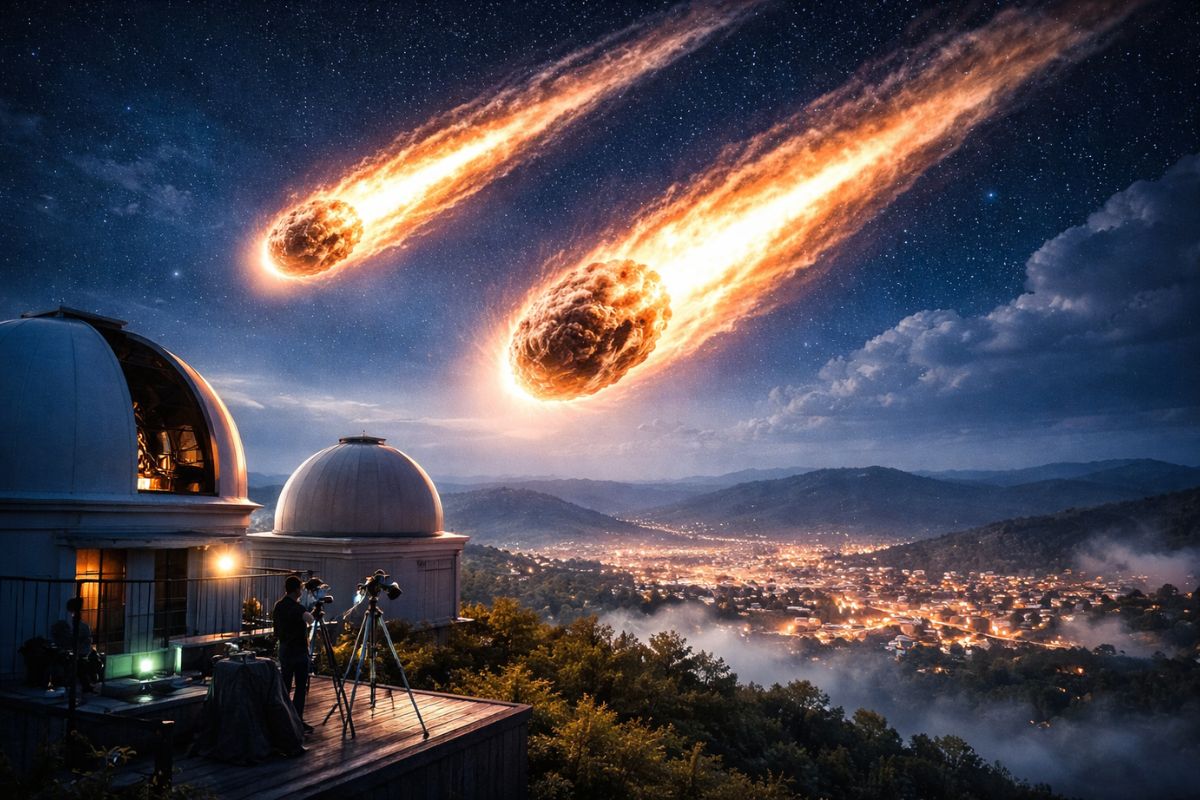
Two meteors were registered by cameras of the astronomical observatory Chat Astronomical about Santa Maria, in Rio Grande do Sul, on Sunday morning with just one minute of difference the first classified as fireball due to extreme brightness and proximity in time and trajectory led scientists to investigate whether the objects share the same cosmic origin.
Two balls of light crossed the sky of Santa Maria, in the Central Region of Rio Grande do Sul, on the morning of this Sunday (29), and the record made by a local astronomical observatory transformed what could have been a fleeting event into an object of scientific investigation. The two meteors were captured by the cameras of Chat Astronomical in an interval of just over a minute the first at 12:12 AM, the second at 12:13 AM. What caught the attention of scientists was not only the proximity in time but the similarity in trajectories and positions in the sky.
The first meteor was classified as a fireball, an extremely bright type that lights up the sky visibly to the naked eye even in urban areas. The second, of lesser magnitude, crossed the sky very close to the first, both in position and in apparent trajectory. Although more than one meteor can be recorded over the same night, occurrences so close in time and location are not common, according to the team of the astronomical observatory. The data will now be analyzed and cross-referenced with information from other observatories to determine if the two objects are related.
What the cameras of the astronomical observatory registered in Santa Maria
The record was made by the observatory of Chat Astronomical, a scientific dissemination project based in Santa Maria that operates permanent celestial monitoring cameras.
-
Fireballs shoot across the skies of the USA and meteor explosions draw attention: what is causing this mysterious wave of sightings?
-
Brazil has quietly developed an electric tactical drone that takes off and lands vertically without needing a runway, flies at 140 km/h in a fully autonomous manner, and can operate in forests, conflict zones, and remote areas.

-
Novo drone Guardian debuts in the United States with an 8-mile range, robotic battery swapping, and Starlink connectivity for continuous response.
-
100 kW megalasers are already pointing to a new industrial phase, with enough power to cut thick steel, drill through rocks, accelerate mining, and increase productivity in operations previously considered too difficult.

On Sunday morning, the system captured two luminous events in the city’s sky in rapid succession something that immediately caught the attention of the team of scientists responsible for analyzing the data.
The first event, at 12:12 AM, produced an intense flash in the sky. Due to its brightness, it was classified as a fireball a term used by astronomy to designate exceptionally bright meteors that exceed the magnitude of Venus in the night sky.
Fireballs are relatively rare and usually generate records in multiple cameras from different observatories, which allows triangulating the trajectory and estimating the altitude and speed of the object.
Just one minute later, at 12:13 AM, a second meteor crossed the sky of Santa Maria in position and trajectory very close to the first. The magnitude of this second event was lower less bright and of shorter duration, but the proximity to the previous fireball is what makes the record scientifically relevant. Two meteors so close in time and space raise the hypothesis that both may have the same origin.
What is a fireball and why was the first meteor classified that way
Not every meteor that crosses the sky receives the same name. Most luminous events we see during meteor showers or on random nights are common meteors small fragments of space rock that enter the Earth’s atmosphere and disintegrate due to friction, producing a trail of light. A fireball is different: it is significantly brighter, often visible even in skies with light pollution, and results from larger or denser fragments.
The fireball registered over Santa Maria at 12:12 AM fits this category. The extreme brightness captured by the cameras of the astronomical observatory indicates that the object had size or composition sufficient to produce a flash that stood out in the city’s night sky. In some cases, fireballs are so bright that they cast shadows on the ground a spectacle that few witness because most occur over uninhabited areas or during sleep.
For the scientists of Chat Astronomical, the fireball is the main event of the record. But it is the second meteor smaller, more discreet and appearing just one minute later that transforms the observation into a case worthy of investigation, because its similar trajectory suggests a possible connection to the first.
Why do two so close meteors intrigue scientists
The fall of meteors is a constant phenomenon: every day, tons of cosmic material enter the Earth’s atmosphere. Most disintegrate unnoticed. What makes the record from Santa Maria unusual is not the existence of two meteors on the same night this happens regularly, but rather the extreme proximity in time and position.
One minute of difference and nearly overlapping trajectories raise a hypothesis that scientists now need to test: the two meteors may have the same origin. This would happen if both were fragments of the same celestial body that broke apart before entering the atmosphere, or if both belonged to the same stream of space debris which would characterize an association with a specific meteor shower.
The team of the astronomical observatory of Santa Maria reported that the data from the record will be cross-referenced with information from other observatories in Rio Grande do Sul and Brazil. The triangulation of data from multiple cameras allows calculating the real trajectory of the meteors, their altitude, speed, and radiant point in the sky information that helps determine if the objects share a common origin or if the proximity was mere coincidence.
The role of observatories in monitoring meteors in Rio Grande do Sul
The record made in Santa Maria was only possible because the observatory of Chat Astronomical operates celestial monitoring cameras permanently.
These systems operate 24 hours a day, automatically recording any luminous event that crosses the field of vision from meteors and fireballs to artificial satellites and other atmospheric phenomena.
Rio Grande do Sul has a growing network of observatories and monitoring cameras that, together, cover a large part of the state’s sky.
When a meteor is recorded by more than one camera in different locations, it is possible to triangulate its real position and reconstruct the three-dimensional trajectory of the object. This information is essential to determine where the meteor came from and, in rare cases, where any fragments may have fallen.
The work of the observatories goes beyond scientific curiosity. Data on meteors feed international databases that help map the population of near-Earth objects and better understand the risks associated with larger impacts.
Each record made by cameras in Santa Maria or any other city contributes to a global monitoring effort that, although rarely making headlines, is essential for planetary safety.
What the investigation about the origin of the two meteors may reveal
If the analysis confirms that the two meteors registered over Santa Maria have the same origin, the result will be scientifically relevant. A pre-atmospheric fragmentation when a body breaks apart before reaching the dense layers of the atmosphere produces exactly this type of pattern: multiple meteors in rapid succession with similar trajectories.
Another possibility is that both belong to an active meteor shower during this time of year. Meteor showers occur when the Earth crosses the orbit of a comet or asteroid that has left behind a trail of debris. If the data points to a common radiant the point in the sky from which the meteors seem to emerge, this would confirm the association with a known debris stream.
Regardless of the outcome, the record from Santa Maria reinforces the importance of keeping observatories active and cameras pointed at the sky.
Two meteors with a one-minute difference over Rio Grande do Sul are a reminder that space is not static and that the sky above our heads is busier than most people imagine.
With information from the portal of G1.
Have you ever seen a meteor or a fireball crossing the sky? Do you live in Santa Maria or Rio Grande do Sul and witnessed these events on Sunday morning? Share in the comments — observer reports help scientists complement the data from observatories.








Seja o primeiro a reagir!