





 Portuguese
  English
  Spanish
  6 min of reading
  0 comments


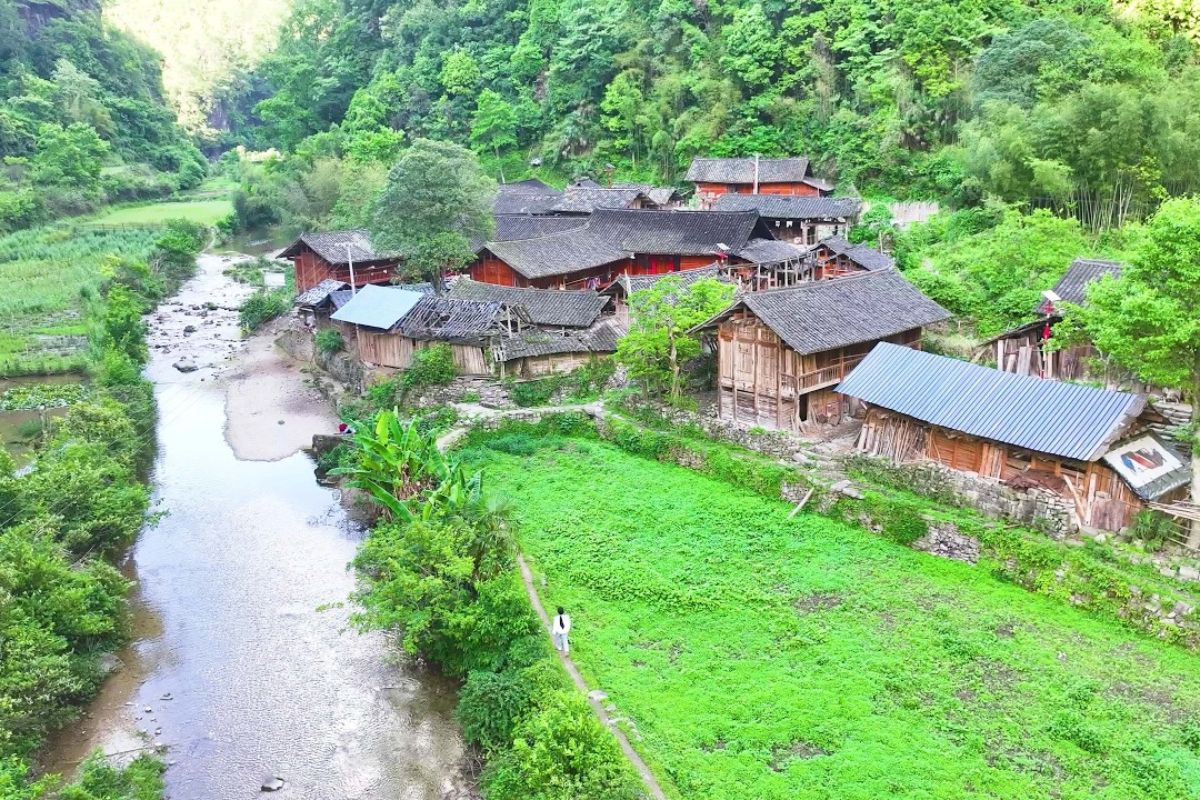
Hidden Village In China, In Shibing County, Guizhou, Is Located Inside A Narrow Tiankeng And Isolated By Peaks, With Path On The Cliff, Horses For Transport, Internet And Agricultural Routine.
The hidden village in China appears at the bottom of a narrow tiankeng, surrounded by peaks that act as a natural barrier. In Shibing, in Guizhou Province, everyday access depends on a long walk, sudden rain, and a trail carved into the cliff.
The hidden village in China has electricity and internet, but no road for cars. The vehicle is left at the edge of the tiankeng, and the rest of the route is done on foot, along a path with a canyon below, a safety cable alongside, and about an hour of uphill and downhill to the bottom.
Where It Is And Why The Place Isolates Everything

In the deep mountains of Shibing County, in Guizhou, the hidden village in China was built inside a tiankeng, a narrow depression surrounded by natural walls and imposing peaks.
-
These living root bridges and ladders are over 700 years old and help indigenous people survive in one of the rainiest regions in the world.

-
From sertanejo star to international investor: Ana Castela invests millions in a mansion in the USA, creates a themed accommodation in Orlando, and shows that the “boiadeira” also wants to grow away from the stage.

-
The 10 most stunning motorhomes in the world: a $3 million trailer with a rooftop nightclub and garage for a Ferrari, “palaces on wheels” with Italian marble, private cinema, and five-star hotel luxury for billionaires.

-
Trump wanted to spend $400 million on the White House, but the courts prohibited the million-dollar construction.


The terrain creates a physical and visual barrier, reducing access and leaving the place away from the common flow of cities and roads.
The scenery changes rapidly due to the local climate.
In one day, there can be records of a rainy morning with heavy rain, and hours later, a clear sky.
In the rainy season, the water rises, ditches flow again, and the stream overflows over stones, changing the difficulty of crossing and leaving slippery points.
The Road Does Not Exist And The Path Was Carved In The Cliff

Access to the hidden village in China requires walking along a mountain road until reaching a passage fixed to the cliff.
The stretch is described as a road of wooden planks and hand-carved rock, with traces of steel chisels still visible on the surface.
Below the passage, there is a canyon with a vertical drop estimated at around 100 meters.
To reduce the risk in a high and narrow location, there is a cable at the edge of the cliff.
Even with this support, progress is slow, with parts of the path winding down to the valley floor and sections that change according to water and mud.
Horses As Transport And Survival Logistics

Without a road for vehicles inside the tiankeng, the hidden village in China uses horses as the main means of transport.
When it is necessary to exchange food for supplies at the county seat, reports indicate that residents rely on horses, and that almost every house has horses.
The horses carry firewood, fertilizers, and anything else that needs to cross the trail.
It is mentioned that, in the past, the village had 11 horses, a number associated with the time when there were more families.
Currently, records show three horses in the village, still active as labor to carry loads and support agricultural work.
Electricity And Internet Descending Into The Abyss
The hidden village in China is remote and described as primitive, but it maintains electricity and internet.
Along the way, there is a utility pole and the explanation that the power source is pulled from the well, bringing electrical service to an isolated location.
This combination creates a direct contrast: basic infrastructure arrives, but displacement still depends on trails, horses, and walking.
The car remains parked at the edge of the tiankeng, and the final step to reach the houses remains physical, subject to rain and wet stones.
Abandoned Fields, Who Stayed And The Weight Of Age In Work
The interior of the tiankeng has fields scattered in the narrow space.
Some of these areas appear abandoned because many people have moved away, and those who remain do not have the demand to keep the entire area productive.
The result is plots with weeds and signs of irregular use, even in a place with soil and water described as rich.
Agricultural routine remains active and includes the elderly in heavy tasks.
There is a meeting with a grandmother who still plants corn and applies chemical fertilizer in the field.
Her age is cited as 83 years, and there is also a reference to residents over 90 years old carrying manure, reinforcing the pattern of prolonged physical work.
Subsistence Agriculture, Animals And What Is Still Raised
The hidden village in China maintains animal husbandry integrated into daily life. The grandmother mentions feeding chickens, pigs, cows, and horses, with a direct mention of two pigs, chickens, and the use of animals as labor.
The planted corn has a practical function: serving as feed for the chickens.
Records also indicate that today few people raise cows because there are not enough crops, and the demand for land has decreased.
Even so, the scenario shows stables, chickens roaming the village, and a domestic logistics that blends husbandry, farming, and use of local resources.
Old Tools, Watermill And Water Everywhere
Along the way, there is an old watermill covered in weeds and out of use.
The mechanism is described as powered by water flow, with a diversion channel and transmission device to turn the millstone, without requiring labor or electricity, representing a type of rural engineering that has lost ground.
Water becomes prominent in Guizhou during the rainy season: ditches flow again, the stream grows, and a waterfall is mentioned further up.
In an attempt to reach the spot, the path requires crossing submerged stones, dealing with cold water and thorny terrain, until the decision is made to use a drone to assess a canyon where proceeding on foot becomes unfeasible.
Wooden Houses, Large Yards And Marks Of Emptying
The hidden village in China is described with traditional wooden houses and local materials, including stone.
Cars do not enter, and preservation is associated with this. There is a highlight on wide yards, firewood stacked for winter, and closed doors in houses where no one lives, signaling the departure of residents.
The technical explanation for the tall foundations of wooden houses is linked to the rain: low eaves would cause water to splash on the wall, and wood in contact with water rots easily.
Therefore, the elevated base serves as structural protection against constant splashing during rainy seasons.
The Visit That Repeats And The Warmth That Becomes Routine
On the second visit, the grandmother’s recognition marks the experience.
Even with poor vision and difficulty hearing, she insists on taking visitors to her home.
The encounter includes conversation at the entrance of the village, insistence on offering a meal, and a domestic atmosphere with a rustic kitchen, direct fire, and meal preparation.
The food served includes bacon, bamboo shoots, free-range egg, and sausage, along with a mention of pigs fed with scraps, which is linked to the taste of the meat.
In the end, there is a promise of return, with the grandmother asking that next time, they come directly and bring nothing.
Do you think a hidden village in China like this should remain isolated to preserve itself, or should it gain roads and easy access even at the risk of changing everything?









-

2 pessoas reagiram a isso.