





 Portuguese
  English
  Spanish
  4 min of reading
  15 comments


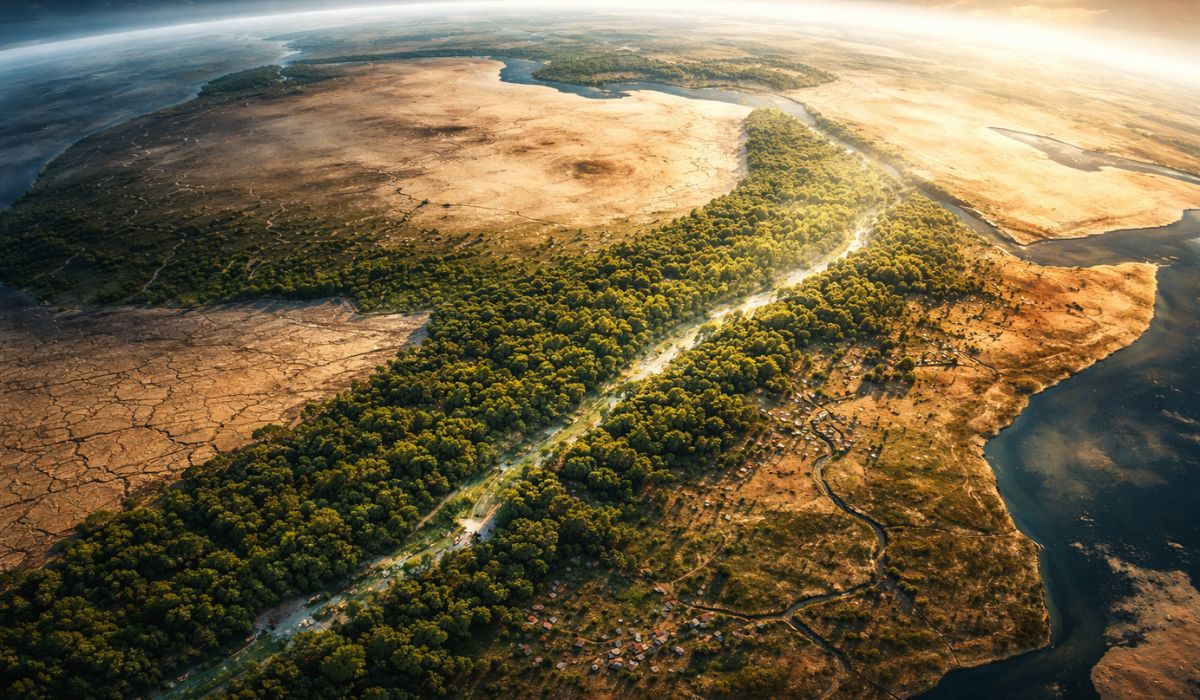


Continental Project Brings Together 11 African Countries to Restore Degraded Lands in the Sahel and Curb Desertification with Environmental and Social Goals by 2030.
A strip of restored areas about 8 thousand kilometers long and 15 kilometers wide crosses the African Sahel as part of an international strategy to combat desertification.
Named Great Green Wall, the initiative brings together 11 countries and aims to recover degraded lands to curb the advance of the Sahara Desert and strengthen productive activities in vulnerable regions.
The project was launched in 2007 by the African Union, in coordination with the United Nations Convention to Combat Desertification (UNCCD).
-
These living root bridges and ladders are over 700 years old and help indigenous people survive in one of the rainiest regions in the world.

-
From sertanejo star to international investor: Ana Castela invests millions in a mansion in the USA, creates a themed accommodation in Orlando, and shows that the “boiadeira” also wants to grow away from the stage.

-
The 10 most stunning motorhomes in the world: a $3 million trailer with a rooftop nightclub and garage for a Ferrari, “palaces on wheels” with Italian marble, private cinema, and five-star hotel luxury for billionaires.

-
Trump wanted to spend $400 million on the White House, but the courts prohibited the million-dollar construction.

The proposal connects actions from Senegal to Djibouti, integrating national environmental restoration policies under a common continental guideline.
Institutional materials and awareness campaigns often describe the initiative as “visible from space” and “three times larger than the Great Barrier Reef.”
These expressions are used as scale comparisons, without a standardized detailing of the criteria adopted for this equivalence in the available technical reports.
Route of the Great Green Wall and Participating Countries
The original line connects the Atlantic Ocean to the Red Sea, passing through Senegal, Mauritania, Mali, Burkina Faso, Niger, Nigeria, Chad, Sudan, Eritrea, Ethiopia, and Djibouti.
Instead of a continuous line of trees, the concept has evolved into a mosaic of interventions adapted to each territory.
In practice, the countries implement projects for the reconstitution of native vegetation, sustainable land management, recovery of pastures, and agricultural systems that are more resilient to climate variability.
The notion of “green belt” remains as a symbolic and geographical reference, but the execution occurs in a decentralized manner.

According to data associated with the initiative, approximately 250 million people live in areas affected by environmental degradation in the Sahel.
The restoration of landscapes is presented by international organizations as a strategy to reduce socioeconomic vulnerabilities in these locations.
Desertification in the Sahel and Climate Impacts
The Sahel region faces recurring cycles of drought, rising temperatures, and irregular rainfall.
Reports from UN agencies indicate that these conditions directly affect agricultural productivity and the availability of water resources.
With the reduction in soil fertility, farmers and livestock keepers report income losses and greater exposure to food insecurity.
In areas marked by armed conflict, the combination of environmental degradation and political instability amplifies logistical challenges for field project implementation.
In this context, the Great Green Wall has been incorporated into international commitments for environmental restoration.
The official goal is to restore 100 million hectares by 2030, sequester 250 million tons of carbon, and create 10 million jobs deemed green, according to documents from the UNCCD and the African Union.
Goals, Hectares Restored, and Discrepancies in Numbers
The numbers released over the years vary according to the period analyzed and the methodology employed.
Balances regarding the period between 2007 and 2018 point to the restoration of about 20 million hectares and the creation of over 350 thousand jobs linked to the program’s actions.
Later updates presented by representatives connected to the initiative indicate that approximately 30% of the restoration goal may have already been achieved, which would correspond to about 30 million hectares.
The discrepancies arise, according to experts consulted in technical reports, from the inclusion of parallel national projects and different criteria for validating recovered areas.
At the national level, Senegal appears in official communications with the mark of more than 12 million trees planted in areas associated with the project.
Ethiopia is also frequently mentioned for implementing restoration programs over millions of hectares.
However, the consolidated data do not always detail seedling survival rates or field verification methods.
Billion-Dollar Funding and Monitoring Platform
Funding gained prominence in January 2021, when governments and institutions announced commitments amounting to approximately 19 billion euros to accelerate the initiative during an international meeting in Paris.
The volume of promises increased the project’s visibility and established short- and medium-term goals.
Subsequent surveys indicated a difference between announced values and resources actually disbursed by the beginning of 2023.
Monitoring reports indicate that part of the funds depends on specific contracts, national schedules, and local counter-contributions.
To organize scattered information, the UNCCD launched a monitoring platform in 2024 aimed at gathering data on projects, financial contributions, and results.
The tool seeks to consolidate indicators and provide greater transparency to the process, according to a statement from the convention itself.
Comparison with the Great Barrier Reef and Challenges on the Ground
The comparison with the Great Barrier Reef is used in promotional materials to illustrate the projected territorial dimension.
However, public documents do not uniformly specify whether the parallel considers linear extension, total planned area, or other parameters.
In addition to measurement issues, the advancement of the project faces practical obstacles.
The coordination between countries with different institutional capacities, insecurity in parts of the Sahel, and extreme climate events influence the pace of activities.
Experts in ecological restoration emphasize, in analyses published by multilateral organizations, that maintaining restored areas is crucial for the durability of the results.
The effectiveness of the program depends both on initial planting and technical follow-up and the involvement of local communities.
As governments and international partners adjust goals and schedules, the 2030 deadline remains the official reference.






Por fin una buena noticia, para y de África, para la humanidad
Parabéns aos países envolvidos nessa ideia 💡. Será muito bom, o povo africano agradece vai gerar empregos e sustentabilidade, e a natureza e o mundo 🌎 e melhora também o clima, vai fazer o bem pra todos dessa região da África.
Correct the title of the article, it’s a 8000km wall and not 8….