





 Portuguese
  English
  Spanish
  5 min of reading
  1 comment


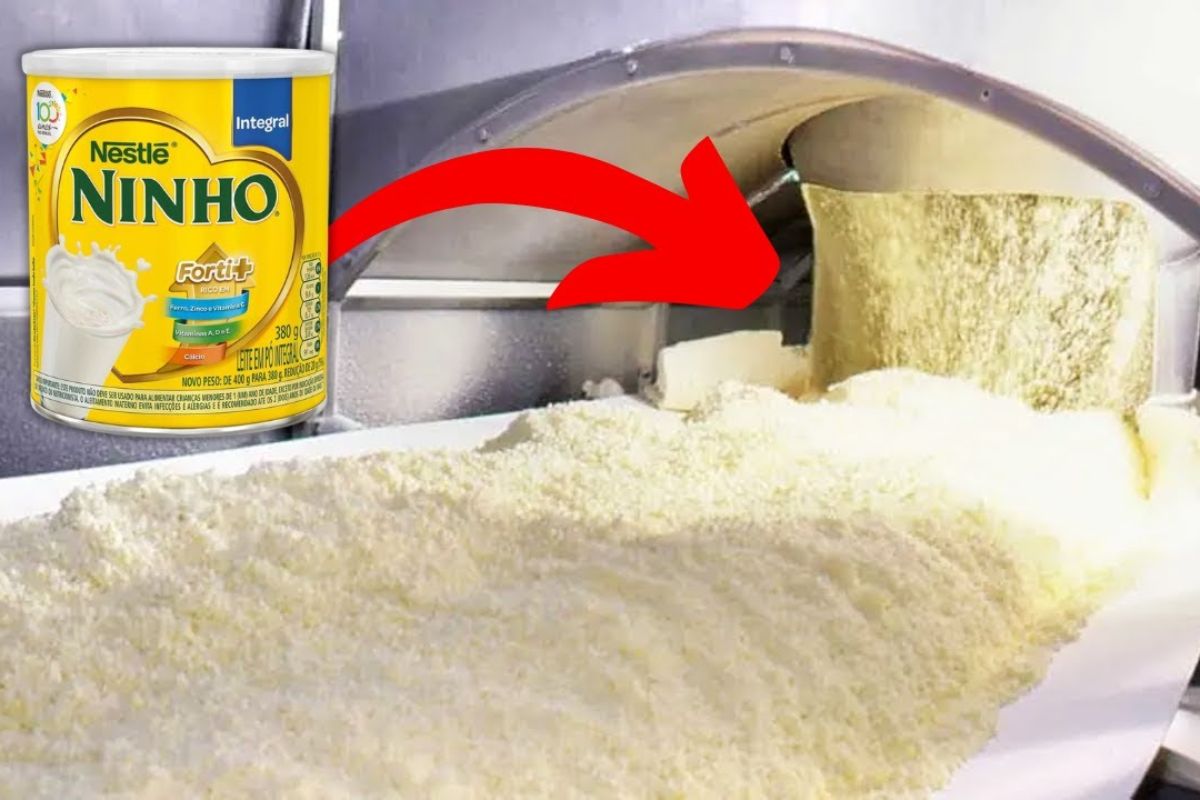


From Milking And Initial Cooling At 4 °C To Refrigerated Transport, Standardization, Pasteurization, Evaporation And Spray Drying, The Process Of Powder Milk Transforms Thousands Of Liters Per Hour With Continuous Quality Control Until Hermetic Packaging
The powder milk originates from an industrial chain that begins on the farm, with mechanical milking twice a day, immediate cooling to 4 °C, and transport in stainless steel tankers between 2 °C and 4 °C. At the plants, the raw material enters 60,000-liter tanks, undergoes rigorous testing, and follows a sequence of thermal and mechanical steps that preserve nutrients and safety.
Globally, millions of tons of powder milk supply both household and industrial consumption. In Brazil, the fourth-largest producer, the operation integrates fine-tuning of composition, quick pasteurization, solid concentration, and instantaneous drying to generate a soluble and stable powder, ready for packaging, labeling, and distribution.
From Farm To First Cooling
Production begins in the field, where high-producing dairy cows deliver between 30 and 50 liters per day. To maintain microbiological quality, cooling to 4 °C occurs immediately after milking, extending shelf life and preserving sensory characteristics of the milk intended for industry.
-
Attracting around 250,000 people a year, a lighthouse 200 meters from the sea, on a 60-meter high cliff, on the North Sea coast in Denmark, becomes one of the most impressive examples of how nature can threaten historical buildings.

-
The narrowest house in the world is only 63 centimeters wide, but inside it can accommodate a bathroom, kitchen, bedroom, office, and even two staircases.

-
In the middle of the sea, these enormous concrete and steel structures, built by the British Navy to protect strategic maritime routes, look like they came straight out of a Star Wars movie.

-
For years, no one could cross a neighborhood in Tokyo because of the tracks, but an impressive solution changed mobility and completely transformed the local routine.

Modern farms utilize large-capacity refrigeration tanks with automatic temperature control. This stage is crucial because the faster the cooling, the lower the bacterial multiplication, which improves processing efficiency and reduces losses in subsequent stages.
Transport In Refrigerated Tank Trucks
The milk is transported in insulated stainless steel tankers designed to maintain 2 °C to 4 °C throughout the journey. Each tanker carries about 25,000 liters, and the operation is timed to coincide with morning milking, minimizing time outside refrigeration.
Drivers are trained for hygiene and load integrity. The connected logistics between farm and factory reduces temperature variations, ensures more uniform receiving, and facilitates line scheduling, allowing continuous processing of large volumes throughout the day.
Industrial Reception And Quality Testing
Upon arriving at the plant, the milk undergoes analyses of acidity, temperature, fat content, and contaminant verification.
Only approved batches enter 60,000-liter tanks connected to refrigeration systems that keep the product in ideal condition until processing.
Storage is temporary and monitored. Robots and automated valves pump with precision the milk between tanks and lines, organizing batches according to the desired final product. This automation supports batch traceability and process consistency.
Composition Standardization
Before conversion to powder milk, the composition of raw milk is adjusted. For whole powder, natural fat is preserved; for skimmed, most of it is removed; in semi-skimmed, an intermediate point is sought.
Standardization separates and reintroduces cream according to specification, and can also adjust proteins and carbohydrates.
This flexibility allows the same raw material to generate different product profiles, responding to market demand without altering the basis of the process.
The result is predictability of labeling and technological performance in both domestic and industrial applications.
Quick Pasteurization And Cooling
Standardized, the milk is sanitized by pasteurization, with heating between about 70 °C and 85 °C for a few seconds in high-efficiency heat exchangers. The thermal shock eliminates pathogenic microorganisms without “cooking” the product, preserving flavor and nutrients.
Subsequently, the milk is rapidly cooled to process temperature.
The speed of these thermal cycles reduces unwanted reactions, maintains protein stability, and prepares the flow for centrifugal separations and concentration stage.
Centrifugation And Separation
High-speed centrifuges separate phases by density. The lighter cream migrates to the center of the drum and is removed, while skimmed milk advances.
In some lines, the protein fraction is also utilized for other dairy ingredients.
This precise separation contributes to the stability of the final powder, as it controls the lipid fraction and minimizes oxidation risks. Additionally, it prepares the product for more energy-efficient water evaporation.
Evaporation And Solid Concentration
In the evaporator, the milk is heated around 40 °C to 45 °C under controlled conditions to remove part of the water. The volume can reduce by up to half, increasing the concentration of proteins, lactose, vitamins, and minerals.
The more solids at the evaporation outlet, the more efficient the subsequent drying.
This stage improves yield and quality because it reduces the time of milk exposure to hot air during drying. The uniform concentration contributes to stable granulation and good solubility in the final product.
Spray Drying: From Liquid To Powder
The conversion to powder milk occurs in spray dryers. The concentrated milk is atomized into microdroplets inside a chamber with heated air that can reach about 200 °C.
The contact lasts seconds, and there is no direct contact with hot surfaces, avoiding cooking.
The droplets lose almost all their moisture and turn into fine powder in a continuous flow. This rapid kinetics preserves milk characteristics and produces particles with good dispersion in water, a requirement for home preparation and industrial use in beverages and foods.
Classification, Screening And Quality Control
After drying, vibratory screens classify the powder by particle size and remove agglomerates. Standardizing granulation improves flow, dosing, and dissolution.
In parallel, samples are collected every 30 minutes on the line to check residual moisture, color, solubility, and composition of fat, proteins, and carbohydrates.
Only batches meeting the parameters proceed. Frequent control prevents deviations, ensures repeatability, and reduces reprocessing.
Sample traceability links laboratory results to the batch number and production time.
Filling, Sealing And Labeling

The final stage directs the powder through closed ducts to automatic fillers. The packages are sterilized beforehand and can be bags, cans, or jars.
After filling, hermetic sealing occurs to protect aroma, flavor, and nutritional value, followed by labeling with nutritional data, manufacturing date, and expiry date.
Subsequently, the units proceed to secondary packaging, boxing, and palletizing. The goal is to protect the product from moisture and oxygen, maintaining quality until consumption.
The final logistics distribute the powder milk to retail and industrial applications.
Which stage do you consider most critical for the quality of powder milk in daily life: quick pasteurization, spray drying, or moisture control after drying?







Controle de qualidade após a secagem.