





 Portuguese
  English
  Spanish
  5 min of reading
  0 comments


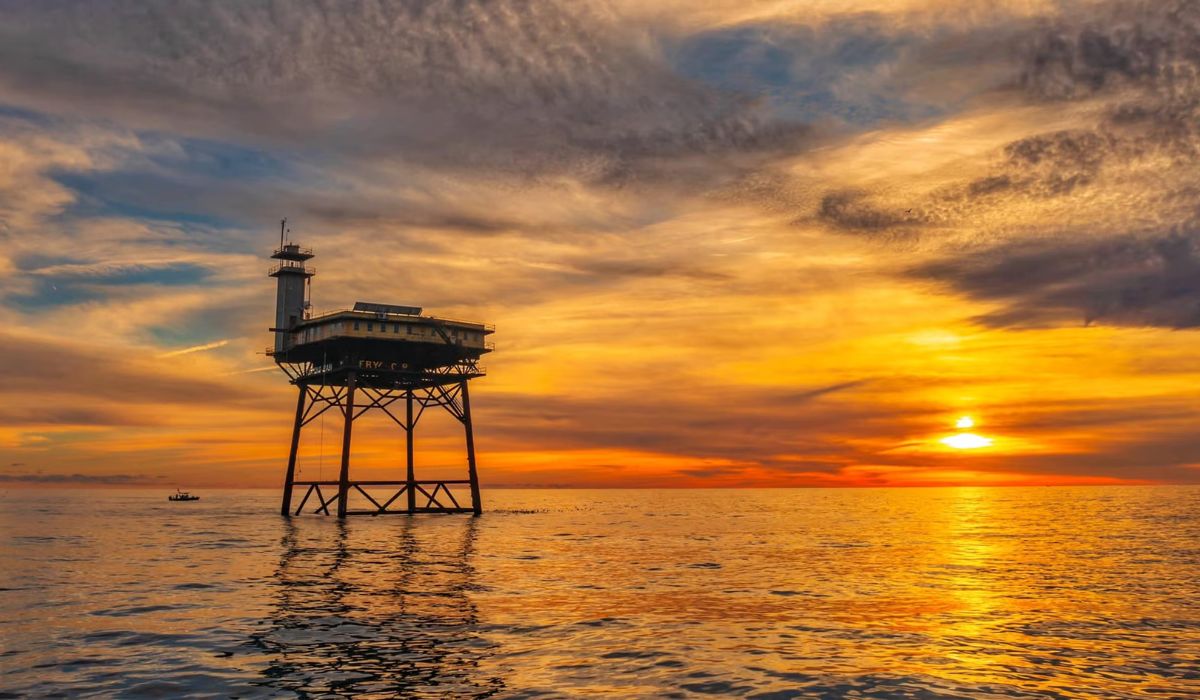
Isolated In Open Sea, An Old US Coast Guard Tower Has Become A Destination For Visitors Who Accept Logistical Risks, Climate Exposure, And Limited Infrastructure, In One Of The Most Unstable Areas Of The North Atlantic, Known For Its History Of Shipwrecks.
The Frying Pan Tower, an old structure of the United States Coast Guard located in open water of the Atlantic Ocean, has started to function as accommodation aimed at visitors interested in isolation and off-the-beaten-path experiences.
The location has earned the nickname of “most dangerous hotel in the world” in international reports due to objective factors such as constant exposure to the climate, restricted access, and the natural wear of a structure surrounded by the sea.
The tower is located about 32 miles off the coast of North Carolina, in an area historically associated with shipwrecks and rapid changes in weather conditions.
-
He started running at 66 years old, broke records at 82, and is now a subject of study for having a metabolic age comparable to that of a 20-year-old, in a case that is intriguing scientists and inspiring the world.

-
Oldest tree on the planet reappears after 130 years of searches: Wattieza, 385 million years old, was 10 meters tall and had no leaves or seeds; Gilboa fossils in New York solved the mystery in 2007.

-
A 48-square-meter house assembled in hours with 4,000 bricks made of recycled plastic that does not absorb moisture, has natural thermal insulation, and costs less than 90,000 reais in a complete kit.

-
Luciano Hang revealed that Havan’s air fleet has already accumulated more than 20,000 landings, 10,000 flight hours, and 6 million kilometers traveled, and he says that without the planes, the company would never have grown so quickly.

The designation is not related to rates of violence or crime.
The risk attributed to the location stems primarily from the combination of distance from the mainland, logistical limitations, and the constant need for maintenance in an environment marked by salt corrosion and intense weather phenomena.
Origin Of The Tower In The Cemetery Of The Atlantic
The Frying Pan Tower was built starting in 1964 as a support station for maritime navigation.
It was part of a set of structures intended to guide vessels in a stretch of coastline known as the “Cemetery of the Atlantic”.
The term has been used for decades to refer to the coast of North Carolina.
In this area, sandbanks, reefs, and storms have contributed to a high number of shipwrecks throughout history.
With the advancement of electronic navigation systems and the automation of lighthouses, the tower lost operational relevance.
It was ultimately deactivated in the early 2000s, according to historical records about the station.
The structure remained unused until it was put up for auction by the US government.
In 2010, the engineer Richard Neal purchased the property for about US$ 85,000.
Since then, the tower has undergone a gradual restoration process.
The work is carried out with the support of volunteers and donations.
According to information released by the owner in interviews and institutional materials, the goal is to preserve the structure and allow controlled visits without turning the place into a conventional hotel.
Why The Frying Pan Tower Is Considered Dangerous
The label of “most dangerous hotel in the world” solidified from reports that highlight the specific conditions of the surroundings.
The tower is located in open water.
The region is subject to storms, strong winds, and the passage of tropical systems.
These factors can quickly alter access and stay conditions.
The distance from the mainland exacerbates potential difficulties.
In cases of medical emergencies, technical failures, or sudden weather changes, the movement depends on boats or helicopters.
This type of operation can take hours or become temporarily unfeasible.
Maritime safety experts point out that isolation increases the complexity of any rescue.
Another frequently mentioned point is structural wear.
Metal constructions continuously exposed to salt water require frequent inspections and repairs.
Even with interventions over the years, parts of the tower remain restricted.
This measure aims to reduce risks associated with material fatigue and corrosion.
How The Stay In The Tower Works

The Frying Pan Tower has eight rooms and common areas adapted to provide basic conditions for staying.
This is not a luxury accommodation.
The space is functional and focused on the autonomy of visitors.
Reports published in international media describe simple dormitories.
The routine is organized around the rational use of resources.
Energy generation occurs primarily through solar panels.
There are backup generators for specific situations.
The water supply relies on capture and storage systems.
This model imposes clear limits on consumption.
The characteristics directly influence the experience.
The dynamic differs from land-based hotels.
According to information released by the project’s coordinators, the stay involves visitor participation in basic maintenance and conservation tasks.
The activities vary according to the needs of the period.
This practice is part of the operational model of the tower.
The location operates with a small team focused on preserving the structure.
Possible Activities At Sea
Among the activities associated with visits are fishing, marine life observation, and diving.
All depend on sea conditions.
The location also favors night sky observation.
The interference of artificial lighting is low.
This aspect is often highlighted in reports about the location.
Additionally, isolation becomes a central element of the experience.
There is no immediate access to external services.
Quick movements are not part of the routine.
Visitors remain focused on life inside the tower.
Interaction with the marine environment is constant.
Tourism researchers point out that this characteristic is common in proposals for extreme ecotourism.
Profile Of Visitors To The Frying Pan Tower
The audience interested in this type of accommodation is usually linked to adventure tourism.
People involved in preservation and historical restoration projects also appear.
Instead of comfort, these visitors seek to experience, for a limited time, the routine of an isolated structure.
Operations follow their own safety rules.
According to analyses by experts in alternative tourism, the risk associated with the Frying Pan Tower is fundamentally environmental and logistical.
It relates to constant exposure to ocean conditions.
The absence of immediate support is a central factor.
There is no linkage to human or urban factors.
Dangerous Hotels: Comparisons And Differences
The term “dangerous hotel” is often used to designate distinct situations.
In some cases, it refers to accommodations associated with crimes or violent episodes.
In others, it refers to buildings marked by abandonment or severe structural problems.
The Frying Pan Tower stands out in this scenario.
It encompasses risks related to the natural environment, isolation, and the adaptation of an old maritime infrastructure for controlled visits.
In this context, the discussion remains open.







Seja o primeiro a reagir!