





 Portuguese
  English
  Spanish
  5 min of reading
  9 comments


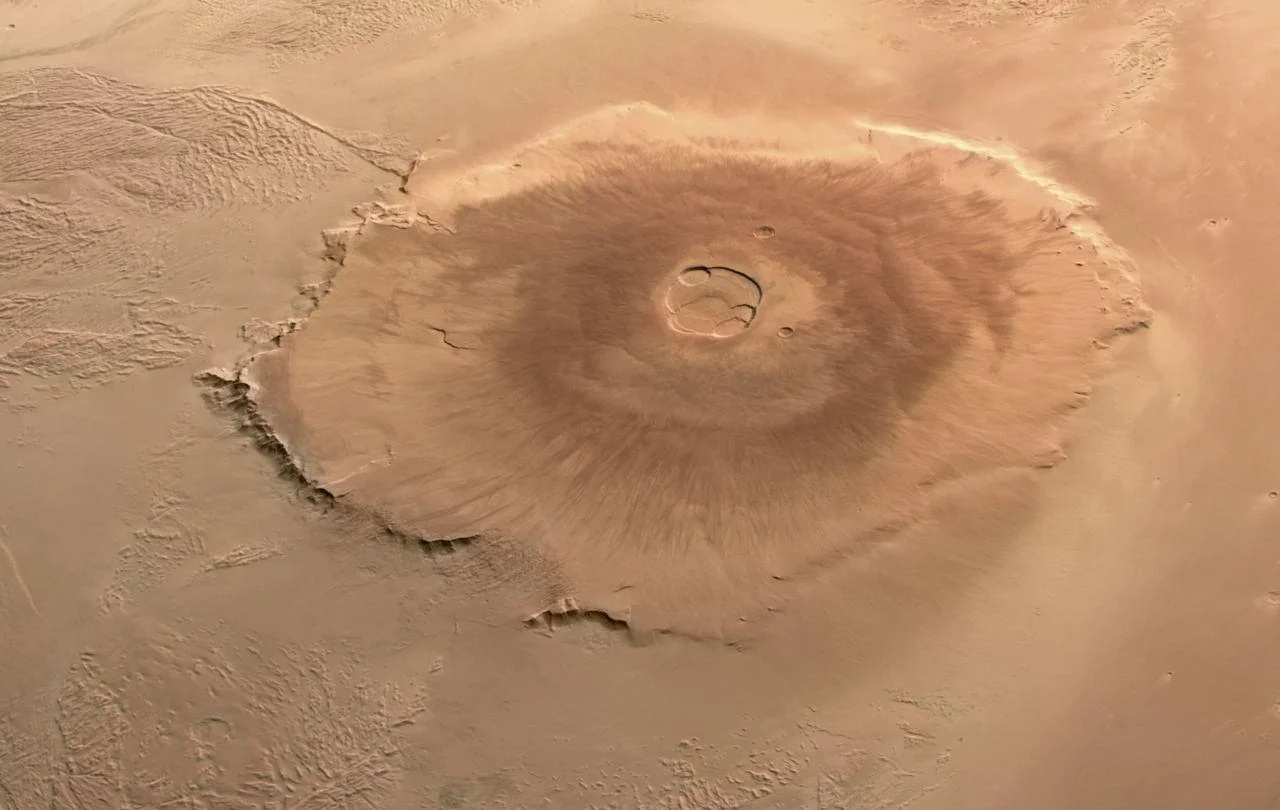


22 Km High Volcano and Continental Base May Have Melted Subsurface Ice, Created Durable Hydrothermal Systems, and Maintained Habitable Environments on Mars for Millions of Years.
No mountain on Earth prepares the observer for the scale of this colossus. It is not only the largest volcano on Mars but also the largest volcano ever identified in the Solar System. The giant in question is Olympus Mons, a structure so extreme that it redefines what geology considers possible on a rocky planet.
With over 22 kilometers in height, almost three times the height of Mount Everest, and a base that spans hundreds of thousands of square kilometers, Olympus Mons is not just a mountain: it is a continental geological system. For a long time, it was seen merely as a symbol of Martian volcanism. However, new readings now point to something deeper: the role of the volcano as a thermal engine capable of generating liquid water and potentially habitable environments for extended periods.
A Volcano That Breaks All Known Scales
Olympus Mons rises from the Martian plains with such a gentle slope that, in many places, an observer would not realize they are ascending a mountain. This is because its base is gigantic: about 600 km in diameter, equivalent to the size of entire countries.
-
With a cost per shot close to zero, the DragonFire laser could change naval warfare in 2027 and provide British ships with nearly unlimited defense against drones.

-
A British startup creates tires that generate electricity in electric vehicles when passing over potholes, speed bumps, and cracks.

-
Scientists have created robots made with living cells that have their own nervous system, swim on their own, explore the environment, and self-organize without any genetic engineering, and now they want to do the same with human cells.

-
Students create a solar-powered ambulance that operates without a plug, without fuel, and still keeps medical equipment running in remote areas.


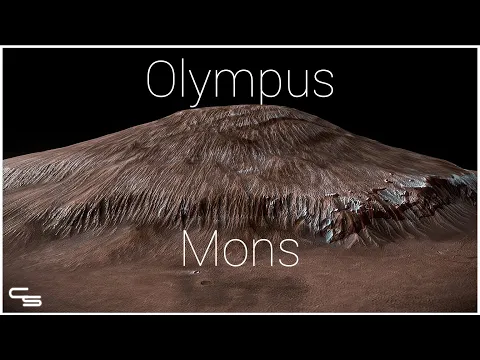

This colossal scale was made possible because Mars has lower gravity and absence of active plate tectonics. On Earth, volcanoes are displaced by the movement of tectonic plates; on Mars, magma kept emerging at the same point for millions of years, stacking layer upon layer of lava.
The result is a volcano that grew vertically and horizontally for a geological duration that is hard to imagine.
Persistent Heat for Millions of Years
What makes Olympus Mons particularly interesting from an astrobiological perspective is not just its size, but its thermal longevity. Evidence indicates that it remained active for hundreds of millions of years, with eruptions spaced out over time.
Even when not erupting, the underground magma system continuously released heat. On a cold planet like Mars, this heat represents something crucial: sufficient energy to melt subsurface ice.
Mars: A Planet Rich in Ice, Even Far from the Poles
It is now known that Mars harbors large amounts of buried ice, including in equatorial and volcanic regions. Layers of regolith and volcanic ash can preserve ice for extended periods, isolating it from the surface.
When an intense heat source like Olympus Mons acts on this ice, the expected result is the formation of liquid water at depth, even if temporary or localized. This process creates exactly the type of environment that, on Earth, supports hydrothermal systems.
Hydrothermal Systems: Classic Birthplaces of Life
On Earth, hydrothermal environments are considered primary candidates for the emergence of life. They combine:
- Liquid water
- Constant heat
- Interaction between rocks and fluids
- Chemical gradients rich in energy

If similar processes occurred beneath Olympus Mons, Mars could have hosted warm subterranean oases on a planet that, at the surface, was already moving toward extreme aridity.
These environments would be protected from intense radiation and severe climate variations, further increasing their stability over time.
Indirect Evidence: Fractures, Flows, and Altered Minerals
Orbital images reveal deep fractures, collapsed channels, and features consistent with fluid release on the slopes and surroundings of Olympus Mons. In some cases, there are signs of hydrothermal alteration, where rocks have been chemically modified by the prolonged presence of hot water.
These signs do not prove life but indicate physically suitable conditions for its existence.
Groundwater Instead of Surface Rivers
Unlike other regions of Mars, Olympus Mons does not exhibit large deltas or visible river networks. This suggests that water there did not mostly circulate on the surface, but underground.
This detail is important. Subterranean environments:
- Are more stable
- Experience less evaporation
- Provide protection against radiation
- Can last much longer
In terms of habitability, this makes the scenario even more interesting.
A Volcano That Functioned as a “Geological Reactor”
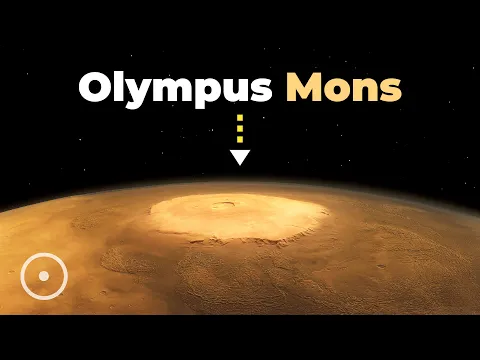
Throughout its long history, Olympus Mons may have functioned as a natural reactor, converting ice into liquid water whenever pulses of heat occurred. Each pulse would create new habitable niches, even if temporary, repeated over millions of years.
This model helps explain how Mars could sustain environments favorable to life even after losing a large part of its atmosphere.
Comparisons with Extreme Environments on Earth
On Earth, microorganisms live in:
- Deep hydrothermal vents
- Rocks heated by magma
- Lightless environments
- Isolated systems for millions of years
What these environments have in common is precisely what Olympus Mons could have offered: heat, water, and active chemistry, regardless of surface climate.
Why Olympus Mons Became a Target of Scientific Interest
For decades, the search for life on Mars focused on ancient surface lakes. Today, the focus is expanding to warmed subterranean environments, where life would have a better chance of surviving for long periods.
In this context, Olympus Mons is not only a geological landmark. It becomes a natural laboratory to understand:
- The persistence of volcanism
- The interaction between heat and ice
- The creation of habitable environments on cold planets
What Future Missions May Reveal
Directly exploring Olympus Mons is a monumental challenge. The extreme altitude, continental scale, and complex topography make landings and movements difficult. Still, more advanced orbital analyses and, in the future, human missions may investigate:
- Minerals altered by hot water
- Subterranean structures
- Chemical records of ancient hydrothermal systems
Each new piece of data helps answer a central question: Did Mars have conditions to support life long enough for it to emerge?
A Silent Giant with Buried Answers
Olympus Mons dominates Mars not only for its size but for what it represents. On a planet that cooled, lost its atmosphere, and became hostile, this volcano may have been a thermal refuge, keeping liquid water and energy available when almost the rest of the Martian world was already frozen and dry.
If life ever found space to emerge or persist on Mars, there is a real chance that it happened beneath the slopes of this colossus.







Tanto se fala em colonizar Marte, porém o que agências espaciais não dizem é que Marte já tem sua civilização altamente tecnológica, porém, por conta das guerras nucleares a milênios, o planeta foi arrasado, o povo comum sobreviveu em bunkers subterrâneos enquanto a elite vinha pra Terra com pompa de deuses iniciando as primeiras dinastias faraônicas no Egito ….
Fonte : doutrina espírita kadercista…
Recomienda de ****ál fumas para estar iguales
Por quê baboseira? Você deve ser terraplanista, não é mesmo? Só porque brasileiro só tem capacidade de criar imposto e bolsa família, não significa que outras nações não consigam a proeza de explorar o Universo! #ficaadica
Gente vcs acreditam nessas baboseira, isso é Photoshop da NASA , só quem está cauterizado pelo sistema que acredita besteira
Vá se informar!! Leia mais!! Seja curioso!! Pergunte bastante!! A exploração espacial teve início nos anos 60!! Nesta década, a década de 1960, mais precisamente em 1961, o primeiro ser humano foi ao espaço!! Leia cada vez mais!! Faz um bem danado e ajuda a abrir as viseiras!!! Fica a sugestão. Baboseira NUNCA foi!! Fale menos e leia e pergunte mais!!A leitura é um antídoto contra a ignorância!!
Baboseira é teu comentário, falou “sistema” já sei que é lunático. Acorda pra vida
Vou nem discutir. Mas te ofereço capim.