





 Portuguese
  English
  Spanish
  4 min of reading
  27 comments




The Imposing Landscape of Rio de Janeiro Raises the Question: Is There Any Volcano in Rio de Janeiro? We Investigated the Geology of the State, the Famous Case of Nova Iguaçu and the Origin of Its Iconic Peaks, Separating Scientific Facts from Popular Narratives.
The striking topography of Rio de Janeiro, with its rocky peaks and deep valleys, often sparks curiosity: could there be any volcano in Rio de Janeiro, active or extinct? Popular narratives, such as that of the “Nova Iguaçu Volcano,” feed this speculation and fascination for volcanic activity in the region.
Understand the geology of the state to separate myths from scientific reality. Although Brazil does not have active volcanoes today, its geological past is rich in magmatic events. Let’s explore whether any volcano in Rio de Janeiro is part of this history or if the famous Carioca mountains have another origin.
Volcanism in Brazil: A Geologically Active Past, a Relatively Calm Present
Currently, Brazil has no active volcanoes. This is due to its location within the South American Tectonic Plate, far from the plate boundaries where most volcanoes are concentrated. Moreover, our relief is ancient and has undergone intense erosion.
-
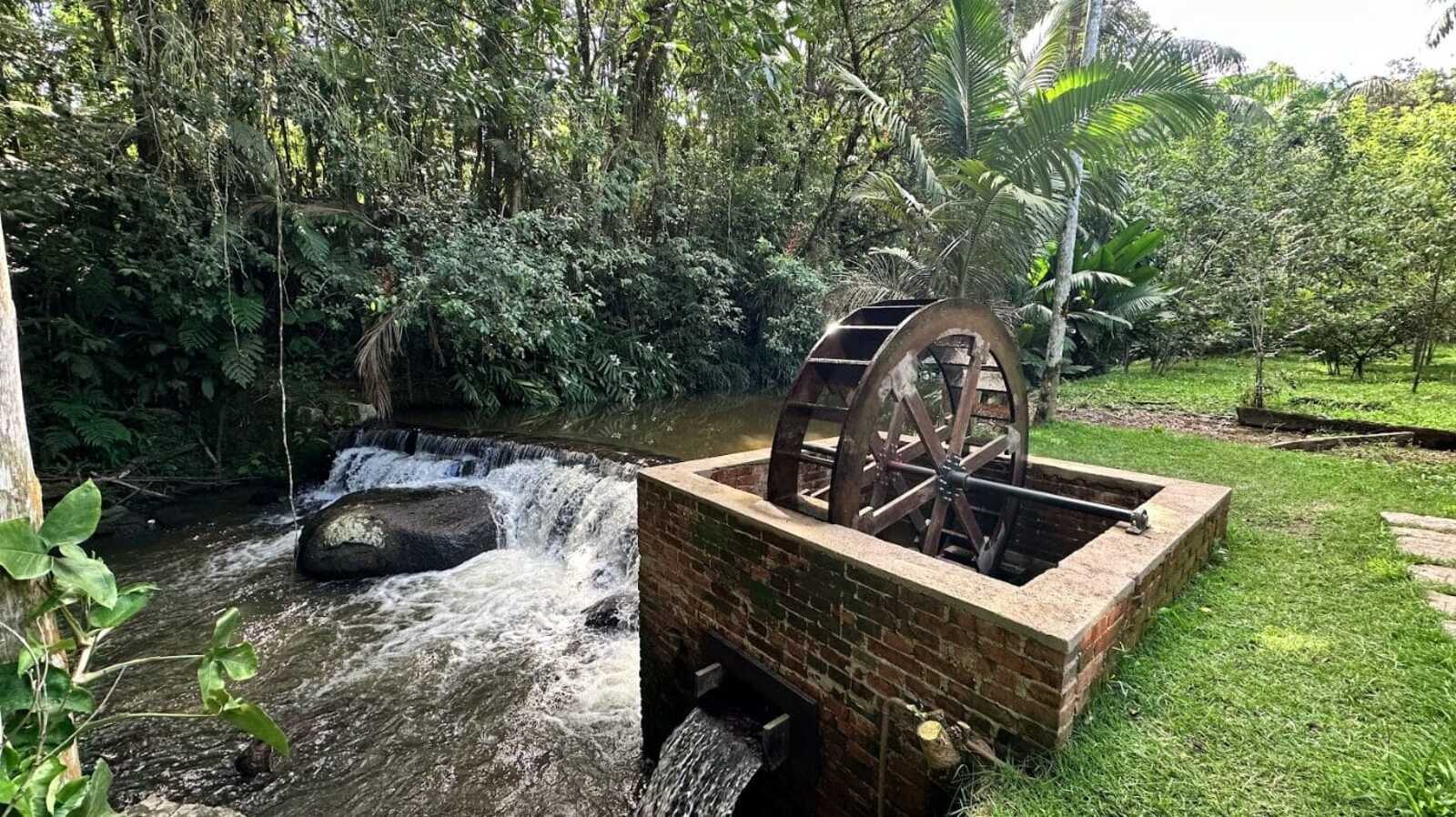
While restoring a historic mansion from 1910, a brick structure with an old turbine that generated energy from the Rio do Testo emerged, along with a hidden door and a rare floor concealed under layers of wax.
-
Italian researchers have detected what appears to be a second Sphinx buried under the sands of Egypt, and satellite scans reveal a gigantic underground megastructure hidden beneath the Giza Plateau for over 3,000 years.

-
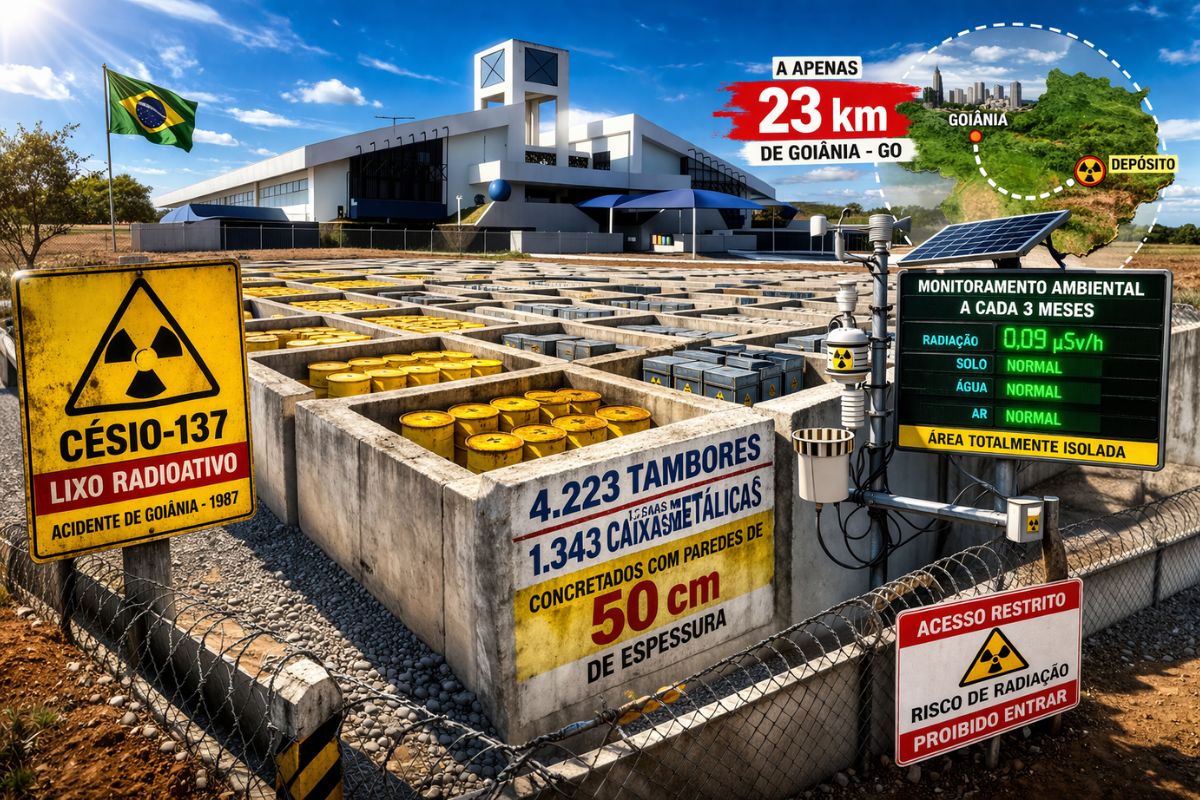
There are 4,223 drums and 1,343 metal boxes concreted with 50-centimeter walls that store the radioactive waste from Cesium-137 in the worst radiological accident in Brazil, just 23 kilometers from Goiânia, with environmental monitoring every three months.
-
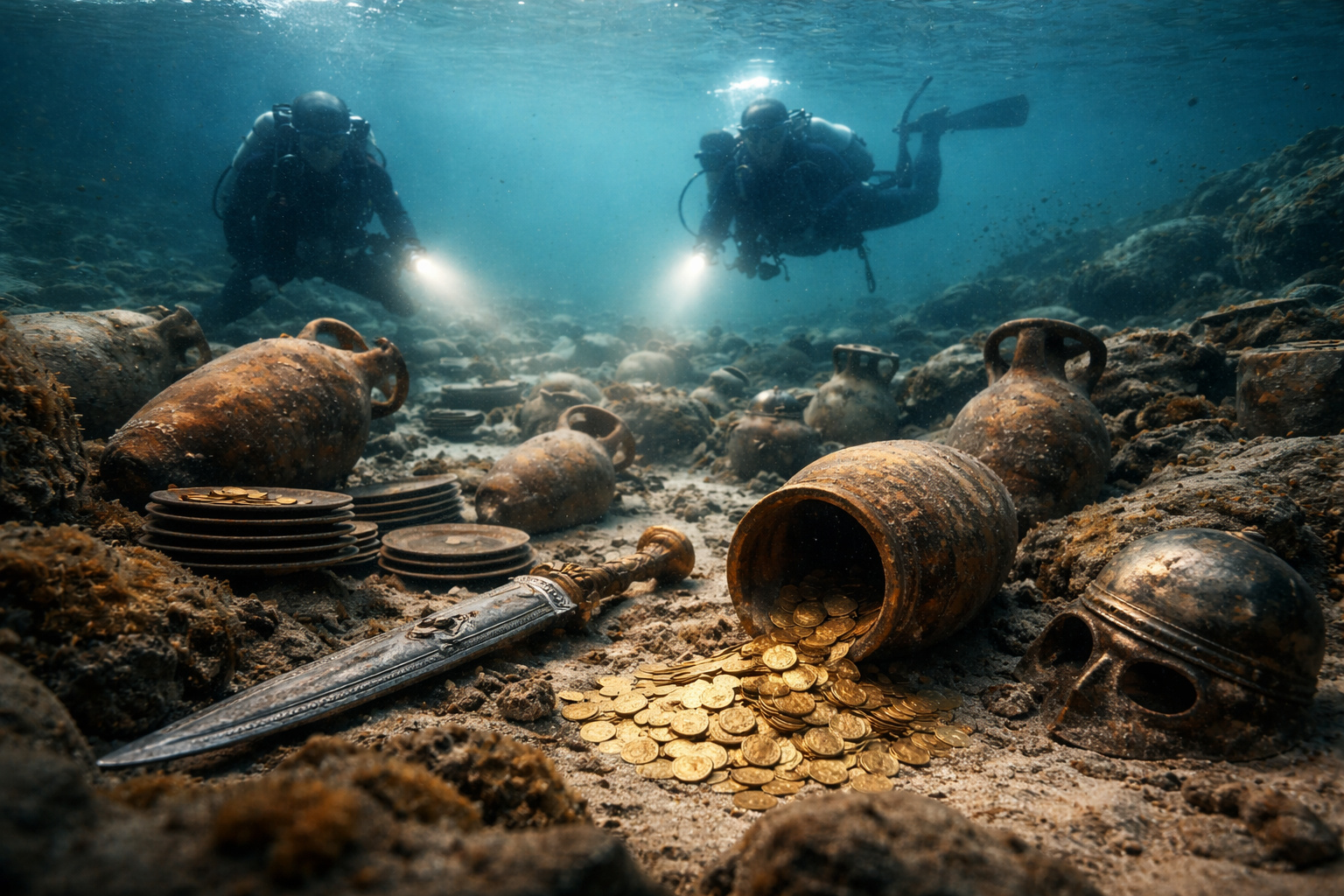
Giant Roman treasure found at the bottom of Lake Neuchâtel in Switzerland reveals an advanced trade system, circulation of goods, and armed escort in the Roman Empire about two thousand years ago.

However, the country has a vast history of volcanic activity in past eras. Examples include the massive basaltic eruptions in the South during the Mesozoic Era and ancient volcanic complexes in the Amazon. Therefore, the search for traces of an ancient volcano in Rio de Janeiro is a valid investigation.
The ‘Nova Iguaçu Volcano’: The Story of a Famous Myth and the Scientific Reality in the State of Rio de Janeiro
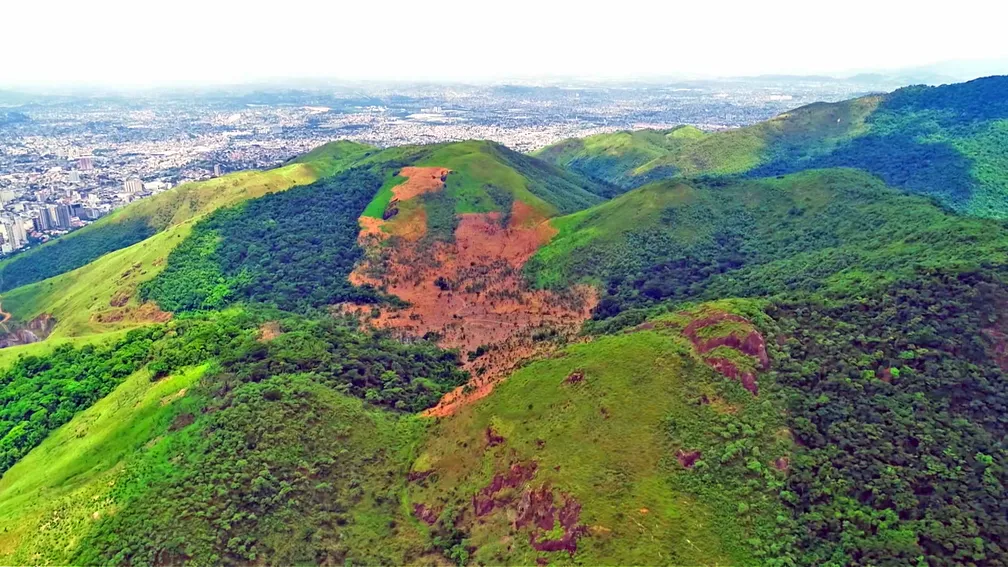
The most emblematic case is the so-called “Nova Iguaçu Volcano,” in the Mendanha Massif. The hypothesis of an extinct volcano emerged in the 1970s, based on the identification of fragmented-looking rocks. This idea was popularized, and the area was even promoted as a geopark with the “volcano” as an attraction.
However, more detailed and recent scientific studies have re-evaluated this interpretation. The supposed crater is actually an erosional valley, and the rocks are part of an intrusive alkaline complex from the Paleocene (about 58-60 million years ago). What is observed today are the “roots” deeply eroded of an ancient magmatic system, whose superficial volcanic structures have been completely removed by erosion. Thus, it is not a volcano in Rio de Janeiro preserved as once thought.
Other Significant Magmatic Manifestations in the State of Rio de Janeiro
The state of Rio de Janeiro has records of other magmatic activities. During the Jurassic and Cretaceous periods, extensive swarms of diabasic dikes occurred, related to the opening of the South Atlantic. From the Neocretaceous to the Eocene (approximately 90 to 40 million years ago), various intrusions of alkaline rocks occurred, including the Mendanha Massif.
In much older (Proterozoic) rocks, amphibolites can be found, which are metamorphosed basic volcanic rocks, witnesses of ancient volcanic arcs and mountain formation processes.
Sugarloaf Mountain, Corcovado and Pedra da Gávea: Could These Carioca Icons Be a Type of Volcano in Rio de Janeiro?
The iconic landscape of the city of Rio de Janeiro, with its world-famous mountains, also raises doubts about a possible volcanic origin. However, science shows that their genesis is different.
The Sugarloaf and Urca Hill are inselbergs made of granite and gneiss, sculpted by millions of years of differential erosion. The Corcovado, where the Christ the Redeemer statue is located, is primarily formed by Corcovado Granite and gneisses, originating from a deep magmatic intrusion during the Brasiliano Orogeny (about 560 million years ago), subsequently uplifted and eroded. The Pedra da Gávea has a gneiss base and a granite top, also a result of these ancient geological processes. None of these formations is a volcano in Rio de Janeiro.
Morro de São João in Casimiro de Abreu: Could This Be the ‘Volcano in Rio de Janeiro’ That Few Know About?


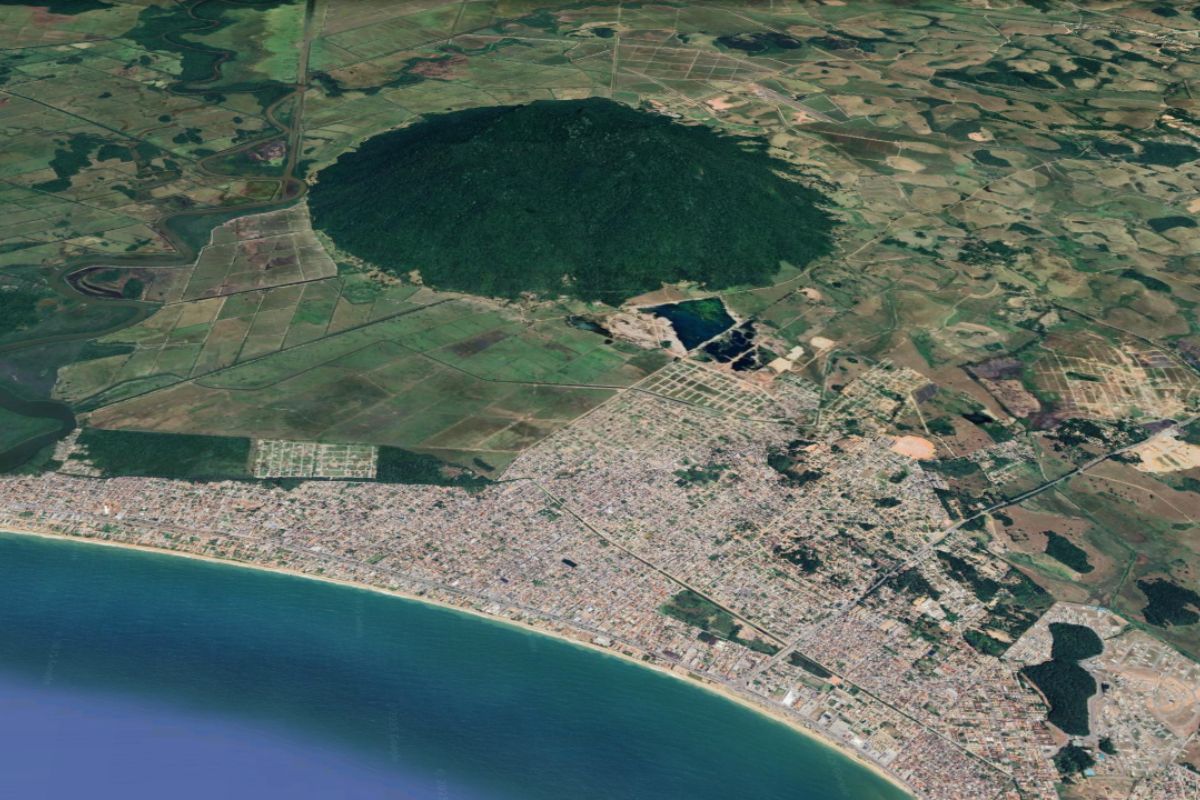
Morro de São João, located in Casimiro de Abreu, is another imposing formation in the state of Rio de Janeiro often questioned as to whether it could be an ancient volcano. Its distinctive shape in the landscape fuels this popular idea. However, in-depth geological studies reveal that Morro de São João is, in fact, a massif of alkaline igneous rocks, such as nepheline sienites, formed by the slow cooling of magma at great depths about 50 to 60 million years ago. Its current morphology is not that of a preserved volcanic edifice but rather the result of millions of years of differential erosion, which wore away the less resistant rocks around it, exposing this harder core.
Similar to the Mendanha Massif in Nova Iguaçu, Morro de São João represents the roots of an ancient magmatic system, not a volcano that erupted at the surface as many imagine. If there was any superficial volcanic structure associated with it, that has been completely removed by time. Nevertheless, Morro de São João has great value as a geological heritage site, being a proposed geo-site, important for studies on the alkaline magmatism of the state and with potential for tourism and environmental education, revealing the fascinating geological history of the region.
If any reader has images of Morro de São João, Corcovado, ‘Nova Iguaçu Volcano’, historical photos of the marvelous city and/or constructive comments, they are welcome in the comments to contribute.







Sou Biólogo e Guia de Turismo e realizo a trilha no Morro Sao João em Casimiro de Abreu RJ no distrito Barra de Sao João. É uma trilha toda dentro da Mata Atlântica preservada com fauna e flora presente. Exemplo e a figueira centenário que é um dos pontos de parada para contemplar e fotografar. Quem desejar fazer essa trilha com segurança e interpretação ambiental entre contato pelo whatsapp 022981665081 ou Instagram @jhonespoubel @ecouberaventuras
Adorei o conteúdo, que inclusive é matéria da minha prova da faculdade. Obrigada 🙂
É importante esclarecer que não existe nenhum vulcão adormecido no Brasil, e nenhum ser humano presenciou erupção alguma no território brasileiro. Aqui se encontram sim vulcões extintos que estavam ativos há dezenas e centenas de milhões de anos, portanto muito antes do surgimento da espécie humana cujos fósseis mais antigos remontam a 300 000 mil anos. Precisamos abandonar crendices e lendas urbanas e conhecer os princípios básicos da geologia.