





 Portuguese
  English
  Spanish
  5 min of reading
  0 comments


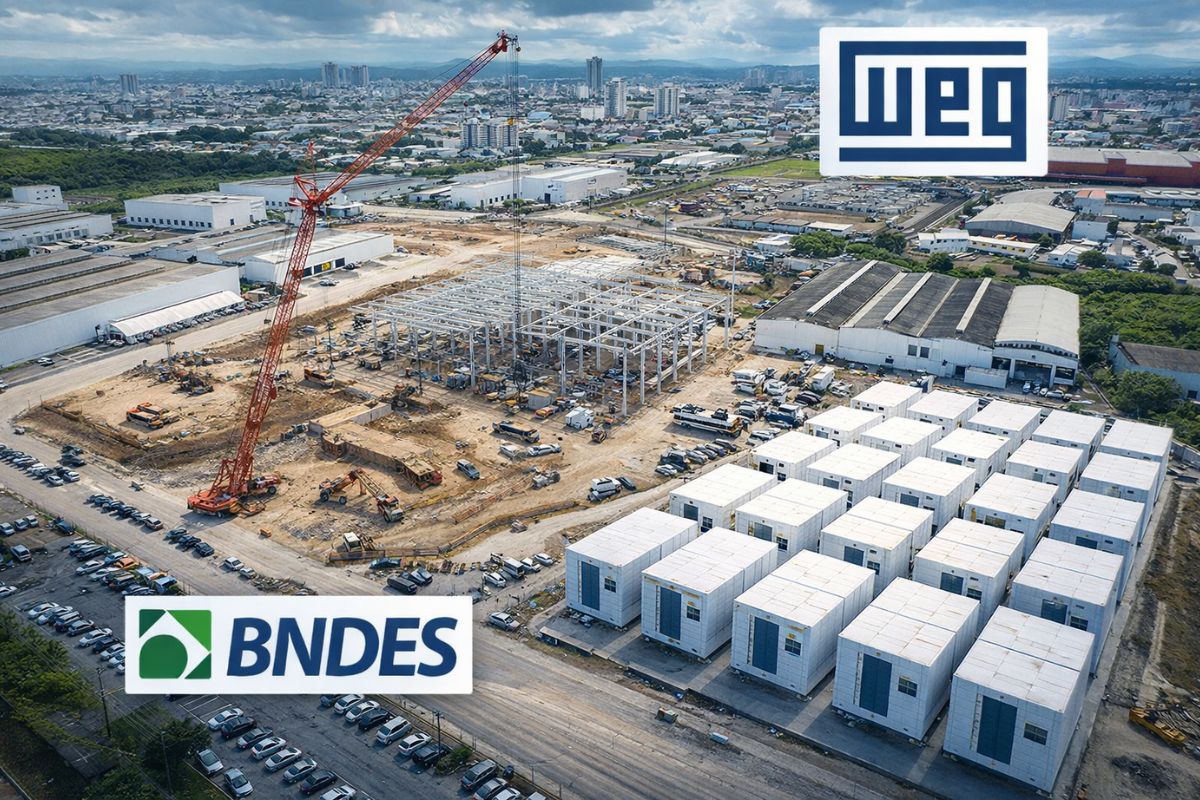
With The Battery Megafactory Announced By WEG In Itajaí, Santa Catarina Gains A Bess Hub Funded With R$ 280 Million From BNDES. The Plant Will Have Automated Lines, Robots, A Laboratory, And A Dedicated Substation, Aiming For 2 GWh And Is Expected To Be Ready In The Second Half Of 2027, Creating 90 Jobs.
The megafactory announced by WEG for Itajaí places energy storage in batteries at the center of the conversation about energy transition in Brazil. The facility will be dedicated to storage systems known as Bess, seen as a strategic technology for holding renewable energy and delivering it when demand peaks.
The project arrives with a clear signal of scale and priority: approved funding of R$ 280 million from BNDES and the promise of a highly automated plant, with a laboratory and a dedicated substation to simulate real operational conditions. In driving the narrative, WEG asserts that the initiative strengthens national competitiveness in this expanding segment.
Why The Megafactory In Itajaí Is Focused On Bess

The megafactory is designed to produce Bess systems, short for Battery Energy Storage System. In practice, these are sets of batteries and control equipment capable of storing electrical energy generated by renewable sources, such as solar and wind, and returning it to the grid as needed.
-
The largest food company on the planet, JBS, has just opened a 4,000 square meter laboratory in Florianópolis to develop customized proteins that modulate muscle mass gain, immune response, and metabolic performance.

-
After nearly 30 bids and competition among industry giants, a Spanish company purchases one of the largest airports in Brazil for almost R$ 3 billion and takes over the management of Galeão in a concession that will last until 2039.

-
The Federal Revenue Service now automatically cross-references everything you declare with data from banks, credit cards, brokerage firms, and insurance companies, and any discrepancy between your income and your expenses triggers an alert in seconds.

-
Amid global tensions, Brazil blocks the United States’ proposal at the WTO and paves the way for a trade crisis and possible retaliations.


This “back and forth” is what makes Bess a strategic asset. When renewable generation fluctuates, the system helps to stabilize the electrical grid, reduce waste, and provide more predictability to supply, especially when demand surges and delivery needs to be immediate.
What It Means To Produce Storage On A Large Scale, Without Becoming An Empty Promise
WEG plans to expand production capacity to up to 2 gigawatt-hours per year, equivalent to 400 systems of 5 megawatt-hours. These numbers place the megafactory at an industrial level that aligns with larger projects, rather than serving only small niches.
The essential point is that “scaling up” here is not a slogan, it’s a measurable goal: defined annual capacity and an equivalence that helps visualize production.
When the factory speaks of 400 systems, it is describing volume, repeatability, and standardization, which are the basis of any national race for stored energy.
Heavy Automation: The Factory That Aims To Eliminate Bottlenecks Before It’s Born
The megafactory will be highly automated, with fully automated and semi-automated assembly lines. This indicates an operation designed for consistency, with processes that reduce variation, accelerate stages, and increase control over what comes off the line.
In addition, the project includes the use of autonomous mobile robots for internal movements. Instead of relying solely on manual transport, the plant is set to gain logistical fluidity within the complex itself, shortening times between stages and reinforcing the idea of production at an industrial pace.
Laboratory And Dedicated Substation: Where Storage Is Tested As If It Were On The Grid
The industrial complex will also feature a laboratory dedicated to testing, developing, and qualifying products. And
in energy storage, this matters because performance depends not just on the battery: it involves system integration, monitoring, load response, and reliability.
The project also includes a dedicated substation to simulate real operational conditions, reinforcing quality control and technological innovation.
This detail elevates the project’s level, as it shortens the distance between development and validation, allowing the megafactory to treat the product as a complete solution, not just as a component.
Calendar, Construction, And Jobs: The Rush Is Not In The Schedule, It’s In The Market
Construction is expected to start soon, with completion anticipated in the second half of 2027, creating around 90 direct jobs.
This interval reveals a type of race that happens without spectacle: as the market grows, those who structure industrial capacity first tend to dominate deliveries and contracts.
For Itajaí and Santa Catarina, the package combines investment, jobs, and a new productive specialization linked to energy transition.
A megafactory doesn’t change a city overnight, but it creates an industrial anchor that can reorganize the supply chain, labor demand, and technological focus around it.
The Role Of BNDES: Why R$ 280 Million Matters More Than The Number
The approved funding of R$ 280 million comes from the National Bank for Economic and Social Development and fits into the BNDES Mais Inovação program, aimed at projects for digitalization, innovation, and energy transition. In practice, this gives the project a layer of public priority, alongside private investment.
The statement from WEG’s president, Alberto Kuba, reinforces the strategy: to position the company and Brazil more competitively, mitigating risks and strengthening national presence in an expanding segment.
When the discourse points to “global competitiveness,” the message is that the megafactory doesn’t just want to produce; it wants to compete.
Strategic Minerals And Lithium: The Background That Supports The Battery Chain
WEG accessed the funding through a public call aimed at the transformation of strategic minerals, such as lithium, described as an essential raw material in the manufacture of batteries.
This is a detail that often goes unnoticed but defines the industrial sustainability of the sector: it is not enough to assemble systems; a supply chain structure is needed.
By linking financing to the logic of strategic minerals, the project connects to the idea of reducing vulnerabilities and enhancing productive autonomy.
When the country discusses energy transition, it inevitably discusses critical inputs, and the megafactory enters this path as a symbol of industrialization of storage.
Energy Security And The Electrical Grid: The Argument That Tries To Convince Everyone
For the president of BNDES, Aloizio Mercadante, the project reinforces the country’s energy security by increasing the resilience of the electrical grid and supporting the expansion of renewable sources.
This is the political and technical bridge of the enterprise: storage is not just a product; it is infrastructure that reduces the risk of instability.
In practice, Bess acts as a kind of buffer for the system. When renewable generation varies, the grid feels it, and the promise of storage is to reduce impacts and organize the flow. This is where Santa Catarina enters the national race: not as a spectator, but as a productive base of a technology that becomes a requirement of the sector.
The battery megafactory in Itajaí combines funding of R$ 280 million from BNDES, the production of Bess systems, automation with mobile robots, a laboratory, and a dedicated substation, in addition to a goal of 2 GWh per year and completion expected in the second half of 2027.
The stake is not just a new plant, but the chance for Santa Catarina to assume a leadership position in large-scale stored energy.
If you could choose, do you think Brazil should prioritize a megafactory for battery storage or invest first in reinforcing the traditional electrical grid? And looking at Santa Catarina, what weighs more for you: the 90 direct jobs, industrial innovation, or the promise of energy security with Bess?







-

-

3 pessoas reagiram a isso.