






The concrete bridge in India appeared without an apparent road in Majhigawan, went viral on social media, and led authorities to investigate the public work, the recovery of rural access, and the planned service for 25 Baiga families
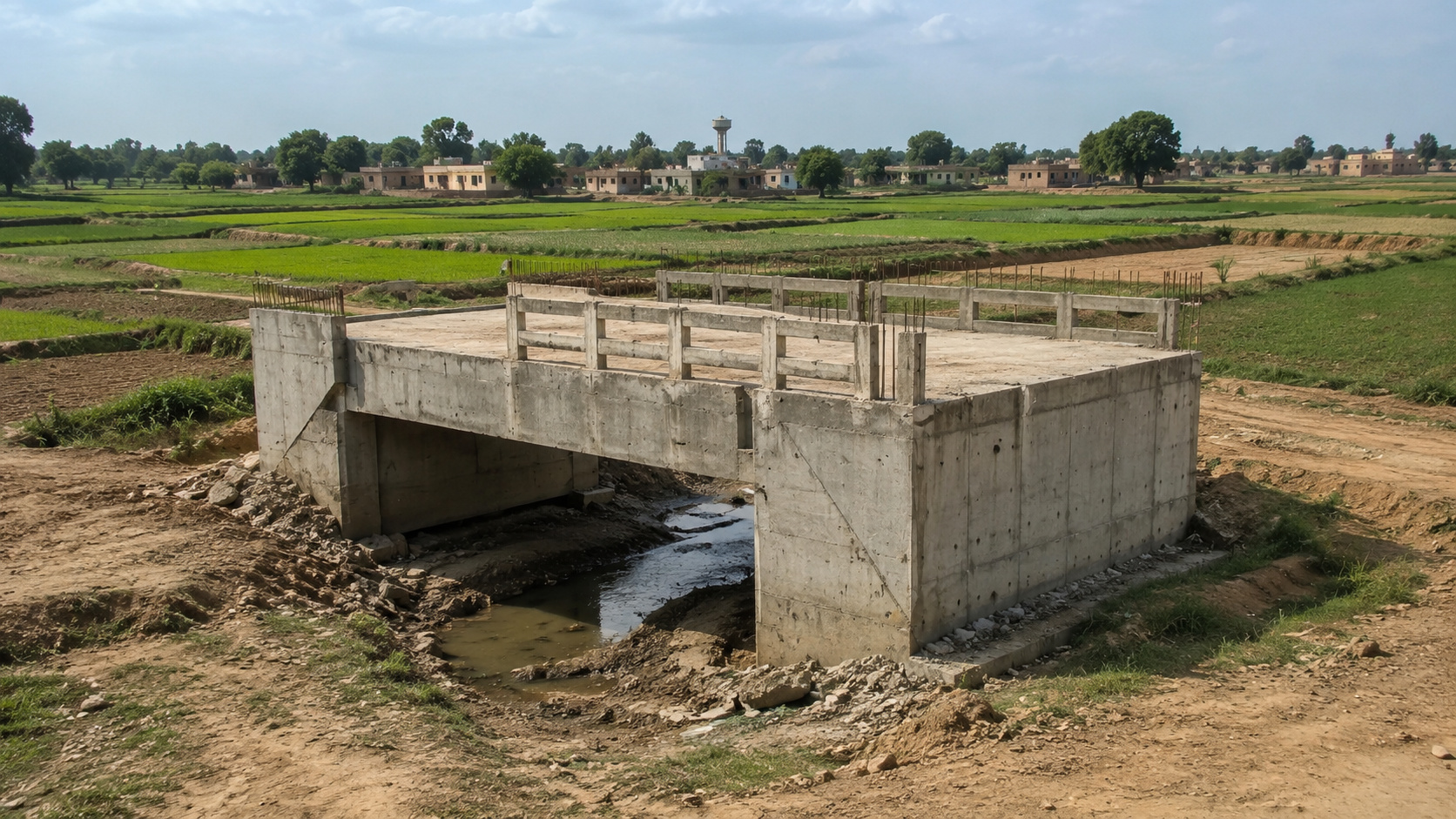
A concrete bridge appeared isolated in the middle of a plantation in India, without any visible road reaching its ends. The structure is located in the village of Majhigawan, in the Singrauli district, and was still under construction when the images began circulating on social media.
The video made the work look like a bridge without a road and without a destination, surrounded only by agricultural lands. The repercussion raised questions about the planning, the purpose of the construction, and the use of resources allocated to the project.
The information was published on July 23, 2026 by The Times of India, a national Indian newspaper with regional coverage. The district administration opened an investigation to verify the facts related to the construction and to find out if the work follows the approved project.
-
Unable to find free land in central London, architects supported a two-story house over a 19th-century warehouse, hid part of the construction behind the rooftops of Covent Garden, and transformed a commercial rooftop into a new urban area awarded by the RIBA.

-
To avoid placing a single pillar in the river, engineers began extending the Joinville bridge over the water from the banks, concreting the base that will support the main span.

-
Without experience in aviation or mechanics, 20 teenagers enter a workshop in South Africa, assemble a four-seater plane in three weeks, and accompany the aircraft flying from Cape Town to Cairo.
-
Without money to buy all new materials, a couple repurposes stones, beams, windows, and pieces taken from 11 barns, builds a castle over decades, and transforms part of the residence into an inn.


Video shows bridge surrounded by plantations and without apparent access
The images show a robust concrete structure erected in the middle of an agricultural area. There is no road appearing to reach one end or continuing on the other side, which created the impression of a completely isolated public work.


The visual contrast was decisive for the viralization. The construction seems ready to receive vehicles, but it is surrounded by cultivated land and poorly defined paths. For those watching the video without any explanation, the question immediately arises: why was a bridge built where there is no road?
No signage appears in the images to explain the purpose of the structure, the planned route, or the stage of execution. Without this information, the work began to be treated on social media as an example of a possible planning error.
Structure is a culvert linked to a rural road project
The construction was identified as a pass-through culvert, a concrete structure that allows a road to pass over a lower point of the terrain. Below, there may be space for water passage or area drainage during rainy periods.
Although it is called a bridge on social media, the structure would be part of an ongoing rural connection project. This means the concrete may be just a part of the work, while the approach path still needs to be restored and connected to the ends.
In projects of this type, the main structure can be built before the complete preparation of the road. The existence of the isolated culvert, therefore, does not by itself prove waste. Its utility depends on the completion of the accesses and the connection with the planned path.
Original road ceased to appear and is also under recovery
The village council officials stated that the site already had a connection with a rural road. The path would have ceased to be visible after the occupation of a strip of public land existing along the route.
The recovery of this road would also be underway. When the path is reopened, the culvert should become part of the route used by the community residents.
Rajendra Prasad Vaishya, secretary of the Majhigawan village council, stated that the construction uses resources from the local council itself and that the services have not yet been completed. The statement reinforces that the work was not presented as a ready or abandoned structure.
Project aims to create access for 25 Baiga families
The rural road and the culvert were planned to serve 25 Baiga families living in a community in the region. The group depends on the recovery of the path to obtain a clearer connection with the rest of the village.
The Times of India, a national Indian newspaper with regional coverage, reported that the approach road should become visible after the route’s restoration. The concrete structure would then integrate the path used to reach the community.
The information helps explain the presence of the construction at that point. At the same time, the lack of a visible road raises important doubts about the pace of execution, the organization of stages, and the ability to complete the promised access.
For the families involved, the practical impact is not just in the existence of the structure. The work will only be useful when the road is restored, connected, and in a condition to allow circulation through the area.
Investigation will verify if the work follows the approved project
The repercussion reached the administration of the Singrauli district. Gaurav Benal, district administrator, confirmed that the case was being examined and that the verification had been forwarded to the direction responsible for the Deosar council.
The investigation should clarify whether the culvert was built at the location indicated by the project, whether the accesses were planned, and whether the work follows the approved plan. It will also be necessary to verify the relationship between the construction and the rural road that no longer appears on the land.
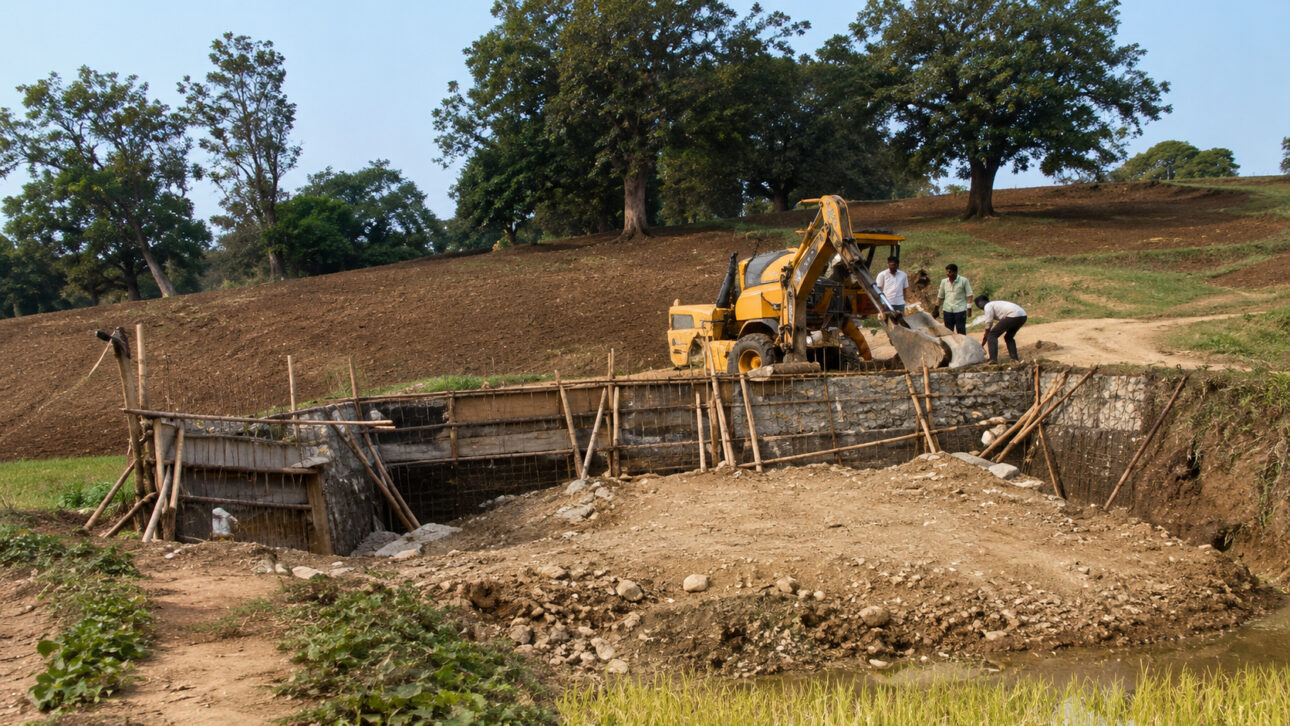
Until the publication of the information, there was no official conclusion about waste or irregularity. There was an ongoing construction, explanations presented by local officials, and an open investigation to check if the execution respects the planning.
The difference is important. A strange image can justify questions and oversight, but it does not replace the analysis of documents, the planned route, and the stages that still need to be completed.
Lack of public information increased suspicion about the work
Infrastructure works are usually divided into stages. The concrete may be ready before opening the path, preparing the land, and connecting with the main road.
However, the population needs to understand what is being built. A sign with the purpose of the work, the responsible agency, the route, and the status of the services would help show why that structure appeared in the middle of the plantation.
Without accessible explanation, an incomplete work may seem like a work without function. This void favors quick interpretations, increases distrust about public spending, and makes it difficult for residents to follow up.
Transparency does not replace the completion of the road, but it allows the community to follow the project and demand answers when services seem stalled, disconnected, or different from what was announced.
The Majhigawan structure remains an unusual image: concrete erected in the middle of agricultural lands, without a road clearly connected to the ends. The local explanation points out that the original path no longer appears and needs to be recovered.
The investigation should show whether the project was executed correctly and whether the promised access to the 25 Baiga families will actually be delivered. Until this answer, the case should be understood as a work in progress under investigation, and not as definitive proof of waste.
When a public project seems to lead nowhere, is it enough to explain the project, or should the authorities also prove, step by step, that it will be completed and utilized? Leave your opinion in the comments and share the post.


