





 Portuguese
  English
  Spanish
  5 min of reading
  0 comments


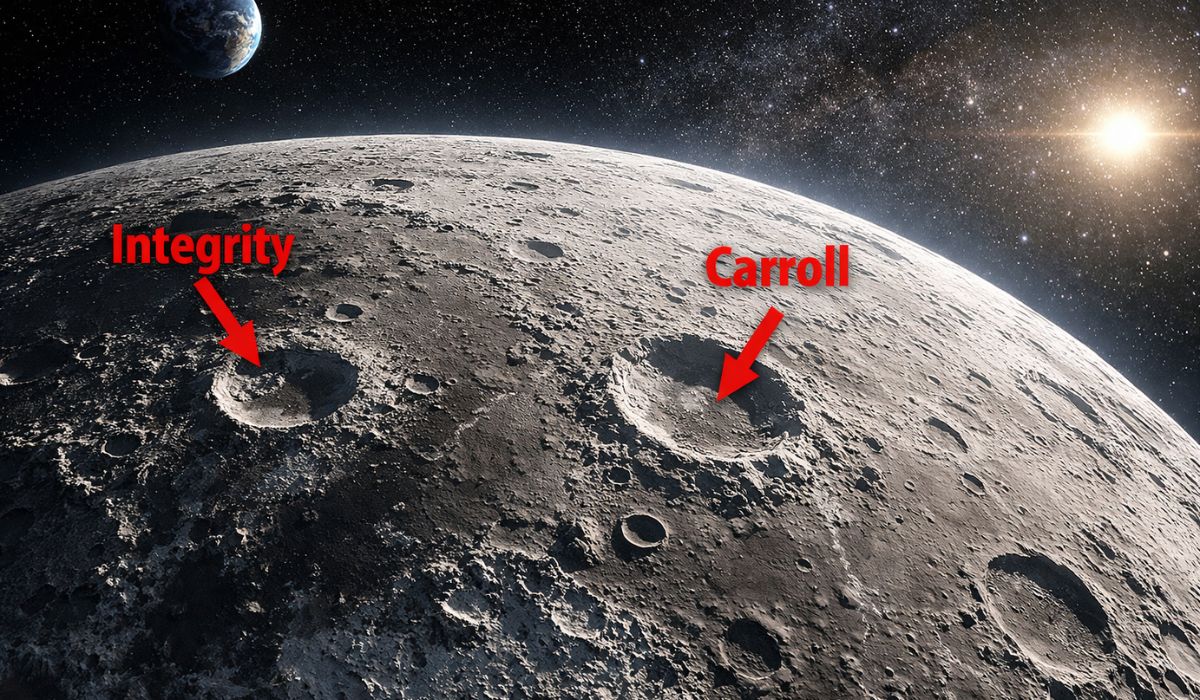
Mission surpasses historic mark in space and transforms a passage by the Moon into a setting for tributes, technical records, and new references within the Artemis program, on a flight closely monitored by space agencies and the public.
The crew of Artemis II proposed to name two officially unnamed craters during the mission’s passage by the Moon.
One of them was suggested to be named Integrity, in reference to the name of the Orion capsule used on the flight.
The other was proposed as Carroll, in honor of Carroll Taylor Wiseman, wife of commander Reid Wiseman, who passed away on May 17, 2020 after battling cancer.
-
The “Green Polo” of the Earth has been advancing to the northeast for decades and has been accelerating since 2010, changing the vegetation map and raising alarms about climate and agricultural production.

-
Scientists capture for the first time clear images of a tectonic plate fragmenting in real time under the Pacific Ocean and compare the process to a train derailing in slow motion, car by car.

-
Antarctica hides fortunes in gold and silver that could spark a giant conflict among nations!

-
A study reveals that the hungriest black holes in the universe are going dormant due to a lack of matter.

The announcement came when the astronauts had already surpassed the record for the greatest distance from Earth ever reached by humans.
The mark was recorded on April 6, 2026, according to an official update from NASA.
At 1:56 PM Eastern Time, the crew surpassed the record of Apollo 13, set in 1970.
Later, the mission reached a maximum distance of 252,756 miles, equivalent to about 406.8 thousand kilometers from Earth.
The previous record was 248,655 miles, around 400.2 thousand kilometers.
This number was achieved by Apollo 13 during its return trajectory to Earth, after a failure that prevented the continuation of the original mission plan.
Craters of Artemis II and tribute on the Moon
The name suggestions were presented by Jeremy Hansen, an astronaut from the Canadian Space Agency, in communication with mission control.
During the broadcast, the team described two small craters without official designation on the lunar surface.
The crater named Integrity is located northwest of the Orientale basin.
The one the crew intends to call Carroll is northeast of the same basin, at the transition between the visible and the dark side of the Moon.
According to NASA, the proposals will be formally submitted to the International Astronomical Union after the mission concludes.
The organization is responsible for regulating the naming of celestial bodies and geographical features outside Earth.
This means that the names announced by the astronauts still depend on formal approval.
Until the conclusion of this process, they remain as suggestions presented by the crew.
Carroll Taylor Wiseman becomes a tribute in a lunar crater
In the case of Carroll, the tribute refers to the wife of commander Reid Wiseman.
NASA reported that Carroll Taylor Wiseman passed away in May 2020.
During communication with Earth, Jeremy Hansen mentioned the loss while presenting the name proposal.
In a statement reproduced by Reuters, he said:
“A number of years ago we started this journey, our close-knit astronaut family, and we lost a loved one.”
“It’s a bright spot on the Moon, and we would like to call that Carroll.”
The statement was broadcast during the mission’s passage by the Moon.
Record of Artemis II surpasses Apollo 13 mark
The Artemis II was not planned to land on the Moon.
The goal of the flight is to test, with crew on board, the systems of the Orion spacecraft on a round trip trajectory around the satellite.
Even without landing, the mission entered the chronology of crewed space exploration by taking humans to a greater distance from Earth than recorded in previous flights.
The Artemis program envisions new stages focusing on future lunar operations.
The mission includes NASA astronauts Reid Wiseman, Victor Glover, and Christina Koch, as well as Jeremy Hansen from the Canadian space agency.
The passage by the Moon included observations of regions of the visible and dark sides of the satellite.
During this segment of the flight, the crew also recorded geological details of the surface.
There was also a period of communication blackout while the capsule passed behind the Moon, as planned in the mission’s plan.
According to NASA, the radio blackout lasted about 40 minutes, between 6:44 PM and 7:25 PM Eastern Time.
This type of interruption was already expected by the control team.
Observation of the lunar surface during the flyby
In addition to the distance record, the mission achieved the closest approach to the Moon at about 4,067 miles from the surface.
This corresponds to approximately 6,545 kilometers.
During this phase, the astronauts conducted a series of observations focused on lunar geology.
Among the targets were the Orientale basin and the Glushko crater.
According to NASA, the Orientale basin is one of the most well-preserved impact structures on the Moon.
The Glushko crater is identified by bright streaks that stand out on the surface.
The announcement of the craters occurred during this observation period.
The American agency reported that the window for analyzing the lunar surface was expected to last approximately seven hours.
During this interval, the spacecraft was in a favorable position for the crew’s work.
The orientation of the capsule and its proximity to the Moon allowed for capturing images and describing formations visible through the Orion’s windows.
Integrity and Carroll mark a moment of the Orion mission
The choice of Integrity directly refers to the name adopted for the mission’s capsule.
Carroll was associated with the tribute made to a person close to commander Reid Wiseman.
The two proposals were announced shortly after the mission surpassed the historic mark previously attributed to Apollo 13.
The timing coincidence caused the names to be presented at a moment of great attention on the flight.
Apollo 13 is remembered for its emergency return to Earth after a serious failure in 1970.
By surpassing that distance, Artemis II now holds the new record for human distance from the planet.
During the broadcast, Hansen also stated:
“As we surpass the greatest distance ever traveled by humans from planet Earth, we do so honoring the extraordinary efforts and achievements of our predecessors in human space exploration.”
The statement was made while the spacecraft was following the return trajectory.
The mission continues to be monitored as part of the preparation for the upcoming flights of the United States lunar program.
With the distance record and the proposal of the two names, the passage of Artemis II through lunar orbit brought together technical, historical, and personal elements in the same stage of the flight.








Seja o primeiro a reagir!