





 Portuguese
  English
  Spanish
  4 min of reading
  0 comments


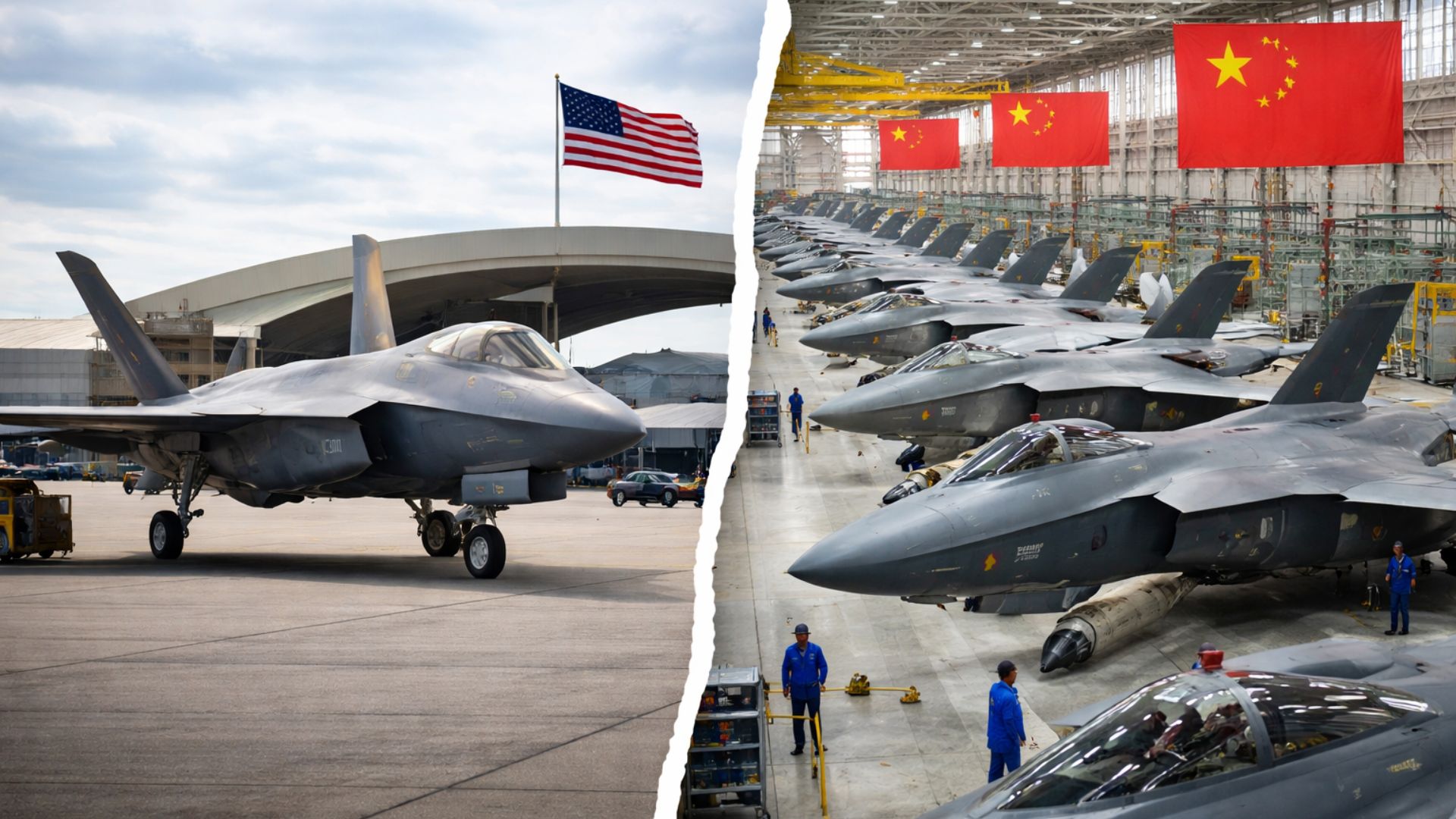
Industrial scale, aging of the fleet, and pressure on the F-35 expose a silent change in the global air balance between the United States and China, with a direct impact on military response capacity and the pace of modern fighter production.
The United States remains the world’s leading air power, but the historical advantage built during the Cold War is no longer as substantial when it comes to industrial scale.
The pressure now comes not only from the aging American fleet but also from the speed with which China has expanded its capacity to produce modern fighters, at a time when the F-35, Washington’s main bet, still cannot fill the gaps in quantity and renewal on its own.
Smaller fleet and aging pressure the US Air Force
The change in the scenario appears in two central indicators.
-
5 tips to make the most of the longest passenger train journey in Brazil: it’s 13 hours and about 664 km with over 30 cities along the route, views of the Rio Doce, the best side of the carriage, and strategic dining times.

-
The army raises the alert signal and prohibits men from leaving the country without military authorization: the requirement is a tactic for expanding from 180,000 to 260,000 soldiers by 2035 in Germany.
-
Abandoned airport becomes a residential neighborhood with an investment of R$ 47.6 billion, 9 circular architecture buildings, 79 luxury apartments, a 200-meter tower, and a complex with hotels, a casino, with opening scheduled for 2027.

-
Hershey admitted that it was replacing real chocolate with palm kernel oil in its most famous candies and now, after a flood of complaints, promised to return to the original recipes with real cocoa.

On one hand, the US combat aviation has become much smaller than it was in the early 1990s.
On the other hand, Beijing has accelerated the assembly of fourth and fifth generation aircraft at a pace that, according to estimates from defense industry analysts, could reach about 300 units per year in the second half of this decade, if the currently expanding infrastructure is fully utilized.
The American difficulty is not limited to comparing raw numbers with China.
The problem is that the accumulated reduction of the fleet occurred at the same time as the average age of the aircraft has continuously increased.
Data presented by the Chief of Staff of the US Air Force indicates that the average age of the fleet rose from 17.2 years in 1994 to 31.7 years in 2024.
In the case of fighters, the contrast with the past is even more striking.
The US Air Force had 4,556 fighters in 1990 and now has about 2,176 aircraft of that type in the latest measurements.
In another comparison, the number of active fighter squadrons is about 60% below the level existing at the time of the Gulf War in 1991.
This shrinkage affects the ability to maintain a continuous presence in more than one theater of operations.
Recent assessments indicate that the current force has difficulty sustaining high readiness, global rotation, and margin for absorbing losses in a high-intensity conflict simultaneously.
Chinese production on a large scale changes the balance
While the US faces budget constraints, program delays, and the retirement of old aircraft, China has invested in manufacturing capacity.
Satellite images and recent analyses of the Chinese aerospace industry indicate expansion in facilities related to the production of the J-20 and other fighters.
The estimated annual capacity of nearly 300 fighters reinforces the perception of a significant industrial leap.
The difference lies less in a single model and more in the method.
Instead of relying on a platform to concentrate almost all technological advancement, China has expanded lines, diversified programs, and increased the manufacturing pace of aircraft from different generations.
This point changes the balance of the competition.
For decades, American superiority relied not only on technology, training, and a network of allies but also on the ability to produce and replenish aircraft on a large scale.
When China begins to compete in this area, the debate shifts from merely who has the best fighter to who can sustain a prolonged campaign.
F-35 remains central, but does not satisfy global demand
The F-35 remains at the center of American air strategy because it combines stealth, advanced sensors, and the ability to act as a data-sharing node in complex operations.
The program has also gained international scale, with over 1,100 aircraft delivered by the end of 2024.
Still, the industrial performance of the project has become part of the problem.
In 2024, about 110 units were delivered, below the annual capacity of 156 aircraft.
In practice, this means that the F-35 remains indispensable, but not sufficient to independently restore the volume lost over decades.
The US Air Force needs to replace old aircraft, preserve combat capability in different regions, and respond to international partners’ demand for the same model.
When the most advanced platform in the system is also the most pressured by schedules and delivery backlogs, the technological advantage no longer automatically translates into operational mass.
Moreover, the debate occurs in a tighter readiness environment.
The drop in fleet availability widens the gap between the total number of aircraft and those truly ready for immediate combat.
Replacement capacity becomes a decisive factor in modern conflicts
The most recent wars have reinforced an old lesson.
Air superiority does not depend only on having the best aircraft but on having enough means to maintain continuous operations.
Simultaneous missions, accelerated wear, and the need for replacement require volume and constant production.
In this environment, the American advantage remains relevant in training and integration.
Still, the margin narrows when the comparison enters the realm of industrial replacement.
The dilemma for Washington involves the ability to maintain production pace, renew the fleet, and sustain military presence abroad without widening operational gaps.
The answer involves budget stability, industrial modernization, and a clearer definition of the ideal size of the air force needed for the coming years.





Seja o primeiro a reagir!