






 Portuguese
  Spanish


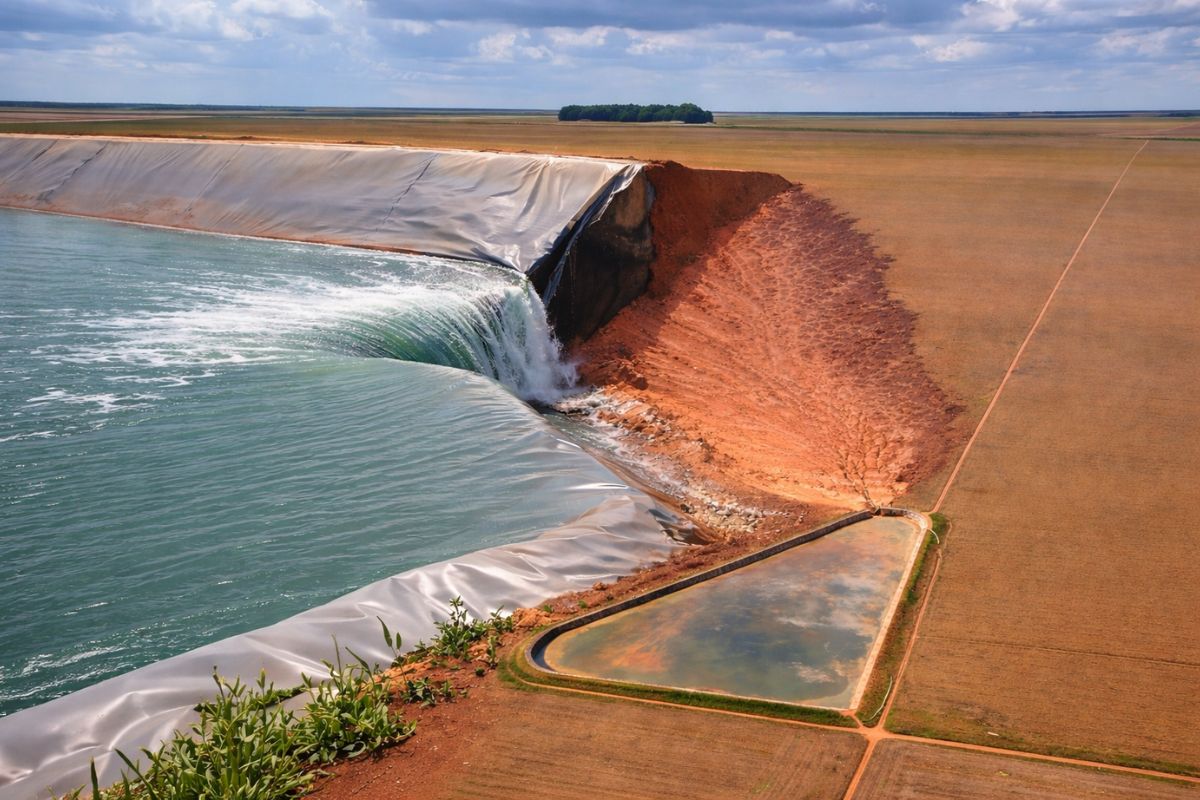

No injuries, irrigation breaks and nearly 1 billion liters flood soybean field, causing damage and authorities have not yet reported the official cause of the incident
The scene captured on video shows the extent of the damage: irrigation breaks and the reservoir appears completely empty and, in the path where the water flowed, there are holes, mud, and damage in the surrounding area. Reports from the site repeatedly warn of the cracks: the risk still exists near the structure, which limits access.
The incident occurred on a farm in southern Piauí, where the large reservoir was used for crop irrigation, but the irrigation broke part of the structure and the water was forcefully discharged. There were no injuries; however, the volume reached a large soybean field, and the causes remain undisclosed by the company or official authorities.
What is seen after the irrigation breaks the large reservoir

The images highlight a central point: the reservoir is empty, as if it had been “swept” from inside out. On the ground, marks of the violent displacement of water appear, with traces of destruction and a visible hole near the area of the large reservoir.
-
Small Farm in Brazil’s Minas Gerais Produces 403 Liters of Milk Daily, Sets Benchmark for Rural Producers

-
Man Revives 1930s Abandoned Trout Farm, Learns from Scratch, and Earns $1.1 Million Annually Selling Fish to Michelin-Starred Restaurants

-
Bangladeshi Farmers Use Bamboo Levers to Pump Thousands of Liters of Water Daily Without Engines or Electricity
-
Brazilian Forests Could Expand by an Area Twice the Size of Switzerland by 2035, but Agricultural Sector Holds the Key, Study Finds




In the video, concerns about safety are expressed directly, mentioning cracks and the risk of approaching the damaged area. This scenario reinforces that, even after the water has passed, the structure still inspires caution.
Where it happened and who is linked to the case


The break occurred on a farm in southern Piauí. The report mentions the property linked to the Guis group and businessman Zezão. As of the time described, there has been no public statement recorded from the company regarding what caused the incident.
The report also indicates that the company is based in Balsas, Maranhão, and has not yet commented on the episode.
Nearly 1 billion liters and the impact on the soybean field

The most striking data of the case is the volume: nearly 1 billion liters of water is discharged and floods a soybean field. This causes significant damage to the crop, with material losses, even without any recorded injuries.
With the water out of the reservoir, the immediate effect is twofold: on one side, the damage to the affected field; on the other, the total loss of the stored volume, which was part of the irrigation operation planning.
Unknown causes and what still needs clarification
The report is clear on one point: the causes have not yet been disclosed by the company or official authorities. This leaves open the possibility of a structural failure, operational problem, or other factors associated with the break.
While there is no official technical explanation, what exists is the visual record of the scenario and confirmation that the incident did not result in injuries, but had a direct impact on the affected crop.
The time to recover the reservoir
Another important detail is the recovery time of the system. The report notes that filling a large reservoir like this can take months to be completely full again, which extends the effect of the break beyond the immediate damage.
When the irrigation breaks and the reservoir empties, the farm loses not only water but also a strategic resource to maintain production during periods of need.
Do you think cases like this should have mandatory public audits and technical reports to prevent future breaks?







