





 Portuguese
  English
  Spanish
  6 min of reading
  0 comments


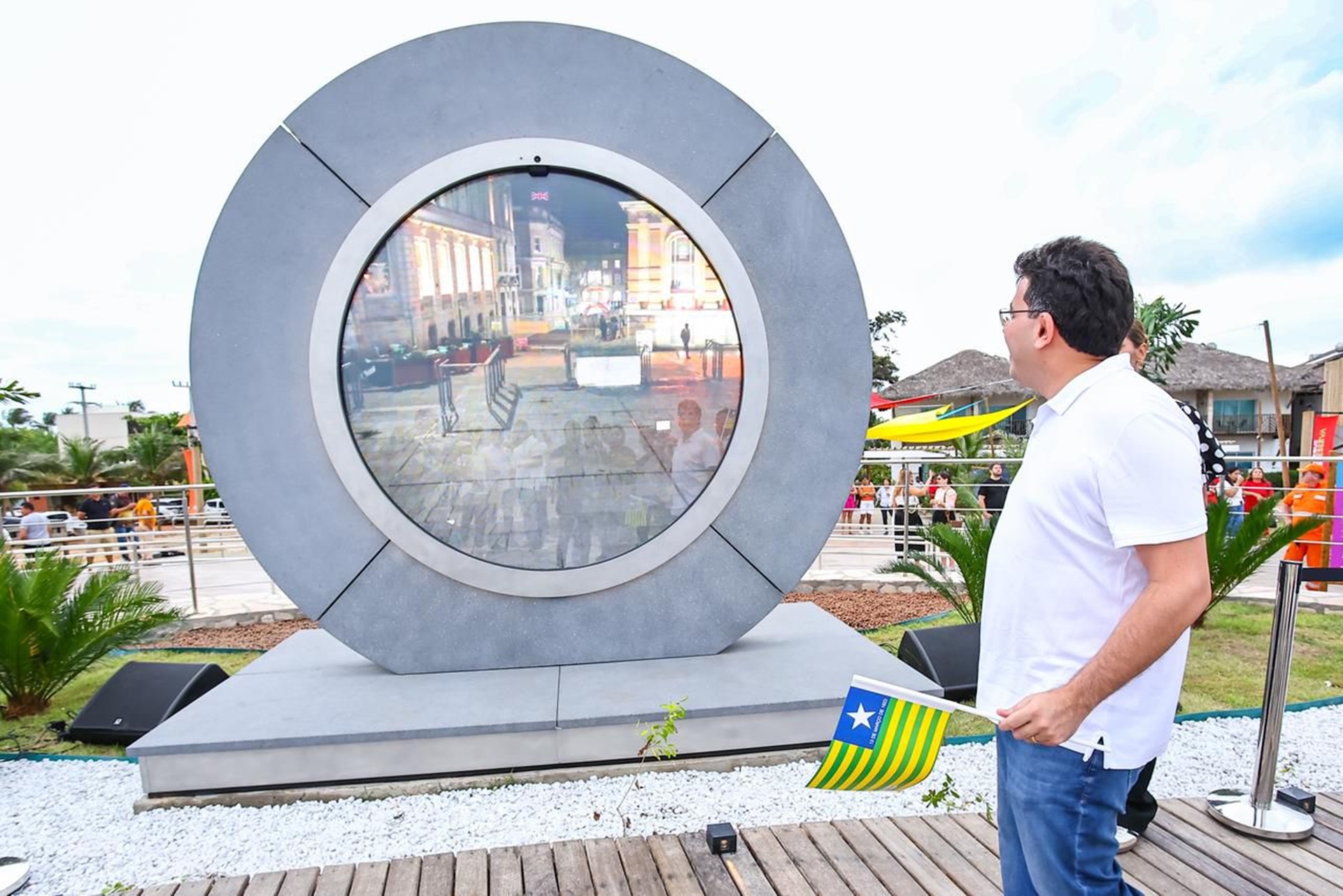
The investment of R$ 5.5 million in an interactive portal in Barra Grande, on the coast of Piauí, opened a debate about public spending priorities in a region where a nearby municipality registers only 0.3% sewage coverage and about 17,500 residents without piped water
The inauguration of a technological interactive portal in Barra Grande, on the coast of Piauí, highlighted a choice of priorities that has been provoking questions from the population.
With a total investment of R$ 5.5 million, the equipment was presented by the state government as a tool to increase the international visibility of the destination, attract tourists, and generate new economic opportunities.
The problem is that the bet on a symbol of global projection occurs alongside a reality marked by a lack of piped water, almost total absence of sewage networks, and serious deficiencies in garbage collection in nearby municipalities, such as Luís Correia.
-
Lula’s government opens 13,000 positions for teachers in Brazil and creates more than 24,000 federal jobs, with an impact of R$ 5.3 billion by 2026.
-
A Chinese electric vehicle technology giant wants to invest up to R$ 200 million in a city in Santa Catarina, and the mayor returned from China with a signed document that guarantees the immediate opening of a CNPJ and the start of operations in Brazil.
-
A beach town in Santa Catarina will distribute 4 tons of sardines completely free of charge to the population next Thursday, with a limit of 2 kilograms per person, and the distribution will end when the stock runs out.
-
A YouTuber bought all the Easter eggs from the market, from the cheapest to the most expensive, weighed each one on the scale, and discovered that some brands deliver extra grams while others charge a fortune for little chocolate.



A coastline sold to the world, but without the basics for everyone
The sanitation data shows a scenario of structural precariousness that is difficult to reconcile with the image of modernity that the government is trying to project for the region.
In Luís Correia, only 43.4% of the population has access to public water supply services. This means that more than half of the residents live without regular access to the network. In absolute numbers, about 17,500 people do not have piped water at home.
Even among those who have some type of access, coverage is not uniform. Only 51.1% of the population receives water through the general distribution network.
The rest depends on alternative solutions, such as wells or other forms considered precarious for supply. In any serious debate about quality of life and regional development, this type of data should occupy the center of decision-making.
Almost nonexistent sewage reveals the extent of the delay
If the water supply already shows a worrying picture, sewage disposal exposes an even more critical situation.
Only 0.3% of the population of Luís Correia has access to the sewage network. In practice, this means that only 88 inhabitants have regular service, while about 30,800 people live without adequate collection.
The majority of households use rudimentary pits or holes, a reality that affects more than 65% of the population.
Moreover, thousands of residents do not even have a bathroom or toilet. The picture is of a municipality that remains far below state and national averages, almost off the sanitation map. While Piauí has about 36% sewage coverage and Brazil reaches almost 60%, Luís Correia practically does not exist in this indicator.
This data alone would be enough to demand caution and rigor in defining budget priorities. After all, when sewage coverage is almost nonexistent, it is not a secondary need. It is a fundamental failure of the public authority to guarantee minimum conditions of health and dignity.
Incomplete garbage collection increases the feeling of abandonment
The scenario of solid waste also helps to understand the size of the problem. Although 54% of the population has their garbage collected, a significant portion still resorts to inadequate practices, such as burning waste.
This reality affects 12,524 people. There are also cases of disposal by burial or other irregular forms, while the municipality does not declare the existence of selective collection.
This reveals more than an operational deficiency. It shows a lack of more advanced planning and reinforces the distance between the discourse of development and the real life of the population. In a region where some residents still need to improvise even the disposal of household waste, seeing millions of reais directed to a visually appealing piece of equipment generates a predictable reaction.
The R$ 5.5 million portal and the logic of the showcase
It was in this context that the government of Piauí inaugurated, in Barra Grande, the first technological and interactive portal in Latin America, as officially announced.
The equipment is part of the international project Portals – Bridge to a United Planet, which connects cities through large circular structures with live transmission. The portal installed on the Piauí coast is already linked to Vilnius, Lublin, Dublin, Philadelphia, and Ipswich.
The total investment reaches R$ 5.5 million. Of this amount, R$ 3,791,291.73 was spent on the construction of the Portal Reserve Park, through the Department of Tourism. Another R$ 1,830,400.00 was allocated for the acquisition of the technological equipment, contracted by Investe Piauí from a foreign company.
The most evident criticism is not that the state invests in tourism or tries to create new attractions. The sensitive point is another: when there are no answers to elementary needs, an expenditure of this magnitude on a work of international visibility begins to seem less like a balanced strategy and more like an attempt to produce image, repercussion, and institutional marketing.

Government bets on economic return and international promotion
Governor Rafael Fonteles stated that the portal should boost tourism on the coast by promoting the destinations of Cajueiro da Praia and Barra Grande internationally. The government’s assessment is that the innovation will help publicize the Piauí coast, enhancing job, employment, and income opportunities.
The Secretary of Tourism, Daniel Oliveira, said that tourism in Piauí grows on average 20% per year and stated that the new attraction could increase the length of stay of visitors on the Route of Emotions. According to studies mentioned by the manager, the expectation is for a 10% to 15% increase in tourist flow to the coast, with an economic impact between R$ 20 million and R$ 40 million over the next three years.
Meanwhile, the president of Investe Piauí, Victor Hugo Almeida, declared that the project arose after an international mission by the governor in 2023 and was seen as an opportunity to reposition the Piauí coast in the global scenario, with potential for tourism, cultural, and educational promotion, in addition to reinforcing activities such as kitesurfing.
These arguments show the government’s logic: to bet on a modern, eye-catching, and internationalized symbol to strengthen the region’s image. The problem is that image does not replace structure, and promotion does not solve basic deficiencies.
The banality of the symbol in the face of the gravity of the need
It is at this point that the discussion about public money becomes inevitable. An interactive portal can attract attention, yield photos, videos, and curiosity from visitors.
It can even serve as a complementary attraction in a tourist area. But, in a territory where thousands still live without treated water, sewage, and proper waste management, the initiative takes on the contours of administrative banality.
The State chose to invest millions in a visually impactful object while part of the population continues without full access to what should be elementary.
The decision can even be defended in the field of tourism promotion, but it comes at a high political price: the exposure of an inverted priority. The government seeks to connect Piauí to cities in Europe and the United States, but has not yet managed to fully connect part of its population to the basics.
Development discourse clashes with local reality
The official material states that the portal is part of a series of government actions to boost Piauí tourism, including improvements in basic infrastructure, water supply, sanitation, urbanization, and new attractions in Cajueiro da Praia and the Central Square of Barra Grande.
Still, the indicators presented for the region show that, if these improvements are underway, they have not yet decisively changed the harshest reality. And it is precisely this that makes the work so symbolic. Not for representing a structural advance, but for clearly exposing the distance between what appears and what is lacking.
In the end, the central question is not being against tourism, innovation, or international promotion. The question is whether it makes sense to transform an interactive portal into a political and financial priority when the surrounding area still deals with such serious needs.
In such a scenario, the portal ceases to be just a modern attraction. It becomes the portrait of a management that decided to invest first in what impresses, and not in what resolves.





Seja o primeiro a reagir!