





 Portuguese
  English
  Spanish
  4 min of reading
  0 comments


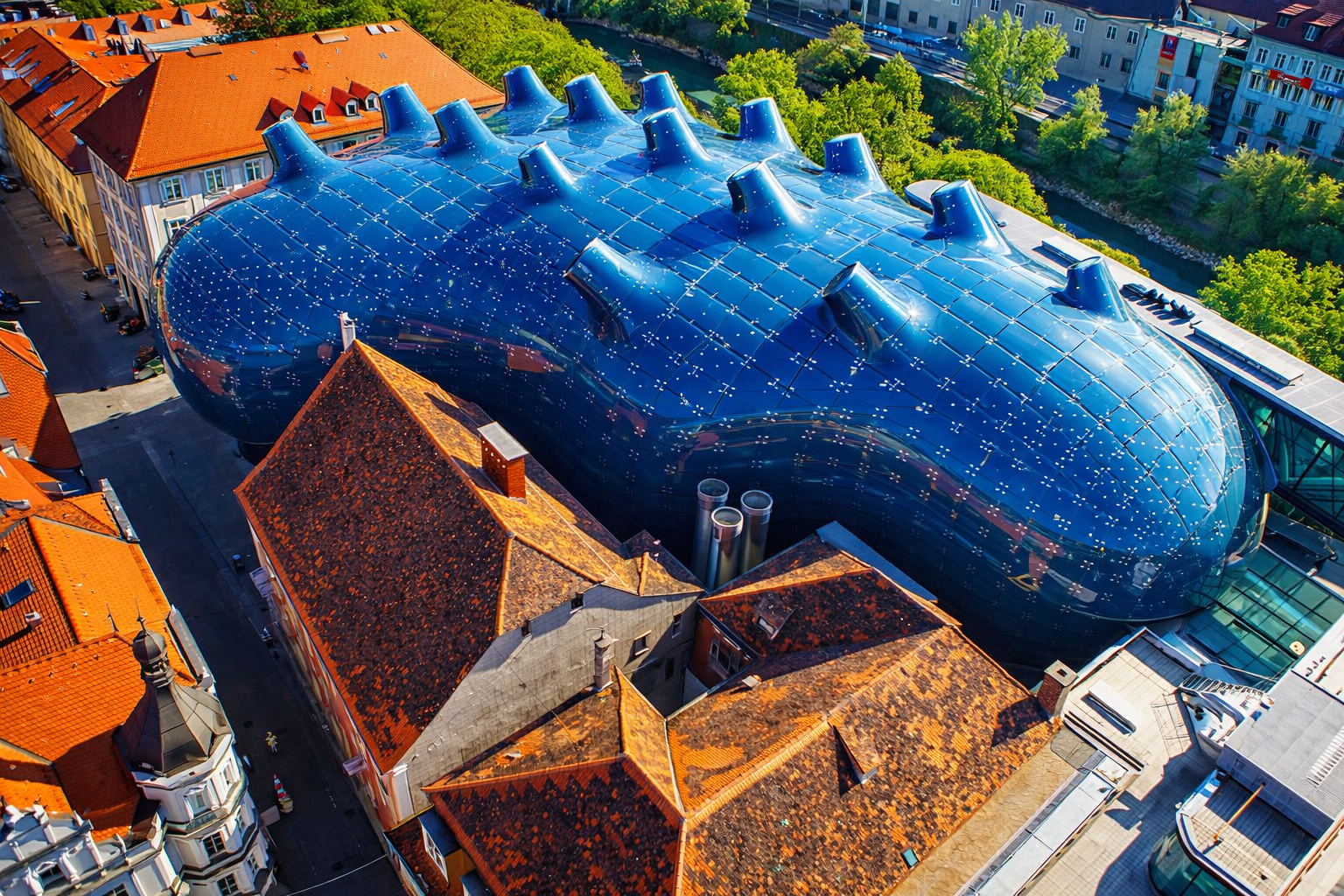
Kunsthaus Graz Museum, the building known as the friendly alien, combines structural innovation, BIX technology on a giant screen, and energy efficiency in one of the boldest projects of contemporary architecture without internal columns
The Kunsthaus Graz, called the Friendly Alien, stands out as one of the most unusual buildings ever constructed in Europe, bringing together futuristic architecture, advanced engineering, and bioclimatic technology in a single project. Located in the historic center of Graz, Austria, the museum breaks with the traditional scenery by presenting an organic blue structure that seems to come from another world.
The building, inaugurated in 2003, has become a symbol of innovation by combining 1,066 acrylic panels, the absence of internal columns, and a façade that communicates with the city. The architectural proposal impacts both specialists and visitors, generating debates and curiosity to this day.
Column-free structure redefines the concept of exhibition spaces
The design of the Kunsthaus Graz introduced an unusual structural solution by completely eliminating pillars inside. The building is supported by a complex exposed steel skeleton, thus allowing large free areas for exhibitions.
-
Scientists warn that a comet about 1 km in size that has started to release gases may actually change direction in space. It was spotted by NASA and surprises with potential impacts near Earth.

-
These living root bridges and ladders are over 700 years old and help indigenous people survive in one of the rainiest regions in the world.

-
From sertanejo star to international investor: Ana Castela invests millions in a mansion in the USA, creates a themed accommodation in Orlando, and shows that the “boiadeira” also wants to grow away from the stage.

-
The 10 most stunning motorhomes in the world: a $3 million trailer with a rooftop nightclub and garage for a Ferrari, “palaces on wheels” with Italian marble, private cinema, and five-star hotel luxury for billionaires.


This approach ensures total flexibility in organizing the galleries, something essential for a contemporary art museum. The absence of internal columns expands the possibilities for setup and circulation, making the space more dynamic.
The portal ArchDaily, an international architecture and design platform, highlighted the Kunsthaus Graz as a reference in blobitecture, a style marked by organic shapes and unconventional structures.
Façade with 1,066 acrylic panels requires an unprecedented solution against thermal expansion
The exterior of the building is formed by 1,066 translucent acrylic glass panels, all with double curvature and three-dimensional modeling. This type of material posed a significant challenge related to thermal expansion.
To avoid structural damage, an innovative fastening system was developed. The mechanical connectors allow the panels to move according to temperature variations, reducing the risk of cracks.
Bollinger Grohmann engineering, a company specialized in complex structures, implemented this solution which has become a reference for projects with climate-sensitive materials.
BIX façade transforms the building into a digital screen and ventilation system
One of the most striking elements of the Kunsthaus Graz is the so-called BIX façade, which functions as a giant low-resolution screen. The structure uses rings of fluorescent lights that display programmable images and texts at night.
In addition to its visual function, the façade plays an essential role in energy performance. The outer skin creates a ventilated layer between the acrylic and the internal structure, reducing the need for artificial cooling.
The studio realities united, a design group focused on digital media and interactive architecture, developed the BIX system as a more accessible alternative to traditional screens.
Nozzle-shaped skylights capture natural light without damaging artworks
The top of the building features structures known as nozzles, which function as special skylights. These elements are positioned to capture natural light from the north, avoiding direct sunlight that could harm the artworks.

This solution ensures efficient and sustainable lighting, reducing electricity consumption within the galleries.
The concept reinforces the bioclimatic character of the museum, which thus integrates architectural design with environmental performance.
Panoramic platform and differentiated access enhance the visitor experience
Another highlight of the Kunsthaus Graz is the platform called Needle, a glassed area that projects out from the building. The space offers a privileged view of the historic city, creating a striking visual contrast.
Access to the alien museum also deviates from the conventional. Visitors enter through the Travelator, an inclined conveyor belt that leads directly into the interior of the structure.
These elements contribute to an immersive experience, reinforcing the innovative proposal of the project.
Architecture divides opinions but boosts tourism and urban debate
The presence of the Kunsthaus Graz in the historic center provokes varied reactions. Part of the population still finds the contrast between the futuristic building and the traditional rooftops of the city strange.
On the other hand, the museum has established itself as one of the main tourist attractions in the region, attracting visitors interested in contemporary architecture and sustainable solutions.
The work demonstrates how bold projects can transform the urban landscape and stimulate discussions about innovation and historical heritage.
Project unites engineering, sustainability, and design in one of the most iconic buildings in Europe
The Kunsthaus Graz brings together characteristics that place it among the most innovative projects in modern architecture. The combination of column-free structure, interactive façade, and bioclimatic system showcases the advancement of engineering applied to design.
The construction reinforces the importance of creative solutions to urban challenges while expanding the dialogue between technology and art.
What do you think about this type of architecture that completely breaks with the traditional standard? Leave your opinion in the comments and share this content with those interested in innovation and engineering.







Seja o primeiro a reagir!