





 English
  Francês
  Alemão
  Italiano
  Japonês
  Norueguês
  Portuguese
  Spanish
  5 min of reading
  0 comments


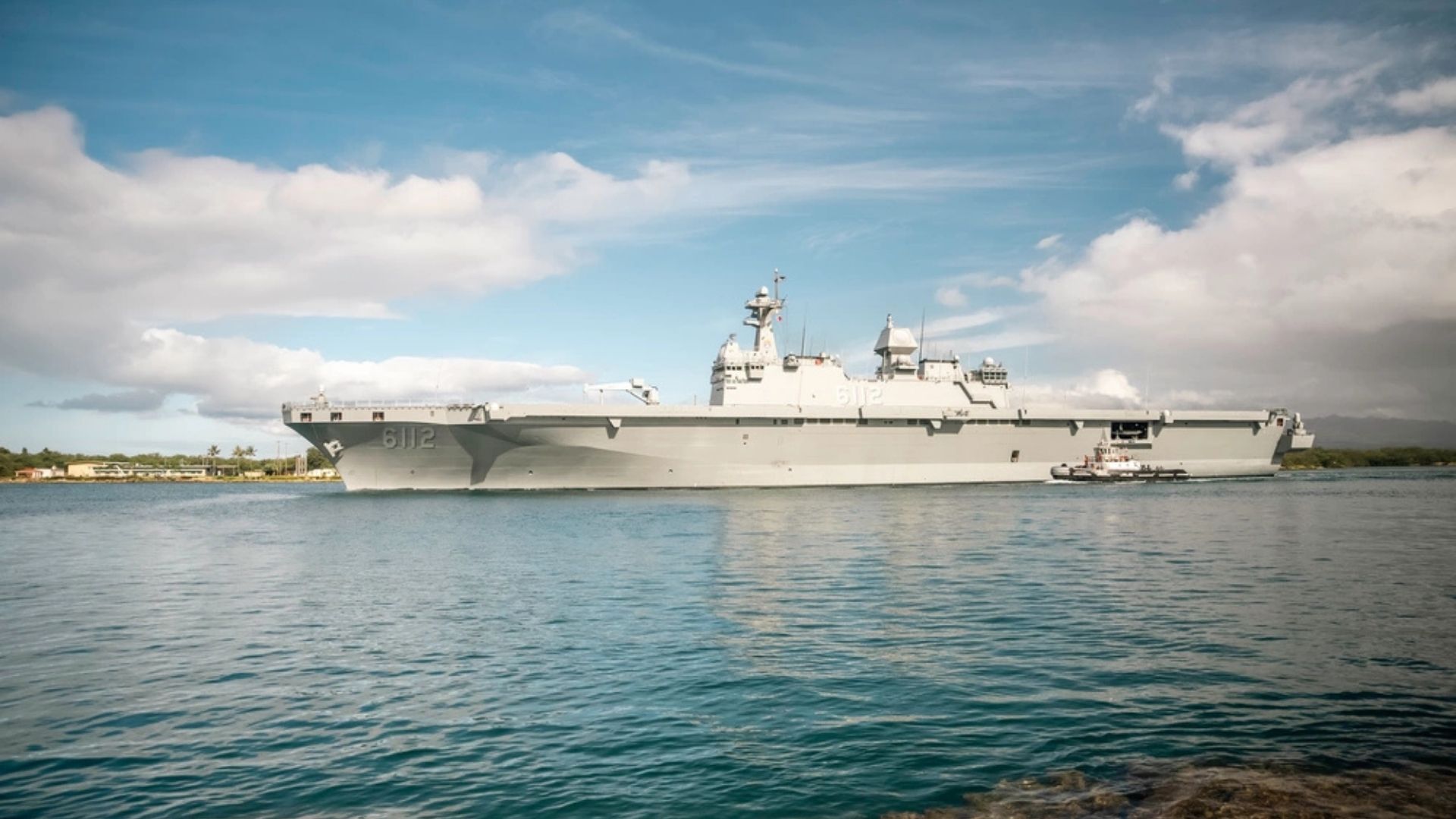
South Korean amphibious ship combines air capacity, troops, and defense in a single mobile platform, expanding maritime projection in the Indo-Pacific and strengthening military presence in international operations, combined exercises, and humanitarian missions in strategic areas of high geopolitical tension.
The ROKS Marado has consolidated South Korea’s amphibious force by bringing together, in a single platform, embarked aviation capacity, troop transport, launch of landing means, and self-defense systems.
Commissioned by the South Korean Navy on June 28, 2021, the ship has expanded the ability to move personnel, vehicles, and aircraft to coastal areas without relying on nearby ports or airports.
Classified as LPH, the acronym in English for landing platform helicopter, the Marado was designed for amphibious operations, command missions, and support for forces deployed in crisis scenarios.
-
The United States has unveiled the MQ-25 Stingray, the world’s first carrier-based tanker drone designed to operate on aircraft carriers and extend the range of naval fighters.

-
A cheap Brazilian invention promises to change the fate of patients in ICUs by accelerating muscle recovery even in critical condition.

-
Kawasaki surprises by revealing a 140-ton aircraft capable of winning wars without a single shot and bets on ultra-secret technology to protect Japan by 2027.
-
A trick with a fan and a PET bottle goes viral in the extreme heat of 2026 and promises to cool the environment while using almost no electricity.


In practice, this allows the vessel to operate simultaneously as an assault ship, coordination center, and mobile base for maritime projection in a regional environment marked by combined exercises and competition for naval presence.
Amphibious capacity and naval power projection
The technical data helps to size this role.
According to Naval News, the ship has 19,000 tons at maximum displacement, about 200 meters in length, 31 meters in beam, 6.6 meters in draft, and a crew of around 330 sailors, in addition to space for 720 marines.

The same publication reports that it can transport six battle tanks, seven amphibious assault vehicles, two hovercrafts, and seven to twelve helicopters, depending on the mission profile.
The Proceedings magazine, from the U.S. Naval Institute, adds that the Dokdo class, of which the Marado is a part, was designed to fulfill tasks far beyond personnel transport.
The ship can reach 10,000 nautical miles at 18 knots and can achieve a maximum speed of 23 knots, a combination that supports prolonged operations and significant movements in the Indo-Pacific without losing the ability to support an amphibious force.
Embarked aviation and extended aerial operations
On the flight deck is one of the main differences of the Marado compared to the Dokdo, the first ship of the class.
The Proceedings notes five helicopter landing spots and the capacity to operate between ten and fifteen rotary-wing aircraft, while Defense News reported that the design received adaptations to accommodate two V-22 Osprey aircraft, compared to one on the previous ship.
The preparation of the deck also reinforced the operational flexibility of the vessel.
The Korea JoongAng Daily reported, at the commissioning ceremony, that the surface received urethane coating to withstand higher temperatures, which enhances the ship’s suitability for vertical takeoff and landing aircraft and strengthens its use in assault, evacuation, air transport, and logistical support missions.
Troop and vehicle disembarkation on multiple axes
Below the main deck, the Marado concentrates the less visible and more decisive part of its amphibious function.
The Proceedings describes internal compartments capable of receiving battle tanks, artillery, wheeled vehicles, tracked vehicles, and support equipment, all connected to a floodable dock capable of operating two hovercrafts, allowing troops and material to be launched directly towards the coast.
This combination creates an operational profile that expands tactical employment options.

While helicopters can insert troops by air, hovercrafts and amphibious vehicles advance across the surface with armored vehicles, ammunition, and support, reducing reliance on a single entry axis and giving the embarked force more room to operate in contested coastlines.
Embedded defense systems and sensors
The ship has also received a sensor and defense package that has elevated its survivability in environments saturated with aircraft, ships, and missiles.
According to Naval News, the Marado is equipped with a multifunctional radar EL/M-2248 MF-STAR, surveillance radar SPS-550K, two Phalanx Block 1B systems, and four K-VLS cells, capable of launching a total of 16 K-SAAM Sea Bow anti-aircraft missiles.
Defense News noted that these changes placed the second ship of the class at a higher level than the Dokdo in controlling the space around the vessel and in close-in defense.
In a region where reaction time matters more than geographical distance, reinforcing hull protection has ceased to be a technical detail and has become integral to the military utility of the ship.
International employment and combined operations
However, the South Korean Navy does not link the Marado solely to combat scenarios.
At the commissioning, the Korea JoongAng Daily reported that the ship has also been designated for disaster rescue and international peace operations, while Proceedings highlights the class’s secondary role in humanitarian assistance, with sufficient structure to support prolonged actions and coordination of means in complex crises.
The recent employment of the vessel shows that this multipurpose design has come to fruition.
The Marado participated in RIMPAC 2022, an exercise held in Hawaii and California with 26 countries, 38 surface ships, four submarines, over 170 aircraft, and more than 25,000 military personnel, and also took part in Ssang Yong 2024, a combined operation between South Korea and the United States aimed at increasing readiness and interoperability.
In the case of Ssang Yong 2024, military authorities reported the presence of ROKS Marado, ROKS Dokdo, USS Boxer, and USS America, along with a contingent of over 13,000 military personnel.
The scale of the exercise indicates that the South Korean ship has not only been used as a technological showcase but as an effective piece of integration with allied forces and maritime projection in combined operations.
Strategic role and presence in the Indo-Pacific
The change in role assigned to the Marado appeared explicitly during the public presentation phase of the program.
In 2018, the then South Korean Defense Minister stated to Defense News that the future role of the ship would be to protect maritime security in Northeast Asia and beyond, a formulation that expands the strategic meaning of the platform beyond immediate coastal defense.
Even the name of the vessel aligns with this interpretation.
According to the Korea JoongAng Daily, the ship was named after Marado Island, at the southernmost tip of South Korean territory, following the Navy’s choice to use extreme islands of the country in its large transport ships, a symbolic gesture that reinforces the connection between maritime presence, national defense, and regional reach.
When a single hull can embark helicopters, troops, armored vehicles, landing means, and air defense missiles, it ceases to be merely a large amphibious transport.
In the South Korean case, the Marado has come to represent a platform for persistent presence, capable of combining mobility, command, logistical support, and military response in one of the most sensitive maritime spaces in Asia.





Seja o primeiro a reagir!