





 Portuguese
  English
  Spanish
  5 min of reading
  0 comments


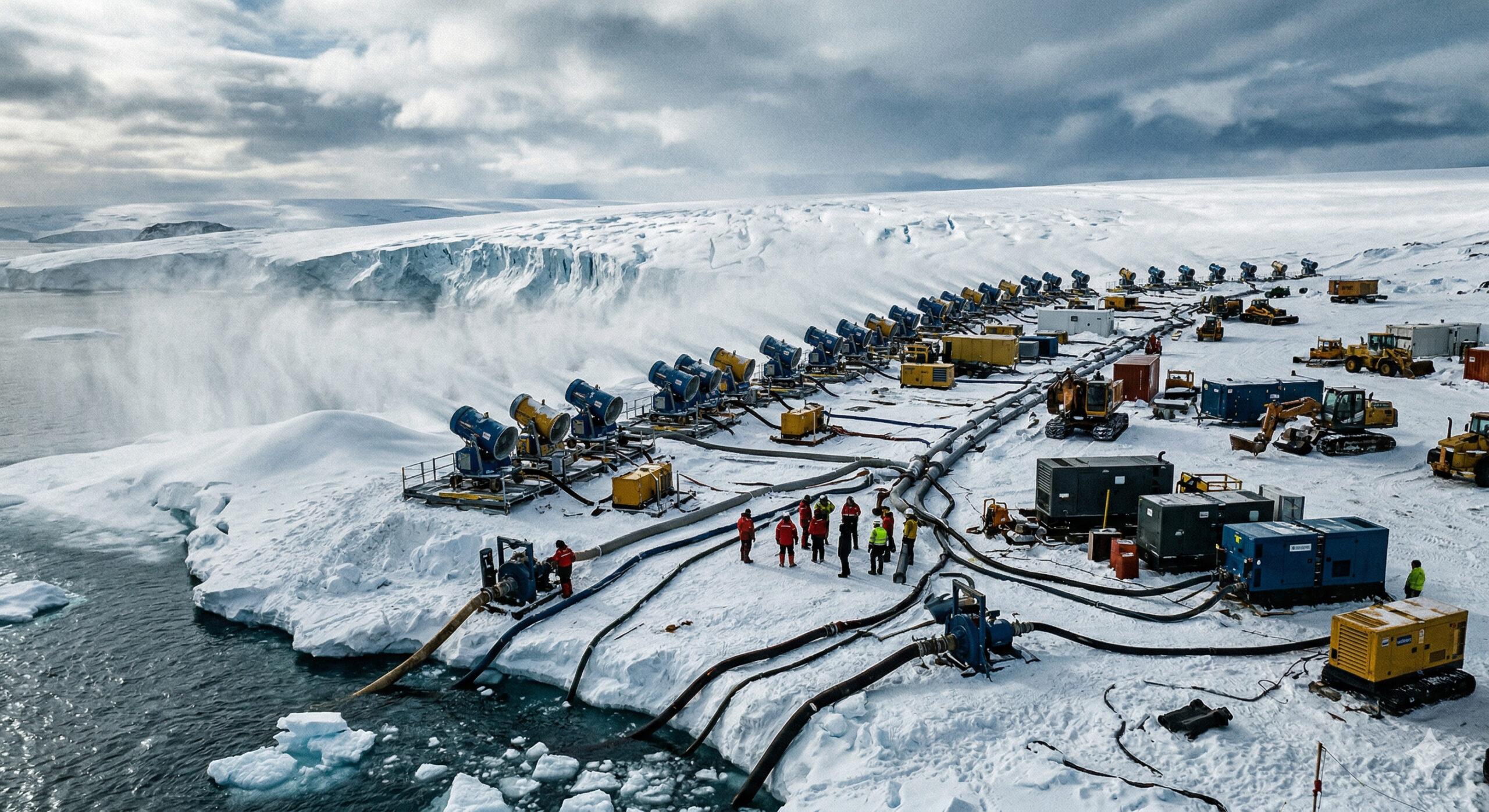
Study proposes dumping 7.4 trillion tons of snow in Antarctica to prevent sea level rise above 3 meters.
In 2019, based on a study published in Science Advances, researchers presented a proposal for climate geoengineering to try to stabilize the West Antarctic ice sheet: artificially adding about 7.4 trillion tons of snow over 10 years in vulnerable coastal areas, in an effort to contain a collapse that could raise global sea levels by more than 3 meters.
The proposal was developed by a team formed by Johannes Feldmann, Anders Levermann, and Matthias Mengel, affiliated with the Potsdam Institute for Climate Impact Research, and is part of a critical diagnosis: there is evidence that the retreat of sectors of West Antarctica, especially in the regions of the Pine Island and Thwaites glaciers, has already entered a self-sustaining discharge process, with a risk of evolution that is difficult to reverse under current conditions.
The central goal is not to “freeze” Antarctica, but to artificially increase the ice mass over these unstable areas, pushing the ice cover back against the bedrock and reducing the flow toward the ocean. According to the authors themselves, the idea would be to stabilize the dynamics of the West Antarctica through additional mass deposition in critical coastal zones, even under enormous technical, energy, and environmental challenges.
-
Found in Giza 100 years ago, an Egyptian dress made of 7,000 beads belonged to a woman from the time of Khufu and impresses with the details preserved after millennia.

-
The US no longer wants to deal with data centers: the state may prohibit projects of 20 MW that consume as much as 15,000 homes, while AI already requires energy from millions of households and even half a liter of water for 50 questions.
-
Elon Musk’s Starlink should watch out! Amazon is launching its satellite internet service with over 3,000 authorized satellites, betting on the New Glenn rocket and promising faster connectivity integrated with AWS.

-
What this solid-state nuclear battery does seems like something out of fiction: generating energy for over 100 years in ultra-low consumption devices, without recharging and without replacement, for critical missions in remote and demanding areas.
West Antarctica holds enough ice to raise sea levels by several meters
The West Antarctica is considered one of the most unstable regions of the global climate system. Unlike East Antarctica, which is situated on a high continental base, much of the western ice rests on a bedrock below sea level.
This configuration makes the region highly vulnerable to ocean warming, allowing warm water to penetrate beneath the ice and accelerate melting.
Studies indicate that the complete collapse of this ice sheet could result in a sea level rise greater than 3 meters, with global impacts on coastal cities, infrastructure, and populations.
Strategy involves pumping ocean water and transforming it into snow on the ice
The technical proposal involves a large-scale logistical system. Ocean water would be:
- captured in the coastal region
- desalinated
- pumped to elevated areas of the ice
- transformed into artificial snow
This snow would then be distributed over critical regions of the ice sheet, especially those that already show signs of instability.
The accumulation of snow would increase the mass and pressure on the ice, reducing its tendency to slide toward the sea, which could slow down the collapse.
Operation would require infrastructure comparable to large global industrial projects
The scale of the project is one of the most impressive points. To achieve the volume of 7.4 trillion tons, it would be necessary to operate continuously for about a decade.
This would imply:
- installation of thousands of pumping systems
- intensive energy use
- construction of infrastructure in an extreme polar environment

The authors of the study themselves highlight that the project would require an operation of nearly industrial scale in one of the most hostile environments on the planet, something unprecedented in engineering history.
Energy required would be equivalent to tens of thousands of wind turbines
One of the main challenges pointed out is energy consumption. Pumping, desalination, and snow production would require enormous amounts of electricity.
Estimates indicate that tens of thousands of large wind turbines would be needed just to power the system.
This requirement raises questions about logistical feasibility and environmental impact, as installing energy infrastructure in Antarctica involves significant technical and regulatory challenges.
Intervention tries to reverse instability process known as “marine ice sheet instability”
The proposal is directly linked to a phenomenon known as Marine Ice Sheet Instability (MISI). This process occurs when the retreat of ice in regions below sea level becomes self-sustaining.
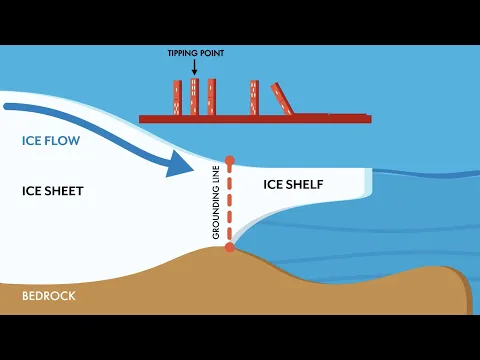

As the ice retreats, it exposes deeper areas, allowing more warm water to enter and accelerating melting even further.
The addition of mass through artificial snow aims to interrupt this cycle, stabilizing the glacier’s position and reducing its vulnerability.
Scientists consider proposal theoretically possible, but extremely challenging
Although the study demonstrates that the idea is physically plausible, the authors themselves acknowledge the difficulties.
Among the main challenges are:
- logistics in a polar environment
- high costs
- environmental impacts
- international governance
Antarctica is protected by international treaties that limit human interventions, which adds an additional layer of complexity to the project.
Environmental impacts and side effects are still uncertain
Another critical point is the potential impact of the intervention. Altering the dynamics of ice can affect:
- ocean currents
- marine ecosystems
- regional climate balance
The lack of data on these effects makes any implementation highly uncertain, especially in such a sensitive system as the polar one. The idea of dumping artificial snow is not seen as a conventional solution, but as a response to scenarios considered critical.
It enters the debate as a possible “last line of defense” if traditional emission reduction measures are not sufficient to contain the advance of global warming.
In this context, geoengineering is being considered as an emergency alternative, even though it involves significant risks.
Study highlights that preventing warming is still more efficient than intervening later
Despite the bold proposal, the researchers themselves emphasize that the most effective solution remains the reduction of greenhouse gas emissions.
Interventions like this are seen as extremely complex, costly, and uncertain, while preventive actions directly address the root cause of the problem.
The case of artificial snow in Antarctica illustrates the challenge of trying to control large-scale natural systems. The interaction between ice, ocean, and climate involves processes that operate at dimensions far beyond the current capacity for human intervention.
The proposal shows how far engineering is willing to go to buy time in the face of changes that are already underway, even if the practical feasibility is still uncertain.
The idea of pumping 7.4 trillion tons of snow over Antarctica seems to come from an extreme scenario, but reflects the gravity of the problem faced. When solutions of this magnitude enter the scientific debate, it indicates the level of risk associated with the collapse of polar ice.
In your view, does this type of intervention represent a necessary technological advance or does it indicate that the problem has already surpassed the limits of human control?








Seja o primeiro a reagir!