





In a small workshop in Azamgarh, in northern India, a young man gathered discarded metal and assembled a solar vehicle with space for seven people. The estimated cost was 8,000 to 10,000 rupees, just over 100 dollars. The range he claims is something no one has been able to measure yet.
Asad Abdullah was 22 years old, had a modest workshop, and a pile of scrap when he began assembling piece by piece what today circulates far beyond his neighborhood in Azamgarh, in the state of Uttar Pradesh. The result is a seven-seater solar vehicle, one for the driver and six for passengers, with a panel-covered roof that provides shade and charges the battery at the same time. The story was recounted by the Indian portal The Better India, in a report by Raajwrita Dutta published on May 25, 2026.
Two numbers explain why the case traveled. The first is the cost: the entire construction would have cost something between 8,000 and 10,000 rupees, an amount just over 100 dollars and corresponds to materials that most people would call junk. The second is the range: it is said to be over 200 kilometers driven while the vehicle is exposed to the sun. The first number is an estimate from the builder himself, and the second is a claim by him that no one has independently verified so far.
A small workshop, a pile of metal, and seven seats
What Asad assembled doesn’t look like anything from a dealership, and the Indian report makes a point of saying that. It is a visibly handmade machine, the result of trial and error, with visible welds and proportions that reveal its improvised origin. But it runs, and that’s where the conversation starts.
-
NASA probe wakes up after almost a year “sleeping” 9.5 billion kilometers from Earth and reveals unexpected clues about the frozen frontier of the Solar System

-
Three engineering students transform parts of old vehicles into an electric motorcycle with cameras, GPS, and sensors, creating a functional prototype after a year of work that slows down and stops automatically when detecting obstacles.

-
Producing 40.43 million tons and remaining practically stable, Brazil’s sugar production ended the 2025/26 harvest at a high level, even with the decline in cane crushing and the drop in productivity of sugarcane fields in the center-south of the country.

-
NASA’s James Webb Telescope discovers giant planet hidden in one of the most famous astronomical systems


The seven-seat configuration is what separates the project from a garage toy. It’s six passengers plus the driver, a number that places the solar vehicle in the range of a small public transport, not a personal vehicle. In a region where the cost of transportation weighs on family budgets, seven seats change the nature of what is being discussed.
Above the seats is the piece that gives the whole thing its name. A solar panel-covered roof serves two functions at the same time: it protects the occupants from the sun, which in Uttar Pradesh is no small detail, and captures energy while the vehicle is stationary or in motion. It’s a solution that solves two problems with just one item, and it’s the kind of decision that appears when the budget doesn’t allow for buying two separate solutions.
From 8,000 to 10,000 rupees, or just over 100 dollars
The cost is the data that makes people stop to read, and it should be handled carefully. The range of 8,000 to 10,000 rupees appears as an estimate made by Asad himself, not as an audited budget or an open purchase spreadsheet. Converted, the value is just over 100 dollars.
To put it into perspective, it’s an amount that in Indian retail does not independently buy a new set of solar panels, charge controller, traction battery, and electric motor. The account only balances because almost nothing there was bought new. The chassis came from discarded metal, and in an earlier version of the project, the motor was taken from a battery-powered two-wheeler that was already out of use. Component reuse is what lowers the cost, not some cheap engineering trick.
It is also worth noting that this price range varies according to the vehicle version and the publication telling the story. In reports from 2022, about an earlier six-seater model, Asad himself mentioned something between 10,000 and 12,000 rupees and about a month of work. The orders of magnitude are similar, and the difference between them is the natural margin of someone estimating the cost from memory instead of adding up receipts.
How the system really works
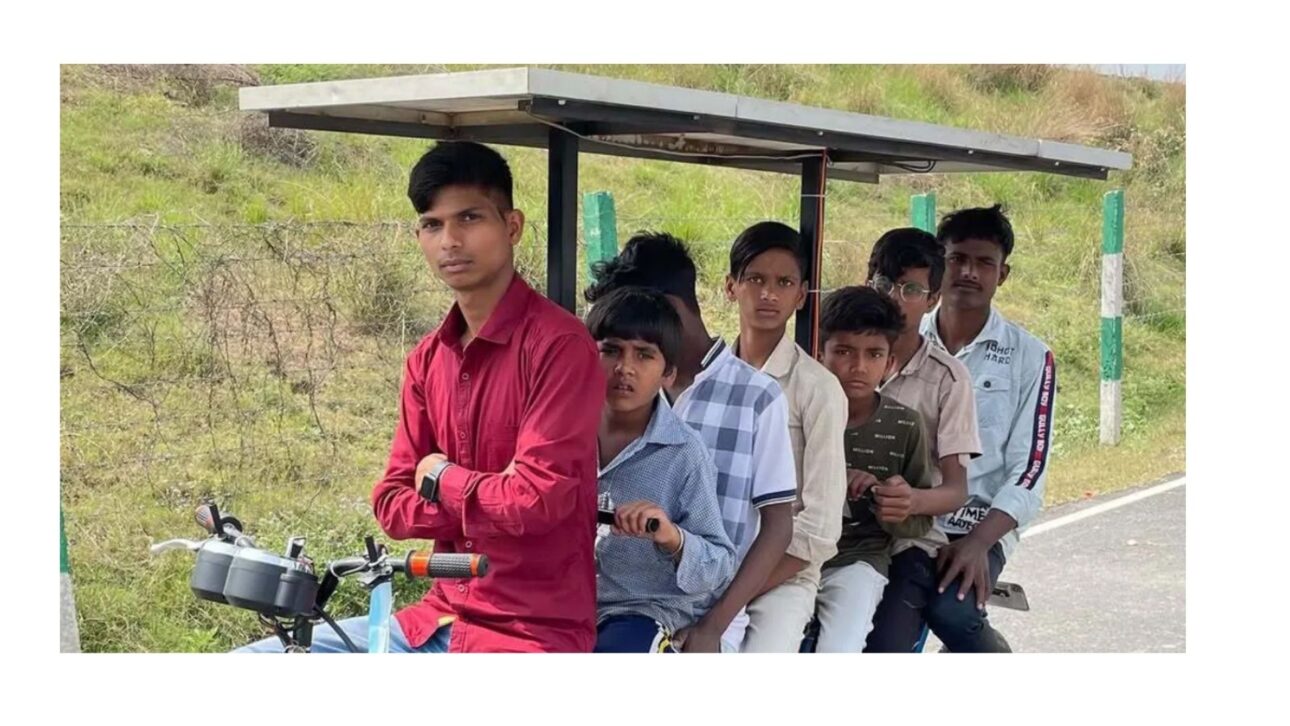
Here comes the explanation that almost no coverage of the case offers, and without it, the promise becomes confusing. The vehicle is not directly powered by sunlight in the sense that the panel pushes the wheel. It is a common electric vehicle in its basic architecture: a motor draws energy from a battery, and the battery is what moves everything.
The role of the sun is to replenish this battery. The panel coverage works as an onboard charger, replenishing charge while there is light. This is why the inventor’s formulation is always the same, that as long as there is sun, the vehicle keeps running without fuel, and not that it runs without a battery. The difference seems subtle and it is not: one thing is to dispense with a gas station, another is to dispense with energy storage.
Understanding this arrangement changes the reading of everything that follows. A solar vehicle of this type does not have a fixed range like a car with a full tank. It has a balance, which rises when the sun hits the panel and falls when the motor draws. If the motor’s consumption is less than the panel’s capture throughout the day, the vehicle may simply not stop. If it is greater, it runs until the battery runs out and then waits.
The 200 kilometers
We have reached the number that supports what needs to be treated with honesty. The figure of more than 200 kilometers originally appears in a video published by Asad himself, in which he claims that the vehicle runs quite a bit and that, as long as the sun is shining, it continues to operate. It is the builder’s statement, not the result of a test.
The Indian report itself marks this distance. It does not state that the vehicle runs 200 kilometers, it writes that there are reports that it does. This editorial caution says more than the number itself and disappeared from much of the international coverage of the case.
What is missing to turn the statement into verified data is precisely what has never been published. No one has disclosed the power of the panels in watts, the battery capacity in ampere-hours, the motor power, the average operating speed, the weight of the set with seven people on board, or the conditions under which the journey would have been made. Without these variables, it is impossible to verify the calculation, and equally impossible to refute it.
There is an interpretation that reconciles the number with physics, and it deserves to be mentioned. If the 200 kilometers are the sum of several days of use at low speed, with the battery recharging in the sun between one journey and another, the value ceases to be extraordinary and becomes plausible. If it is 200 kilometers in a single journey with seven occupants, the energy requirement increases significantly. The phrase Asad uses, that the vehicle keeps running as long as there is sun, points much more to the first interpretation than to the second.
The six-seater predecessor that Anand Mahindra promoted
This solar vehicle did not come out of nowhere. Before it, there was a six-seater electric bicycle, also made from scrap, which was completed in about a month and put Asad’s name in national circulation in India.
The push came from above. In December 2022, Anand Mahindra, chairman of the Mahindra group, posted a short video of the vehicle on his own account, and the post surpassed 1 million views. Mahindra tagged the automotive design director of the group in the post and raised the possibility of a global application for that design, even suggesting its use as a leisure vehicle in busy European tourist centers. He also noted that rural transportation innovations impress him because that’s where necessity forces someone to invent.
At the time, Asad explained where the idea came from, and the motivation was prosaic. The price of gasoline was rising, and he wanted to build something that could carry six people without consuming fuel. Even then, he said he intended to commercialize the project and sell it at an affordable price. Entrepreneur Harsh Goenka, chairman of the RPG Enterprises group, also showed interest in his work on another occasion.
The invitation from IIT Kanpur
The repercussion brought a more concrete consequence than just likes. After the seven-seater solar version appeared, the Indian Institute of Technology Kanpur, one of the most respected engineering institutions in the country, invited Asad for a discussion about the project.
The open perspective there was financial support to improve the product, should the institution be interested in the idea. It’s the difference between going viral and being taken seriously, and few garage projects cross that boundary. An invitation of this kind usually means access to a test bench, instrumentation, and people capable of measuring exactly what social media buzz never measures.
There is no public information about the outcome of this conversation, and this text does not claim that it resulted in funding or partnership. What is documented is the invitation.
Where the inventor comes from
Asad did not appear ready on the internet. He has been creating small inventions since childhood and spent years publishing what he did in videos on YouTube, for an audience that was almost non-existent at the beginning. The initial recognition came around 2017, and it was this feedback that pushed him to delve deeper into electronics.
The plans he declares are more ambitious than the current vehicle. He talks about setting up his own company to manufacture two-wheeled electric vehicles and says he dreams of a solar-powered airplane. The logic he applies is always the same, that clean energy needs to be usable in daily life, and not locked inside expensive technology.
This phrase is what sustains the interest in the case, more than the machine. The argument is not technical, it’s about access. A solar vehicle assembled for 100 dollars with discarded material suggests that sustainability does not necessarily have to be a high-shelf product, and this proposal works as a provocation even if the announced autonomy is not confirmed.
The Indian tradition of making do with what you have
The Indian report places the case in a specific cultural context, and it helps to understand why such stories repeat in that country. India has a long tradition of building things in unlikely places, in small towns and improvised garages, solving problems with whatever is at hand.
It’s a way of doing things where necessity commands and perfection is not on the horizon. Asad’s vehicle fits exactly in this space, as a solution that is not finished, not pretty, and not certified, but that moves and carries people. In a country where transportation costs and pollution are ongoing challenges, even a rough model like this serves as a trigger for public conversation.
This also explains why coverage of this type of invention tends to be generous and not very technical. The perceived value lies in the gesture, in the demonstration that someone without a laboratory and without a budget managed to assemble something that works. Measurement rigor comes later, when it comes.
The story has more road than it seems
A chronological detail helps put everything in place. The solar vehicle returned with force in 2026 when the Indian article was published, but its public journey started earlier: the six-seater electric bicycle appeared at the end of 2022, and the seven-seater solar version was already described in 2023 when the invitation from the technology institute came.
In other words, the age of 22 mentioned in the reports corresponds to the time when he built the vehicle and gained visibility, not necessarily to today. It’s the same story reappearing, which is common with makeshift invention content that does well on social media and resurfaces from time to time.
None of this diminishes the achievement. A seven-seater vehicle assembled with scrap for about 100 dollars remains a seven-seater vehicle assembled with scrap for about 100 dollars, whether it happened in 2023 or yesterday. What changes is what can be said about the present: there is no recent public information about the vehicle being in use, having been improved, or becoming a product.
What this story proves, and what it still doesn’t prove
The case of Asad Abdullah clearly proves one thing: it is possible to assemble a functional seven-seater vehicle with discarded material, a reused engine, and a panel cover, spending the equivalent of just over 100 dollars. This is documented on video, was seen by millions of people, and caught the attention of two of India’s most well-known entrepreneurs and a technology institute.
What history has yet to prove is the number that appears most in the titles. The 200 kilometers are a statement from the builder, without independent testing, without published technical specifications, and without described test conditions. The absence of verification does not turn the statement into a lie, it turns it into an unverified promise, and those two things are different.
And here is the question that sparks real discussion. Do you think this type of garage invention deserves public investment and university support, or that without testing and certification it is just a pretty internet video? Comment below if you would get into such a vehicle to drive on the road, and what you would need to see before trusting it.


