





 Portuguese
  English
  Spanish
  6 min of reading
  0 comments


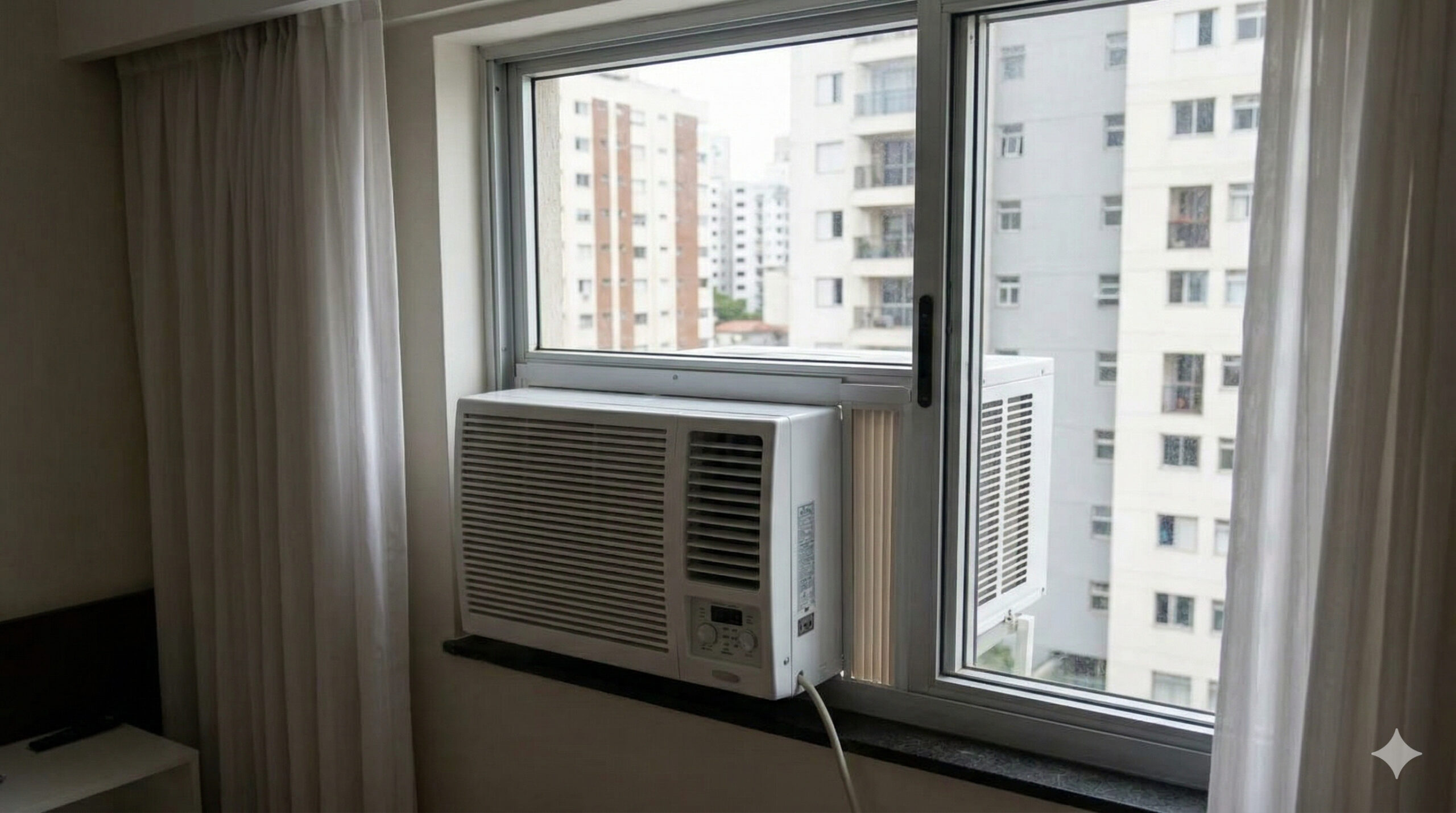
Monoblock air conditioner installed in the window dispenses with a separate external unit and becomes an alternative for those who cannot use split systems in apartments.
In 2024, Japanese manufacturers highlighted a well-established solution that has been underexplored in some markets: the monoblock air conditioner installed in a window. According to an official statement from the Japanese manufacturer Corona about its line of window air conditioners, this type of equipment is defined as a single-body air conditioner, designed for installation in sliding windows, without the need for wall work and without requiring a separate external unit.
The proposal of these devices has gained recent relevance not because it is new, but because it directly addresses a recurring problem in urban areas: the difficulty of installing external condensers in properties with physical limitations or more restrictive installation rules. In the same material, Corona states that the system can even be used in homes where there is no space for the external unit, and highlights that the piece launched in 2024 also facilitates installation in rented properties, as it avoids permanent fixation marks on certain types of windows.
In the official description of its own product line, the devices are presented as a solution compatible with small windows of apartments and residential complexes, reinforcing why this format remains relevant in Japan, where the compaction of residential spaces favors integrated equipment and simplified installation.
-
China prepares a 78,000-ton pilotable floating island for deep-sea research: it accommodates 240 people for months, withstands category 17 typhoons and 9-meter waves, and uses metamaterials that dissipate nuclear explosions.
-
End of the stove: new technology from Xiaomi promises to retire the old stove with a smart pot that prepares up to 16 servings in 24 minutes and has 10 automatic levels controlled by an app.

-
If Ormuz closes, the world freezes: the 1,200 km Saudi Petroline transports oil from the Gulf to the Red Sea, operates near 7 million barrels/day, and becomes a geopolitical weapon in the crisis with the US.

-
Scientists restore seagrass meadows in the open sea.


Instead of the split arrangement, the system concentrates all essential air conditioning components in a single body, eliminating the need for a separate condenser and reducing installation complexity.
What is a monoblock air conditioner and how does it work in practice
The monoblock air conditioner is a climate control system that integrates all the necessary elements for the refrigeration cycle into a single cabinet. This includes the compressor, condenser, evaporator, and ventilation system. Unlike the split system, which separates these functions between two units (indoor and outdoor), the monoblock concentrates everything in a single piece of equipment.
In the case of window models, the device is partially installed facing the outside, allowing heat to be dissipated outside the environment. This ensures the operation of the thermodynamic cycle necessary for cooling the indoor air.
This type of system is already widely described in standards and technical literature on air conditioning, including standards from ASHRAE (American Society of Heating, Refrigerating and Air-Conditioning Engineers), which recognizes the monoblock as one of the classic architectures of air conditioning.
Why this type of air conditioner is common in Japan
Japan presents a combination of factors that favor the use of window and monoblock air conditioners. Among them are:
- Reduced residential spaces
- Strict regulations on building facades
- High urban density
- Culture of efficiency and practicality in equipment installation


In many Japanese buildings, it is not allowed to install visible external units, which makes the use of traditional split systems unfeasible. In this context, the monoblock emerges as a viable solution, as it does not require significant structural changes.
Japanese manufacturers such as Panasonic and Daikin maintain specific lines of this type of equipment, adapted to local construction standards.
Installation in the window dispenses with complex structural work
One of the main characteristics of this type of air conditioner is the possibility of direct installation in existing windows or openings. This reduces the need for:
- Drilling walls
- Installing piping
- Complex electrical adaptations
In many cases, the equipment can be installed with simple supports and proper sealing, although the actual installation time varies depending on the environment and window structure.
This factor is particularly relevant for rented properties, where permanent modifications may be prohibited by contract or condominium regulations.
Difference between monoblock, split, and portable
Although the monoblock shares some characteristics with other types of air conditioners, there are clear differences between the systems.
The split system consists of two separate units, with greater energy efficiency and lower internal noise levels. The portable unit is also monoblock but relies on an exhaust hose that needs to be positioned in the window, which can reduce efficiency.
The window model, in turn, is fixed and designed to operate with part of the equipment facing outward, which improves heat dissipation compared to portable units.
This distinction is important because the three systems are often confused, despite having different performances and applications.
Energy efficiency depends on the model and embedded technology
Some modern models of monoblock air conditioners already incorporate inverter technology, which adjusts the compressor speed according to the cooling needs. This technology is also widely used in split systems and helps reduce energy consumption compared to traditional fixed-cycle systems.
However, technical studies and efficiency comparisons indicate that, in general, inverter split systems tend to show better overall energy performance due to the physical separation between evaporator and condenser, which reduces thermal losses.
Therefore, although there are efficient monoblock models, the claim that they consume less energy than splits is not a general rule and depends on individual specifications.
Noise level is one of the main points of attention
By concentrating all components in a single body, including the compressor, the monoblock air conditioner tends to generate more internal noise compared to split systems, where the compressor is located outside the property.

This factor is often cited in technical evaluations and user analyses as one of the main limitations of the system, especially in environments such as bedrooms and offices.
Despite this, recent advances in acoustic insulation have partially reduced this impact in more modern models.
Practical application in rented properties and environments with restrictions
The main differential of the monoblock air conditioner lies in its applicability in scenarios where the split system is not viable. This includes:
- Rented apartments with construction restrictions
- Buildings with a ban on external installation
- Old properties without infrastructure for piping
- Temporary or commercial spaces
In these contexts, the equipment allows for climate control without the need for permanent interventions, which facilitates both installation and removal.
Global market has kept the technology active for decades
Although it has regained prominence in some recent discussions, the monoblock air conditioner is not a recent innovation. Window models have existed since the early 20th century, being widely used in the United States and other countries.
What has changed in recent years is the incorporation of digital technologies, sensors, remote control via apps, and improvements in energy efficiency.
This movement aligns with a broader trend in the appliance sector, which seeks to modernize existing technologies rather than completely replace them.
Trend points to a search for more flexible and less invasive solutions
The growing demand for solutions such as the monoblock air conditioner is directly linked to the transformation of the real estate market and the increase in the number of people living in rented properties or with structural restrictions.
By offering an alternative that dispenses with complex construction and adaptations, this type of equipment meets a growing practical need in large urban centers.

At the same time, the technological evolution of these systems indicates that the monoblock is not being replaced, but rather repositioned within a broader ecosystem of climate control solutions.
The monoblock air conditioner installed in a window represents a functional and established solution for climate control in environments with structural limitations. Although it does not completely replace the performance of split systems in terms of efficiency and quietness, it offers specific advantages in terms of installation and flexibility.
Its current relevance lies not in absolute innovation, but in its ability to meet real demands from users who cannot or do not wish to make permanent modifications to their properties.
Based on technical data, manufacturer materials, and recognized standards in the field of air conditioning, the equipment remains a valid alternative within the global air conditioning market.








Seja o primeiro a reagir!