





 Portuguese
  English
  Spanish
  4 min of reading
  0 comments


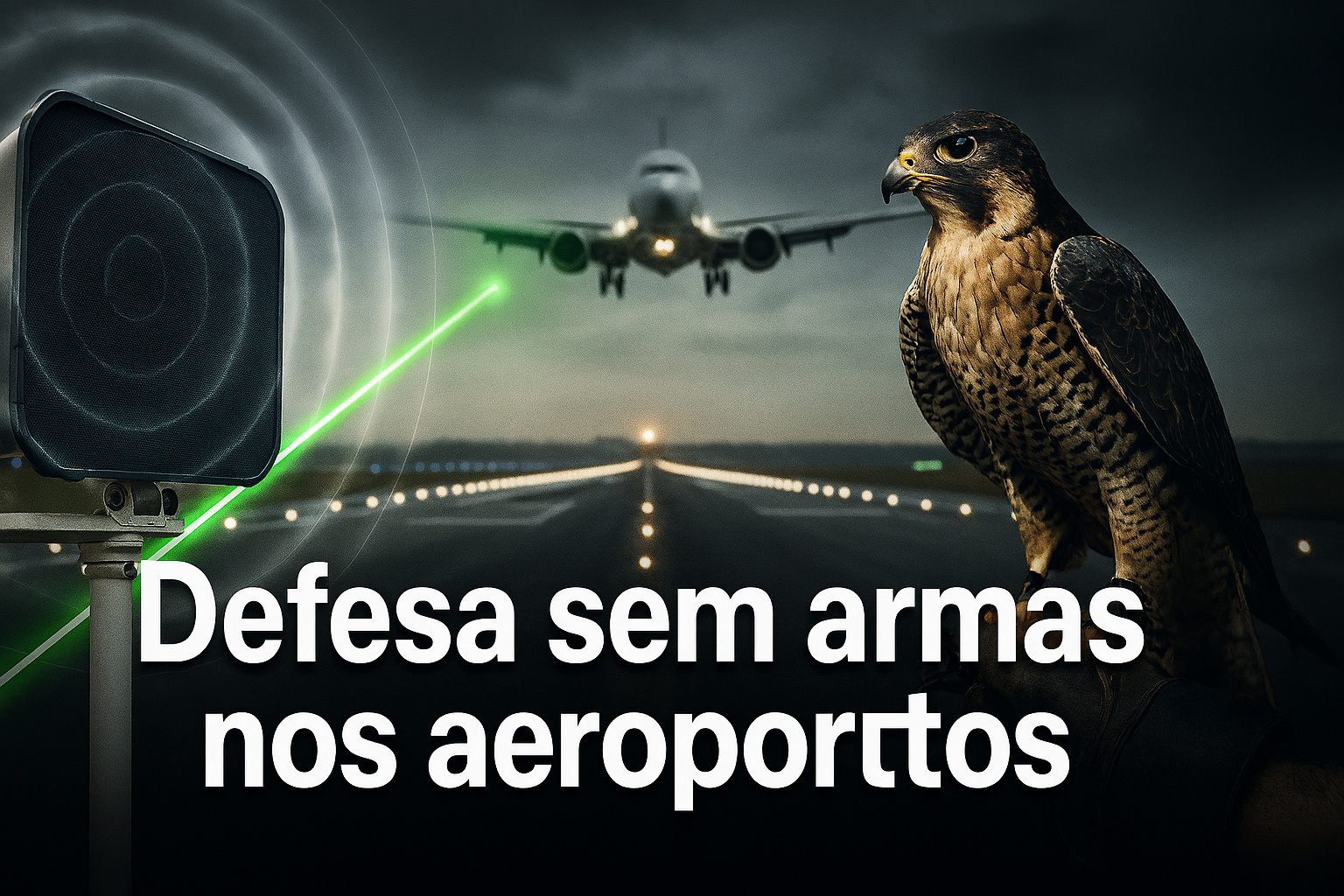
Airports Adopt Sound Cannons of 150 dB, Green Lasers, and Trained Hawks to Avoid Collisions with Birds and Increase Safety in Landings and Takeoffs.
As passengers board calmly, thousands of meters above the runway, an invisible battle unfolds. Among the baggage systems, radars, and runway lights, major airports around the world implement advanced non-lethal defenses to eliminate one of aviation’s greatest risks: the impact between aircraft and birds, known internationally as bird strike. The reason: in 2018, the FAA (Federal Aviation Administration) estimated that over 200 human fatalities and losses exceeding US$ 1 billion occurred as a result of bird strikes. To prevent a bird from entering the turbine, airports needed to reinvent themselves.
Three Technologies: Powerful Sound, Invisible Laser, and Trained Birds for a Single Goal
Sound Cannons (LRAD and Other Acoustic Systems)
These devices emit pulses of up to 150 decibels — similar to a rocket launching — and are used to emit high-pitched sound signals that disturb the vestibular systems of birds, causing them to fly away from the runway in seconds. Unlike blank shots or explosives, the sound is directed, instantaneous, and does not damage the ground or machinery.


The system is activated automatically by motion sensors around the runway or by ground operators when there is a concentration of birds.
-
Chaos On Airplane Could Be Expensive: Proposal Aims To Prevent Disruptive Passengers From Flying For Up To 1 Year In Brazil And Face Fines Of Up To R$17,500

-
Man Arrested After Halting Takeoff of Fire Department Helicopter During Child Rescue in Guaratuba

-
With 37 Tons of Cargo, Over 8,000 km Range, and Ability to Land on Unpaved Runways, the Airbus A400M Demonstrates How Europe Created a Military Giant That Transports Armored Vehicles, Aerially Refuels Fighters, and Operates in Conflict Zones and Humanitarian Missions Worldwide
-
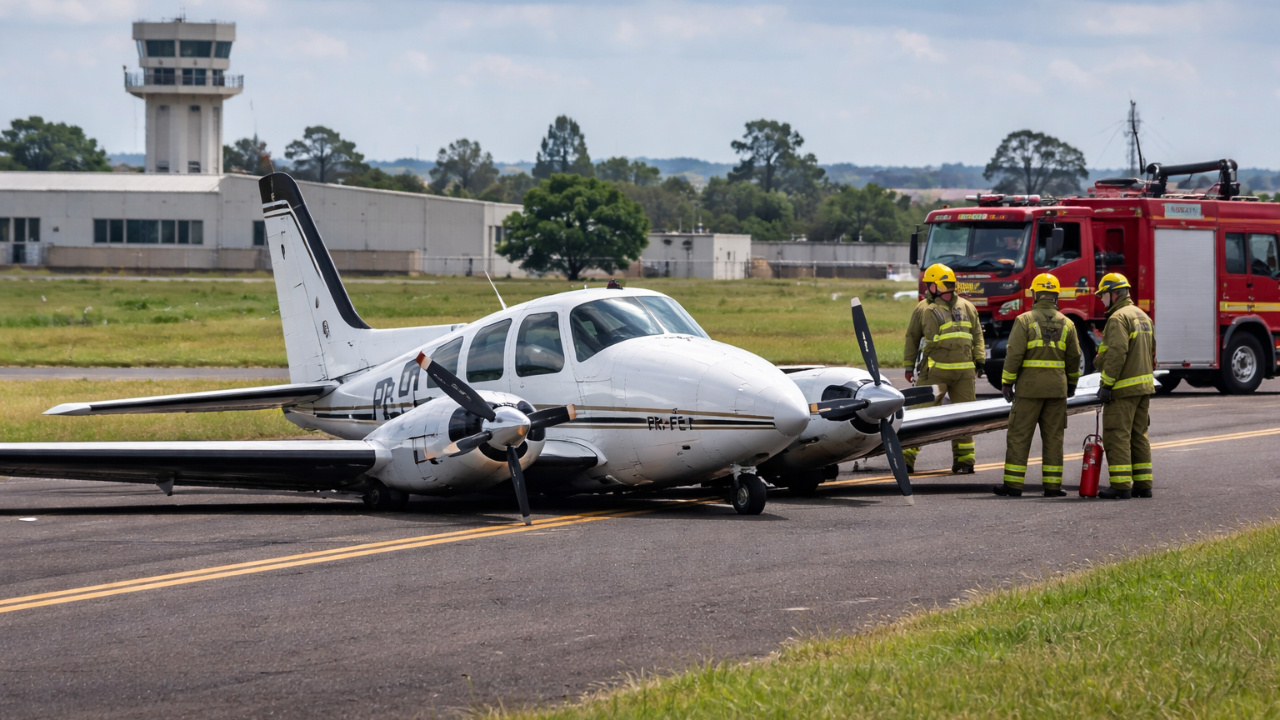
Emergency Landing in Campos Amarais After Bird Strike on Small Plane

Green and Long-Range Infrared Lasers
Lasers of 520 nm (green) or invisible versions in the infrared are pointed at the sky at power levels safe for humans but uncomfortable for birds. When the birds notice the beam or the reflection, they change their course in a fraction of a second.
These devices typically cover areas of up to 2 km² and follow the approach curve of the runway, creating an invisible “dispersion envelope.”
Trained Hawks and Seagulls
Meanwhile, many airports turn to professional falconers with trained birds of prey — such as peregrine falcons to patrol the perimeter of the runway. The simple flyover of these birds already causes the dispersion of smaller flocks that recognize the predator.
This technique is combined with technology, forming an integrated system: sensor detects common birds > laser and sound divert > hawk patrols > runway cleared.
Why So Much Technology for a Silent Threat
- Flight Speed: A 1 kg bird at 270 km/h exerts forces comparable to 1 ton of load on a jet engine.
- Critical Altitude: Many birds migrate precisely within the corridors of flight routes.
- High Maintenance: A bird strike can cause engine failure, fire, or depressurization.
- Urban Environment: Airports close to wetlands, landfills, and parks have a constant risk of attracting wildlife.
Thus, every inch of the area around the runway is monitored and treated as an integral part of aviation safety.

Success Stories and Recent Statistics
- Banfield International Airport, United Kingdom, reported a 70% decrease in bird strikes after installing LRAD and lasers.
- Denver Airport, USA, implemented a falconry program and reduced from 127 cases in 2015 to 42 in 2023.
- Reports from ICAO and FAA indicate that acoustic and laser systems are now part of the international mitigation recommendations.
Challenges and Ethics in Wildlife Defense
Although effective, these technologies are not without controversy. Some environmental organizations warn about:
- the risk of continuous stress to local wildlife;
- the need for licensing for laser use;
- specialized training for LRAD operators;
- balancing air safety with environmental preservation.
Therefore, many airports coordinate with wildlife agencies to ensure that bird dispersion occurs without collateral damage.
Why This Type of Defense Is Increasingly Necessary
As air traffic grows at an estimated 5% per year globally — the risk of collisions with animals also increases. Larger jets, more frequent flights, and the use of additional runways near urban areas all amplify the wildlife challenge in the vicinity. There is no simple solution: weapons are not permitted, wildlife cannot be eliminated, and the airport environment requires a quick and effective response.
The sound, laser, and raptor technologies offer a “defense without weapons,” perfectly aligned with civil aviation regulations, environmental protection, and public image, while also reducing aircraft maintenance costs.
As passengers take their seats and the jet accelerates, the detection system has already worked — the sensors triggered the lasers, the sound cannons buzzed, the hawks patrolled. All of this to ensure that no bird crosses the path of the machine.
It is a silent war, an invisible theater that heavy protection and cutting-edge systems undertake to ensure that the grand show of takeoff and landing occurs smoothly.
The next time you board, remember: a safe flight depends on technology, which sometimes starts with a buzz, a green beam, or the flapping wings of a hawk at the edge of the runway.









Seja o primeiro a reagir!