





 Portuguese
  English
  Spanish
  5 min of reading
  0 comments


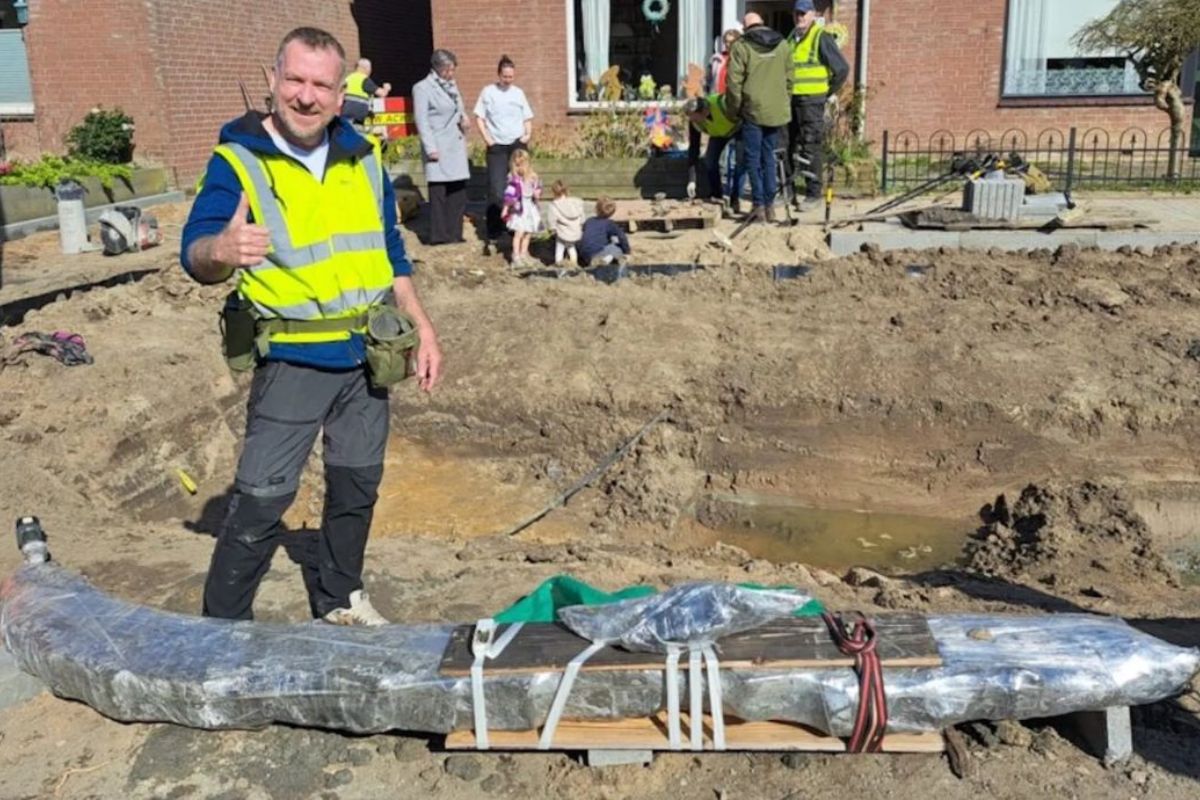
A routine maintenance work in the sewer of Wijk bij Duurstede, in the Netherlands, revealed a 3.2-meter-long and 30-centimeter-thick wooden beam that experts believe is part of a 1,300-year-old Viking ship, a piece that could help reconstruct the history of Nordic presence in Europe during the Carolingian period and the navigation routes of the Utrecht region.
According to the portal ndmais, a team of workers was maintaining the sewer pipes in the city of Wijk bij Duurstede, in the Netherlands, when they found something no one expected: a 3.2-meter-long wooden beam, buried alongside fragments of pottery from the Carolingian period. Experts believe that the piece found in the sewer is part of a Viking ship about 1,300 years old, one of the most significant archaeological finds in the region in recent years.
The find mobilized archaeologists, local authorities, and the Museum Dorestad. The preliminary analysis of the Viking ship indicates that the beam has a shape, carvings, and finish compatible with Nordic shipbuilding from the 8th or 9th centuries, although researchers also consider that the piece may belong to a cog ship from the same period. The beam was packaged to prevent drying out and will undergo tests that may take months, but the potential to reveal details about the navigation routes of medieval Europe already excites the scientific community.
How sewer workers found a piece of a 1,300-year-old Viking ship
The discovery happened by chance. The service was a routine maintenance of the sewer network of Wijk bij Duurstede, a city with a millennia-old history in the province of Utrecht, in the Netherlands.
-
Scientists caught a water vapor explosion on Mars exactly when it shouldn’t have happened: an unexpected dust storm launched the water to an altitude of 80 kilometers and accelerated the escape of hydrogen into space by 2.5 times.

-
The Brazilian Navy launched the NPa Mangaratiba (P-73) on April 27: a 54.2 m Macaé-class patrol vessel, with 43 crew members, 6 days of autonomy, and a range of 4,000 km to monitor the entire Blue Amazon.

-
Chinese scientists have identified 122 viable asteroids for large-scale asteroid mining and outlined the Tiangong Kaiwu plan to explore space water ice and metals throughout the Solar System by 2100.

-
Does compulsive lying exist? What does science know about mythomania and why does it go beyond ‘lying too much’?


The workers identified an atypical beam inside the sewer and alerted Danny van Basten, an amateur archaeologist and volunteer, who realized the potential of what could be a fragment of a Viking ship and immediately informed the Museum Dorestad.
The news spread quickly. Mayor Petra Doornenbal and local authorities visited the construction site after the repercussions of the find, and naval construction experts were called to assess the fragment of the Viking ship.
Kees Sterrenburg, one of the consulted experts, stated that the shape, carvings, and finish of the beam are indicative that it was part of the structure of a Nordic vessel—the type of shipbuilding associated with Viking ships.
The 3.2-meter beam and indications that it belongs to a Viking ship

The piece found in the sewer measures 3.2 meters in length and is approximately 30 centimeters thick—dimensions compatible with structural beams of large medieval vessels.
Together with the beam of the possible Viking ship, fragments of pottery from the Carolingian period were found, reinforcing the dating between the 8th and 9th centuries, a time when Nordic presence in the region of present-day Netherlands was intense.
The preliminary analysis indicates two possibilities: the beam may be part of a classic Viking ship or a cog ship—a type of merchant vessel common in medieval Europe that shared some construction techniques with Nordic ships.
In either case, the piece found in the sewer is about 1,300 years old and is a direct physical record of the navigation routes that passed through the Utrecht region during the Viking era.
Wijk bij Duurstede: the Dutch city that was once one of the largest ports of medieval Europe
The discovery of the possible Viking ship in Wijk bij Duurstede is not so surprising when one knows the history of the city. From the 7th to the 9th centuries, the site housed Dorestad, one of the largest commercial and port centers of medieval Europe—a connection point between Nordic maritime routes and the rivers that crossed the continent.
Viking ships arrived there regularly, bringing goods from Northern Europe and Scandinavia.
Dorestad declined after Viking attacks and changes in river courses in the 9th century. But the underground of present-day Wijk bij Duurstede continues to hold traces of that past, and the fragment of the Viking ship found in the sewer is further proof that centuries of history are literally beneath the feet of the residents.
The Museum Dorestad, which preserves the memory of the ancient port, is now responsible for coordinating the analysis of the piece.
What happens now with the piece of the Viking ship found in the sewer

The investigation is being coordinated by archaeologist Anne de Hoop, who leads the cleaning and analysis of the pieces found in the sewer network. The fragment of the Viking ship was immediately packaged to prevent drying out—a fundamental concern with millennia-old woods that can deteriorate quickly upon contact with air.
The next steps include carbon-14 dating, analysis of the wood species, and comparison with other pieces of Viking ships already cataloged in Europe.
The ultimate goal is to restore the piece for public display, helping to tell the story of the navigation routes of the Viking ship in the Utrecht region and the Nordic presence in medieval Holland. The tests may take months, but expectations are high.
A 1,300-year-old Viking ship hidden beneath the sewer of a Dutch city
What should have been a maintenance work in the sewer turned into one of the most relevant archaeological discoveries in the Netherlands in recent years. A 3.2-meter beam, possibly from a 1,300-year-old Viking ship, found inside a pipe alongside pottery from the Carolingian period. The history of medieval Europe and the Nordic routes that crossed the continent may gain a new chapter thanks to workers who were fixing a sewer.
And if beneath a Dutch sewer network there was a piece of a Viking ship, what else might be hidden beneath the ground of the cities we walk on every day?
Have you ever heard of any archaeological discovery made by chance? And what do you think about finding a Viking ship inside a sewer? Share in the comments.









Seja o primeiro a reagir!