






 Portuguese
  Spanish


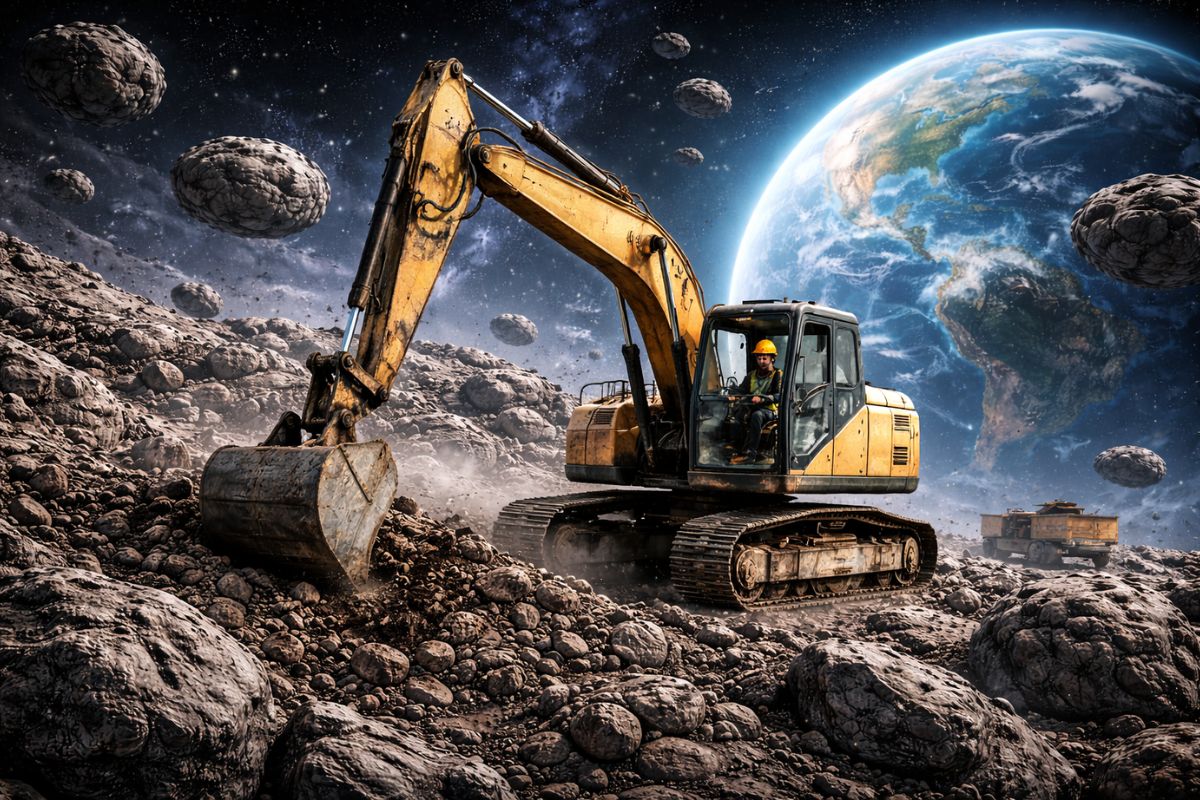

The Tiangong Kaiwu roadmap presented by Chinese scientists describes four phases of asteroid mining and extraction of space water ice that aim to transform the Solar System into a supply network connecting the Moon, Mars, and the region of Jupiter by the end of the century
Chinese scientists linked to the China Aerospace Science and Technology Corporation have identified 122 near-Earth asteroids that are considered technically and economically viable for large-scale asteroid mining. The number is part of a larger survey that mapped about 700 objects with materials valued at over 100 trillion dollars each, and now supports a four-phase plan to explore resources throughout the Solar System by the year 2100.
The initiative is called Tiangong Kaiwu and was presented by academic Wang Wei as a long-term roadmap that goes far beyond scientific missions. The plan includes the extraction of space water ice at the lunar poles, refueling of ships at gravitational equilibrium points, and a transportation network connecting Earth, Moon, Mars, and the main asteroid belt, transforming space exploration into a permanent industrial economy.
From a 17th-century encyclopedia to a plan to mine the Solar System

The name Tiangong Kaiwu was not chosen by chance. It comes from a Chinese encyclopedia of craftsmanship and technology published in 1637 that documented how people transformed natural materials into tools and products.
-
Realme Launches Affordable 16x 5G Phone with Military Certification, 6,600 mAh Battery, 50 MP Camera, and 6.8-Inch Screen Starting at $320

-
Amazonian Fruit Bacuri: A Nutrient Powerhouse with Antioxidants, Vitamins, and Bioactive Compounds, Ideal for Sweets and Beverages
-
Açaí Genome Sequenced for the First Time, Potentially Tripling the Speed of Developing New Cultivars
-
Geologists Find 4% of Normandy D-Day Beach Sand Still Contains Metal Fragments from WWII Explosions





The Chinese scientists adopted the title to signal a continuity of ideas: materials are born in nature, and human skill transforms them into civilization.
In 2023, Wang Wei and his colleagues presented the Tiangong Kaiwu as a development concept, which was later released by the China National Space Administration as an official vision in three stages: prospecting, extraction, and utilization.
In practice, the roadmap advances in four major phases that cover everything from lunar resource surveys to the construction of a network of supply stations throughout the Solar System, connecting cislunar space, Mars, and the region of Jupiter into a single supply chain.
Four phases from 2035 to asteroid mining in Jupiter
The first phase, expected by 2035, focuses efforts on detailed resource surveys at the lunar poles and on small bodies near Earth, as well as initial demonstrations of extraction technology.
This is where the 122 asteroids mapped by the Chinese scientists gain practical importance, serving as priority targets for the first asteroid mining operations.
By mid-century, the plan envisions pilot extraction of space water ice at the lunar south pole and on volatile-rich asteroids, with the first refueling stations in cislunar space.
By around 2075, the activity would extend to Mars and the main asteroid belt with in-orbit processing, and by 2100, Chinese scientists envision a complete network linking the Solar System in transport routes between Earth, Moon, Mars, and Jupiter.
The Lagrange points, zones of gravitational equilibrium between celestial bodies, would function as depots where ships would be refueled and cargo transferred.
Space water ice is worth as much as metals in this plan
Among all the resources mentioned in the Tiangong Kaiwu, space water ice holds a position as strategic as precious metals.
This is because water found in lunar craters and asteroids can be decomposed into oxygen and hydrogen, providing breathable air, propulsion fuel, and drinking water without the need to transport everything from the Earth’s surface.
For the Chinese scientists, this ability to produce essential supplies directly in space is what makes long-duration missions feasible and renders asteroid mining economically sustainable.
Without space water ice, every kilogram of fuel and every liter of water would need to be launched from Earth at a very high cost, making permanent operations in the Solar System unfeasible.
The roadmap also mentions a digital infrastructure on a gigawatt scale combining communications, computing, and debris tracking, transforming orbital space into an industrial corridor.
Why China wants to mine space: resource crisis on Earth
The Tiangong Kaiwu is not presented merely as a prestigious space project. Wang Wei argues that the development of space resources can alleviate resource scarcity, energy crises, and environmental pollution that are already affecting Earth, injecting momentum into the planet’s sustainable development.
The numbers justify the urgency. The United Nations Environment Programme reports that global extraction of natural resources has tripled in the last five decades, with projections of an increase of more than 60% by 2060.
The International Energy Agency estimates that demand for minerals for clean technologies could triple by 2030 and quadruple by 2040, with demand for lithium growing more than forty times.
For the Chinese scientists, asteroid mining offers an alternative: extracting metals and volatiles from outside Earth would protect forests, mountains, and rivers while maintaining the production of batteries, wind turbines, and electric vehicles.
The risks that the plan still needs to address
Despite the ambition, the Tiangong Kaiwu faces serious obstacles. Each launch that transports mining equipment into space consumes fuel and leaves waste in the upper atmosphere, and recent studies warn that rocket soot in the stratosphere could warm the air and slow the recovery of the ozone layer if launch rates increase.
Orbital congestion is another problem. Space agencies already monitor about 40,000 fragments of debris larger than a softball, in addition to thousands of active satellites.
A more industrialized Solar System, with oil tankers and processing stations spread throughout cislunar space, would exacerbate this overcrowding. There is also the legal issue: the Outer Space Treaty prohibits claims of sovereignty over celestial bodies, but national laws in the United States and Luxembourg already allow companies to own the resources they extract in space.
The Tiangong Kaiwu adds a powerful state actor to this race, and the question that the Chinese scientists have yet to answer is who will set the rules to prevent asteroid mining from repeating the worst habits of terrestrial mining.
Do you believe that space mining will happen this century?
The Tiangong Kaiwu roadmap is, for now, a strategic plan and not a fully funded project.
But the clarity of the four phases, the mapping of 122 viable asteroids, and the emphasis on space water ice show that the Chinese scientists are treating the exploration of the Solar System as state policy, not as science fiction.
Do you think asteroid mining will become a reality by 2100? Is space exploration the solution to Earth’s resource crisis or will it just export the same problems to space? Leave your opinion in the comments.


