





 Portuguese
  English
  Spanish
  4 min of reading
  0 comments


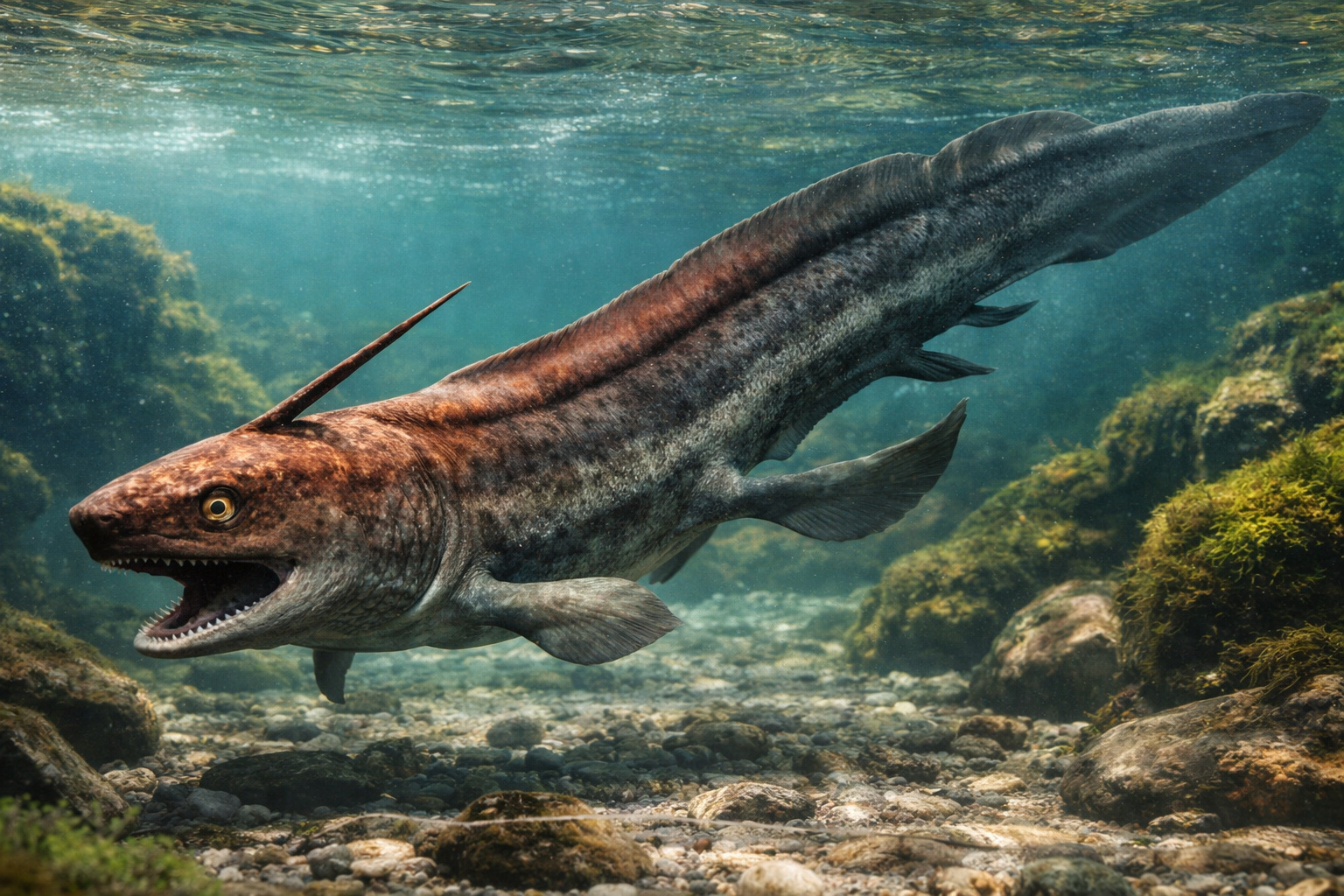
Up to 5 Meters, Venomous Spine on the Head, and Total Adaptation to Freshwater: The Xenacanthus Was a Freshwater Shark That Dominated Rivers for Over 200 Million Years.
When talking about prehistoric sharks, the image almost always refers to deep oceans and giant marine predators. The Xenacanthus completely breaks this imaginary. It was not an occasional visitor to rivers nor a coastal animal that ventured into estuaries. This is a genuinely freshwater shark, adapted over hundreds of millions of years to live, hunt, and breed exclusively in rivers, lakes, and continental swamps. During an impressive geological interval, spanning from the late Devonian to the Triassic, this animal dominated freshwater ecosystems in virtually every continent.
A Shark That Did Not Belong to the Sea
The Xenacanthus lived approximately between 300 and 200 million years ago, surviving major extinctions and global climate changes. Unlike modern sharks, which rely on the marine environment to maintain physiological balance, it developed complete adaptations for freshwater. Its fossils are found in continental sediments, associated with ancient river and lake systems, and not in marine environments, confirming that its natural habitat was inland rivers.

This adaptation was not momentary. The genus persisted for tens of millions of years, indicating enormous evolutionary success in freshwater environments, something exceedingly rare among sharks throughout the history of life on Earth.
-
The Himalayas continue to grow to this day, with tectonic plates advancing 5 cm per year, mountains rising up to 10 mm annually, and the 2015 earthquake that killed 9,000 people may have increased the risk of an even larger seismic mega-event.

-
At an altitude of 400 km by astronauts from the International Space Station, Paris transforms at night into a golden mesh so precise that it reveals the outline of the Seine River, avenues, and entire neighborhoods like a luminous map drawn over the Earth.

-
iPhone 17 reaches historic low price with 256 GB, 120 Hz display, and drops to R$ 5,703 on Shopee, featuring A19 chip, dual 48 MP cameras, battery life of up to 30 hours, and advanced AI features.

-
Trip to Mars getting closer: Pulsar Fusion, from the UK, advances with plasma ignition in fusion engine and could drastically reduce space travel time, making crewed missions faster, safer, and economically viable.


Dimensions That Rivaled Large Modern Predators
The largest species of Xenacanthus reached about 5 meters in length, a size comparable to that of large oceanic sharks today. In prehistoric rivers and lakes, this placed it at the absolute top of the food chain. For comparison, a modern bull shark, considered large for freshwater environments, rarely exceeds 3.5 meters and only enters rivers for limited periods.
In an ancient freshwater ecosystem, a 5-meter predator with an elongated body and powerful musculature meant total dominance over bony fish, giant amphibians, and even semi-aquatic reptiles of the time.
The Venomous Cranial Spine: A Unique Weapon
One of the most intriguing aspects of the Xenacanthus was the presence of a long spine located at the back of its head. Unlike simple defensive structures, this spine had internal channels associated with venom glands. Anatomical evidence indicates that the toxin could be released into wounds caused by the spine, serving both as a defense against large predators and as an offensive resource in confrontations.
This feature is extremely rare among sharks and practically non-existent in modern species. The cranial spine of the Xenacanthus reinforces the idea that it occupied dangerous environments, where disputes with other large freshwater animals were common.
Serpentine Body and Ambush Hunting Strategy
The body shape of the Xenacanthus also differed from current sharks. It had a long, narrow, and flexible body, resembling more of a giant eel than a classic shark. This anatomy was ideal for low-visibility environments, common in ancient rivers and swamps, often laden with sediments.
Instead of fast pursuits in open water, the Xenacanthus likely hunted by ambush. The strategy involved staying partially concealed on the bottom or amidst aquatic vegetation, suddenly lunging at its prey. This combination of a serpentine body, powerful bite, and possible use of the venomous spine made its attack extremely efficient.
A Domination That Lasted Over 200 Million Years
Few predators maintained ecological relevance for as long as the Xenacanthus. It appeared before dinosaurs dominated the Earth and survived major extinction events, adapting to deep environmental changes. Throughout this period, rivers and lakes underwent radical transformations, but the Xenacanthus remained one of the main predators in these environments.

Its disappearance occurred only at the beginning of the Triassic, a period marked by deep ecological reorganizations following the largest mass extinction in the history of the planet. Even so, its evolutionary longevity is a clear indication of biological success.
Comparison With Modern Freshwater Sharks
Today, the Ganges shark and the bull shark are well-known examples of species that frequent rivers. None of them, however, is truly freshwater in their entire evolutionary history, nor do they reach the combination of size, duration of dominance, and specialization that the Xenacanthus exhibited.
While modern sharks enter rivers as a temporary extension of their marine habitat, the Xenacanthus represents an extreme evolutionary experiment: a shark fully adapted to the continent, capable of dominating freshwater ecosystems for hundreds of millions of years.
A Forgotten Giant of Prehistory
Despite its size, duration of existence, and unique adaptations, the Xenacanthus remains little known outside academic circles. Its history reveals that prehistoric rivers were much more dangerous and complex scenarios than one might imagine, harboring predators capable of rivaling the largest marine monsters in history.
It was not just a shark out of the ocean. It was one of the most enduring and efficient freshwater predators the planet has ever produced, a true lord of the rivers in a much wilder Earth than the current one.










-

-

-

-

-

-

71 pessoas reagiram a isso.