





 Portuguese
  English
  Spanish
  4 min of reading
  0 comments


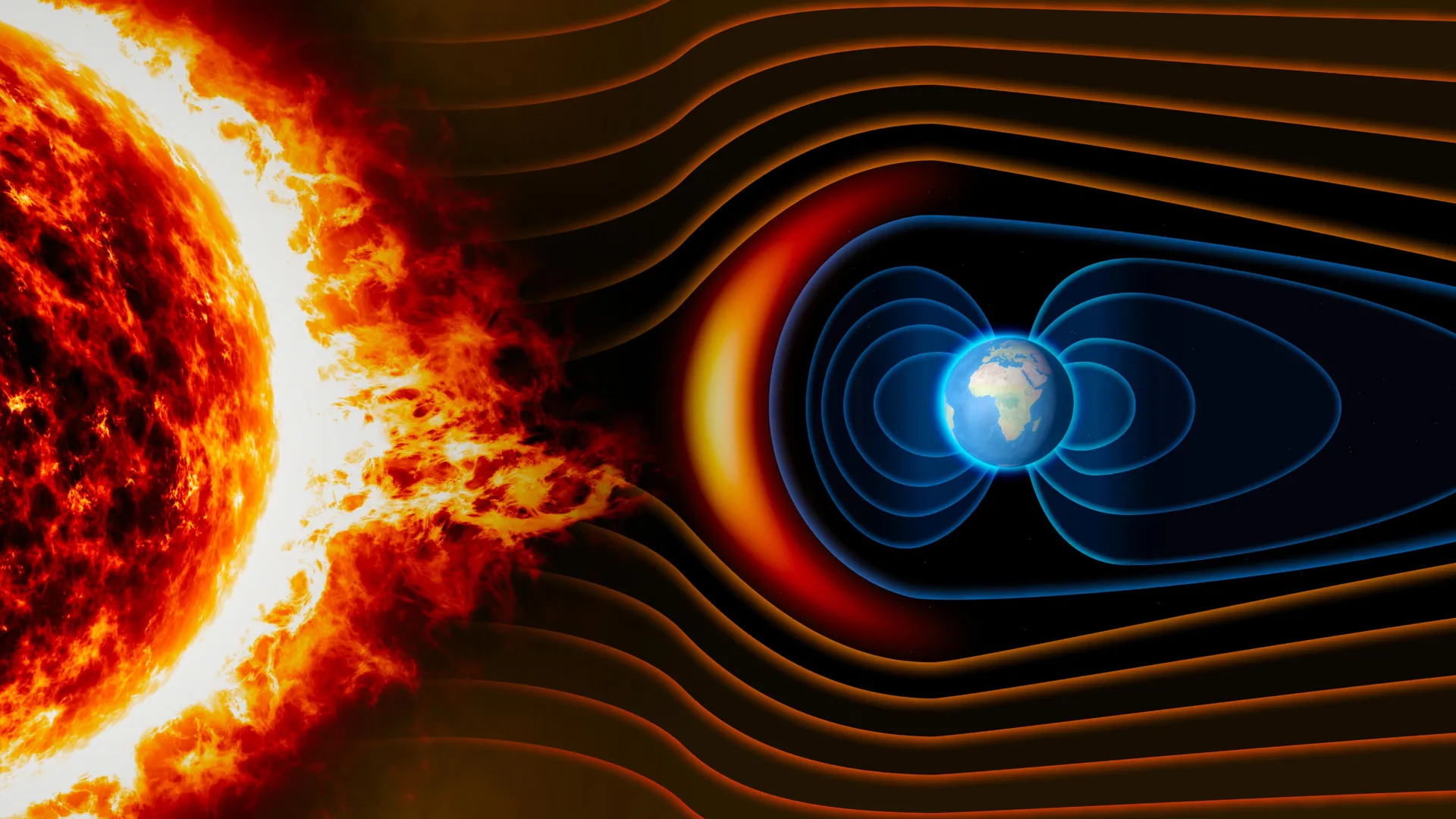
Innovative study uses analysis of volcanic rocks in Morocco and new statistical models to reveal how the Earth’s magnetic field was organized during the mysterious Ediacaran period, enabling the unique mapping of continents and prehistoric oceans.
A new study led by Yale University has solved a geological mystery regarding the abrupt and seemingly chaotic fluctuations of the Earth’s magnetic field during the Ediacaran period. The research, published in the journal Science Advances, suggests that instead of random fluctuations, the planet’s magnetism followed an organized global structure and a deeper pattern.
This revelation allows scientists to use data from ancient rocks to accurately reconstruct the arrangement of continents and oceans 600 million years ago. The finding clarifies why the Earth’s magnetic field behaved so distinctly from previous and subsequent eras.
Analysis of rocks in Morocco challenges tectonic plate theories
The investigation focused on the Anti-Atlas mountain range in Morocco, a location that preserves layers of volcanic rocks from the Ediacaran period, which lasted from 630 to 540 million years ago. Traditionally, the unusual magnetism of this time was attributed to the accelerated movement of tectonic plates or the shift of the planet’s rotation axis, known as “true polar wander.”
-
Astronomers identify the planets with the best real conditions to host extraterrestrial life in the universe and reveal the priority targets for the James Webb Telescope!

-
Student finds dragonfly wing from the dinosaur era that was hidden for 75 million years in a park in Canada!

-
The smallest bird of prey in the world is at risk of extinction and could disappear by 2050.
-
Researchers extracted DNA from a bone fragment of a Neanderthal found in the Denisova Cave in Russia.

However, by analyzing samples layer by layer with high-sensitivity instruments, the Yale team dismissed these hypotheses due to the rapidity of the events. The drastic changes in the Earth’s magnetic field occurred on timescales of thousands of years, not millions, which invalidates explanations based on slow tectonic movements.
The high-resolution stratigraphic data collection allowed for determining the exact speed of magnetic pole shifts. James Pierce, the study’s first author and a PhD student at Yale, explained that the innovative approach surpassed traditional analytical tools that assumed stable magnetic behavior in the past.
Collaborators from institutions in Switzerland, Germany, and Dartmouth College helped define precise timelines for the rock layers. With this data, the researchers were able to identify that the variability, previously dismissed as statistical noise, has a structured logic.
New statistical model to map ancient continents and oceans
From the discovery that the oscillations followed a pattern, the scientists developed a new statistical analysis method for paleomagnetic data. The model proposes that the magnetic poles may have shifted in a way that took them across the entire planet, rather than just oscillating around the rotation axis.
This technical advancement is considered key to producing robust maps of global geography during the Ediacaran. David Evans, a Yale professor and co-author of the study, stated that the new method finds structure in the variability of the Earth’s magnetic field, allowing for a consistent visualization of plate tectonics over billions of years.
The study fills a critical gap in geological history, as data from this specific period had been considered incomprehensible by the scientific community. The application of this statistical model offers a pathway to connect the oldest rock records with more recent periods of Earth’s history.
With this, researchers hope to overcome the obstacle that the Ediacaran period represented for mapping oceanic and continental movements. The new understanding of order within magnetic chaos provides a solid foundation for future visualizations of planetary evolution.
Implications for understanding the global structure of the planet
The discovery that the magnetic field followed a global organization, even in a state of extreme fluctuation, alters the perception of the Earth’s internal dynamics in the past. The model suggests that the magnetic poles crossed the globe in a structured manner, challenging the view that the system was simply out of control.
This new informative structure is vital for researchers dedicated to understanding how magnetism protected the planet during crucial phases of biological evolution. The Earth’s magnetic field thus proves to be an even more powerful tool for deciphering the environmental and geological history of the prehistoric world.
The research also highlights the importance of using sensitive technologies to detect subtle magnetic signals in well-preserved volcanic rocks. By combining precision geochronology and advanced statistics, the international team was able to transform a long-standing problem into a new frontier of knowledge.
The success of the project at Yale demonstrates that even the most confusing periods of Earth can be explained when new analytical methods are applied. Now, scientists have the necessary resources to see through the ancient “magnetic chaos” and reconstruct the past accurately.
With information from: ScienceDaily






Seja o primeiro a reagir!