





 Portuguese
  English
  Spanish
  5 min of reading
  0 comments


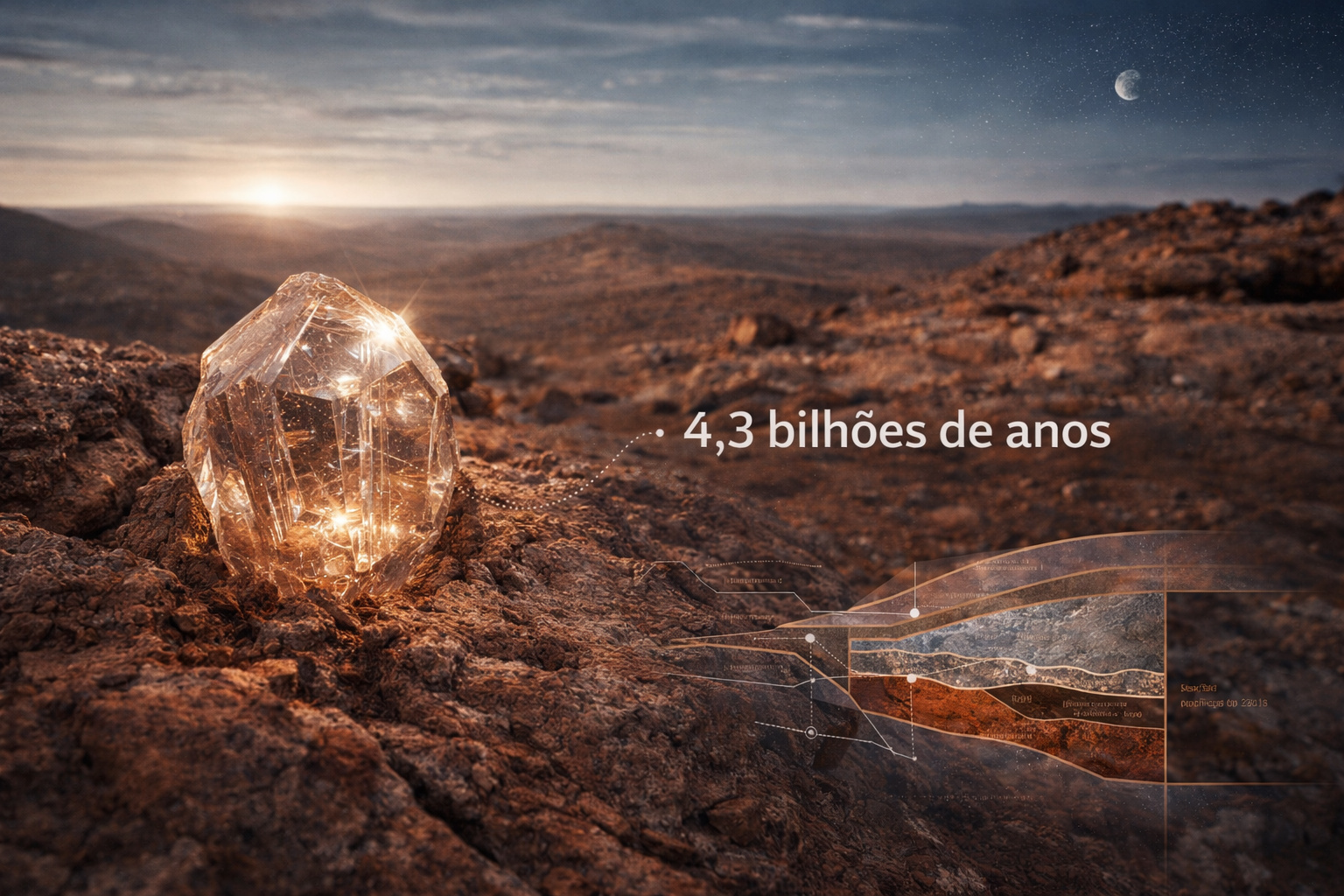
In A Remote Region Of Australia, Zircon Crystals Over 4.3 Billion Years Old Suggest That The Earth Formed Solid Crust Even Before The Moon Appeared.
Few people know that some of the oldest materials ever found on Earth are not fossils, meteorites, or lunar fragments, but rather small, shiny crystals formed when our planet was still a chaotic environment. These crystals, called zircons, have been identified in rock outcrops in the Jack Hills region of Western Australia and dated to be up to 4.3 billion years old. For comparison, the Earth is about 4.54 billion years old, which means these tiny grains formed when the planet was still in its first 300 million years of existence.
What makes these zircons so important for science is that they contain chemical clues about the planet’s primitive surface. Among the hypotheses raised is the idea that the earth’s crust solidified much earlier than previously thought and that liquid water could have already existed during this period, contradicting older models that depicted the Earth as a magma sphere for hundreds of millions of years after its formation.
Zircon, Dating, And The Challenge Of Observing The Geological Past
Zircons are silicate minerals containing zirconium and oxygen, with the formula ZrSiO₄. They are resistant to pressures, temperatures, and erosion processes that destroy other minerals. Therefore, they have a rare scientific advantage: they can survive for billions of years without completely losing their internal characteristics.
-
With a cost per shot close to zero, the DragonFire laser could change naval warfare in 2027 and provide British ships with nearly unlimited defense against drones.

-
A British startup creates tires that generate electricity in electric vehicles when passing over potholes, speed bumps, and cracks.

-
Scientists have created robots made with living cells that have their own nervous system, swim on their own, explore the environment, and self-organize without any genetic engineering, and now they want to do the same with human cells.

-
Students create a solar-powered ambulance that operates without a plug, without fuel, and still keeps medical equipment running in remote areas.


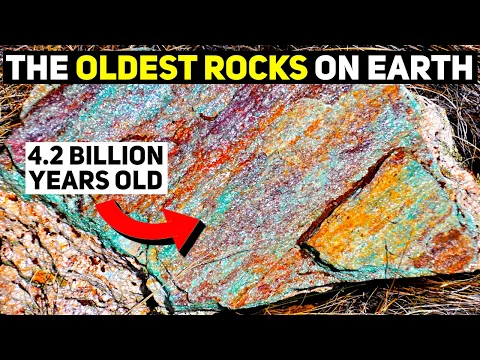

To date such ancient zircons, geochronologists use the uranium-lead (U-Pb) method. When the mineral crystallizes, it incorporates uranium into its structure but almost no lead. Over time, uranium decays to lead at a predictable rate. By measuring the ratios of isotopes, it is possible to estimate the crystallization age accurately.
At Jack Hills, analyses have shown ages ranging from 3.0 to 4.3 billion years, with the oldest belonging to the period known as Hadrian, a phase in Earth’s history from which practically no entire rocks remain, only fragments like these crystals. This is because the primitive crust has been recycled through tectonic and metamorphic processes over time.
Jack Hills zircons, therefore, are not just old; they are microscopic windows into the Hadrian, an era that exists almost solely in theory and geophysical models.
Early Solid Crust And The Hypothesis Of A Less Infernal Planet
For decades, textbooks portrayed the beginning of Earth as an almost apocalyptic scene: extremely high temperatures, constant asteroid impacts, and a global ocean of cooling magma. According to this view, it was only after hundreds of millions of years that the crust would solidify, and only then would oceans emerge.
The Jack Hills zircons have helped to challenge this narrative. In isotopic analyses, researchers observed that some crystals have oxygen compositions (δ¹⁸O) compatible with rocks formed in the presence of liquid water. This suggests that primitive continents and hydrological cycles could have existed as early as 4.3 to 4.0 billion years ago, much earlier than expected.
There is no absolute consensus, but the hypothesis has gained traction because the data suggest that the planet could have been sufficiently cool to form a crust and maintain water in a liquid state. This interpretation impacts debates about the origin of oceans, atmospheric evolution, and conditions for microbial life.
And The Moon Enters The Story: Gigantic Impact And An Uncertain Chronology
The discovery of zircons also touches on another theme: the formation of the Moon. The currently most accepted hypothesis suggests that the Moon formed after a large impact between the Earth and a Mars-sized body called Theia. This impact would have vaporized part of the crust and created a debris disk that condensed to form the Moon.
Whether the Jack Hills zircons crystallized before or after this collision is part of an intense geological debate. Some models propose that the impact occurred about 4.47 billion years ago and that the planet went through an extremely hot period after the event. Other studies indicate that the crust could have reconstituted rapidly, allowing for zircon formation still in the early Archean.

Once again, there is no definitive consensus. However, zircons demonstrate that the thermal chronology of primitive Earth may need adjustment, and that the planet may have stabilized faster than previously thought.
The Role Of Water And The Limits Of Scientific Speculation
One of the most fascinating points of this story is the presence of liquid water during the period when the zircons formed. If this interpretation is correct, it alters hypotheses about:
- the origin of the oceans (whether they came from internal outgassing or impacts with comets),
- atmospheric evolution,
- the onset of plate tectonics,
- the potential for early microbial life.
It is worth reinforcing that some aspects are still controversial. For example, there are no whole rocks from that time—only microscopic fragments. Therefore, part of the conclusions depends on isotopes, minerals, and modeling. Geologists often work with different levels of uncertainty, and this is a hallmark case.
Even so, the existence of such ancient zircons, with chemical compositions suggesting advanced crustal processes, means that the planet may not have spent as much time in a completely melted state as previously thought.
Jack Hills Today: Remote Field, Microscopes, And A Planetary History
Jack Hills, despite being a well-known name in geology, is a remote location in Western Australia, with arid landscapes and few indications that it holds planetary secrets. Most research does not happen there, but in laboratories equipped with electron microscopes, spectrometers, and microanalysis techniques capable of observing growth zones within the crystals.
Each zircon may have internal layers, like a tree trunk, that record different geological events. Some layers may record a cooler environment, while others may record later metamorphism, allowing researchers to reconstruct parts of Earth’s history that no longer physically exist.
These techniques have transformed the Jack Hills zircons into geological archives, capable of preserving data that survived geological time, metamorphism, and crust recycling over billions of years.
What A Microscopic Crystal Teaches About The Planet
In the end, the story of zircons is not just about minerals but about how science can reconstruct the most distant past based on tiny fragments. These crystals remind us that Earth cannot always be explained solely by theoretical models; sometimes, material witnesses reappear where least expected.
The Jack Hills zircons raise a question as simple as it is profound: if the crust and water already existed so early, when did the geological history of Earth as a habitable planet actually begin?
The answer is still being built—layer by layer, atom by atom, crystal by crystal.








-

-

-

-

-

-

33 pessoas reagiram a isso.