





 Portuguese
  English
  Spanish
  4 min of reading
  1 comment


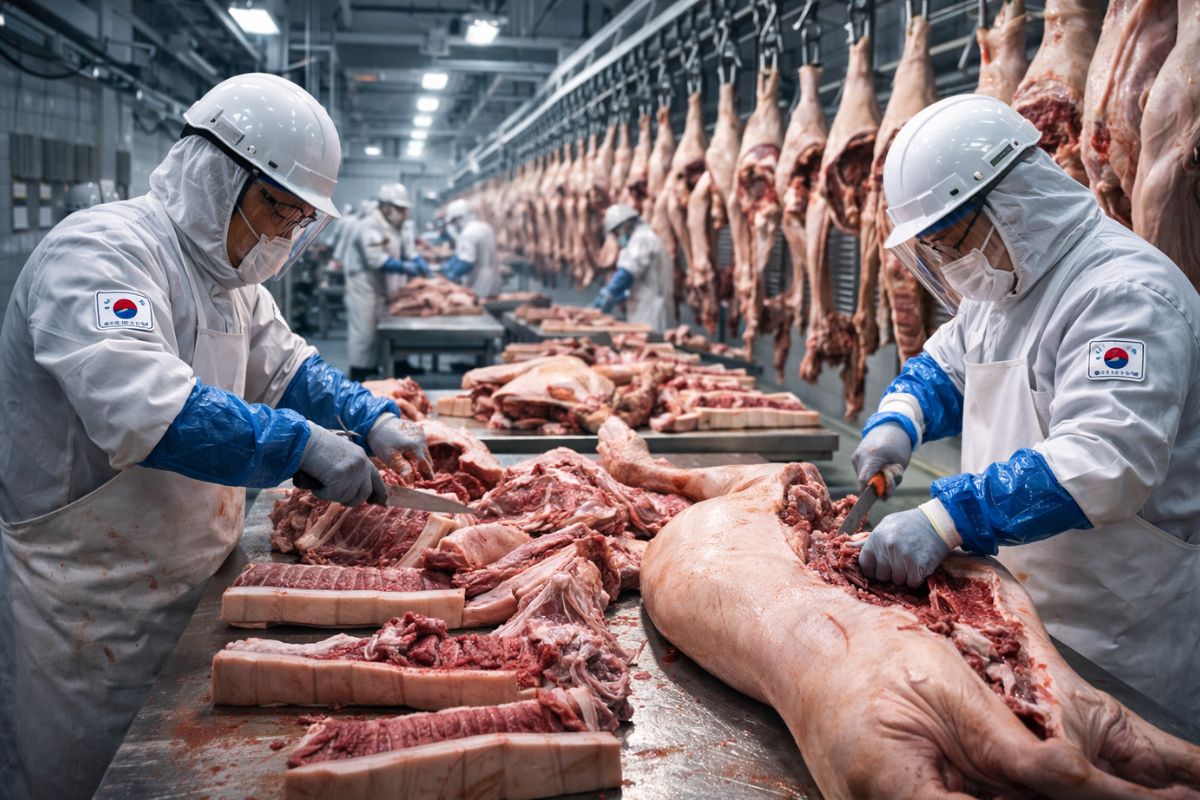


Korean Factory in Anseong Processes 2,000 Pigs Monthly and Generates US$ 40 Billion with Constant Industrial Rhythm: Cuts in Three Parts, Assembly Line Team, Skin and Fat Removal, Vacuum Packaging, Labels, Metal Detector and Double Check Before Sending for Daily Consumption without Noise
The Korean factory visited in Anseong, in Gyeonggi-do province, operates at a volume that alone explains the silence of the process: 2,000 pigs per month and annual sales of US$ 40 billion. What reaches the consumer as ready cuts goes through a sequence of disassembly, standardization, and packaging that reduces variation and speeds up the line.
In this flow, almost nothing is “artisanal” in the common sense: the strength lies in controlled repetition. Assembly line team, division by responsibility, fat and impurity adjustment, vacuum packaging, labels, and metal detector appear as layers of control so that the product is uniform, verifiable, and has internal tracking.
From Whole Pig to Efficient Cut in Three Parts

The first step is breaking the whole pig into pieces to make the operation viable at scale.
-
A woman went out for a regular walk and ended up finding a treasure buried for over 900 years, with more than 2,000 medieval silver coins compared by archaeologists to a lottery prize and considered one of the most significant finds in recent years in the country.
-
Scientists revealed 11 signs that very intelligent people exhibit in their daily lives, and most people have no idea that some of these common behaviors are directly linked to an above-average brain.

-
From space, Buenos Aires appears as a colossal spot of light surrounded by kilometers of darkness, revealing at a single glance the exact boundary between the metropolis and the countryside, seen from 400 km altitude.

-
NASA spent over 118 million reais to build a single bathroom that works in zero gravity, and it has just gone to space on the first crewed mission to the Moon in more than 50 years.

The division into three parts, front legs, body, and hind legs, creates clear paths inside the Korean factory: each segment goes to hands and workstations that are already ready for that type of cut.
This separation also reduces downtime.
Instead of one person trying to handle everything, the work is organized into successive steps, and pigs cease to be “a whole animal” to turn into operational blocks with a defined destination.
Assembly Line Team: Each Hand Does a Part and Passes It On

The central logic is that of a line: each person works on the part under their responsibility and passes the piece along.
The cut becomes an internal delivery, not an end in itself.
This applies to legs, body, hind ribs, and what turns into packaged pig feet sent separately.
In practice, the assembly line team limits improvisation. When one step ends, the piece moves on, and the next station takes over.
In this Korean factory, the rhythm does not depend on “one specialist solving everything,” but on many operators maintaining the same standard.
Loin, Belly, and the Removal of Skin, Fat, and Impurities
In the body, loin and belly enter, precisely the most recognizable parts for those who buy.
The removal of skin and the cutting of hind ribs appear as standardization decisions, so that each portion comes out with consistent size and finish.
After the large cuts, another worker continues the processing for fine cleaning.
The process continues by removing impurities and adjusting fat, even in the loin and belly.
Here, efficiency is repetition, and repetition requires fixed criteria on how much to trim and what to discard.
Vacuum Packaging and Labels: When the Cut Becomes Product
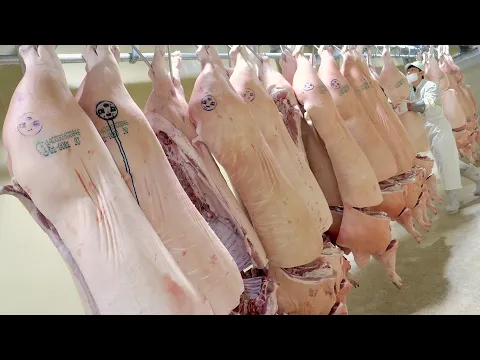

With the trimmed meat, the stage changes in nature: what was disassembly becomes the final presentation.
The meat goes into a bag and follows for vacuum packaging, a format that allows for standardizing volumes and reducing variation between units.
It is also the point where the consumer “sees” the result, even without realizing the path.
Next come the labels.
Labeling, weighing, and sealing is not just aesthetics; it is batch control, internal organization, and separation by purpose.
The Korean factory describes this segment as secondary processing, with detailed work by consumer need and by part of the animal.
Metal Detector and Double Check: Control After Sealing
After being sealed and labeled, the package goes through the metal detector.
The logic is simple: it only makes sense to inspect when the product is already in the final format, because it is the one that will be sent.
The inspection looks for abnormalities and interrupts the flow when something deviates from the standard.
And it doesn’t stop there.
There is a double check, with another verification for foreign objects before shipping.
The metal detector and double check function as two sequential barriers, especially relevant in a line that does not stop and deals with a high volume of pigs.
Why This Matters: Scale, Invisibility, and Consumption Habit
When a Korean factory processes 2,000 pigs per month, the routine becomes “invisible” to those who buy.
The consumer sees cuts, vacuum packaging, and labels; rarely do they see the assembly line team, skin removal, fat adjustment, metal detector, and double check as parts of the same system.
It is this sum that explains how a whole pig turns into multiple products without drawing attention.
The process is made to disappear, not to be remembered, and the disappearance depends on standardization: pigs entering, cuts coming out, packaging repeating, metal detector confirming, and the double check sustaining the shipment.
The silent promise of this Korean factory is not in spectacle, but in predictability: pigs disassembled in steps, trimmed meat, vacuum-sealed packaging, labels applied, metal detector activated, and double check before the truck leaves. The result is daily consumption that seems simple because the complexity is all along the line.
Would you buy meat knowing it passed through a metal detector and double check, or does that not change anything for you in your daily life? What weighs most in your trust: packaging, inspection, or the transparency of the process?






Um “moderno” e verdadeiro festival de horrores patrocinado pela gula selvagem e necrofagia repugnante humana. A tecnologia a serviço do homem das cavernas que é representado por cerca de 90% da humanidade desumana.