





 Portuguese
  English
  Spanish
  6 min of reading
  0 comments


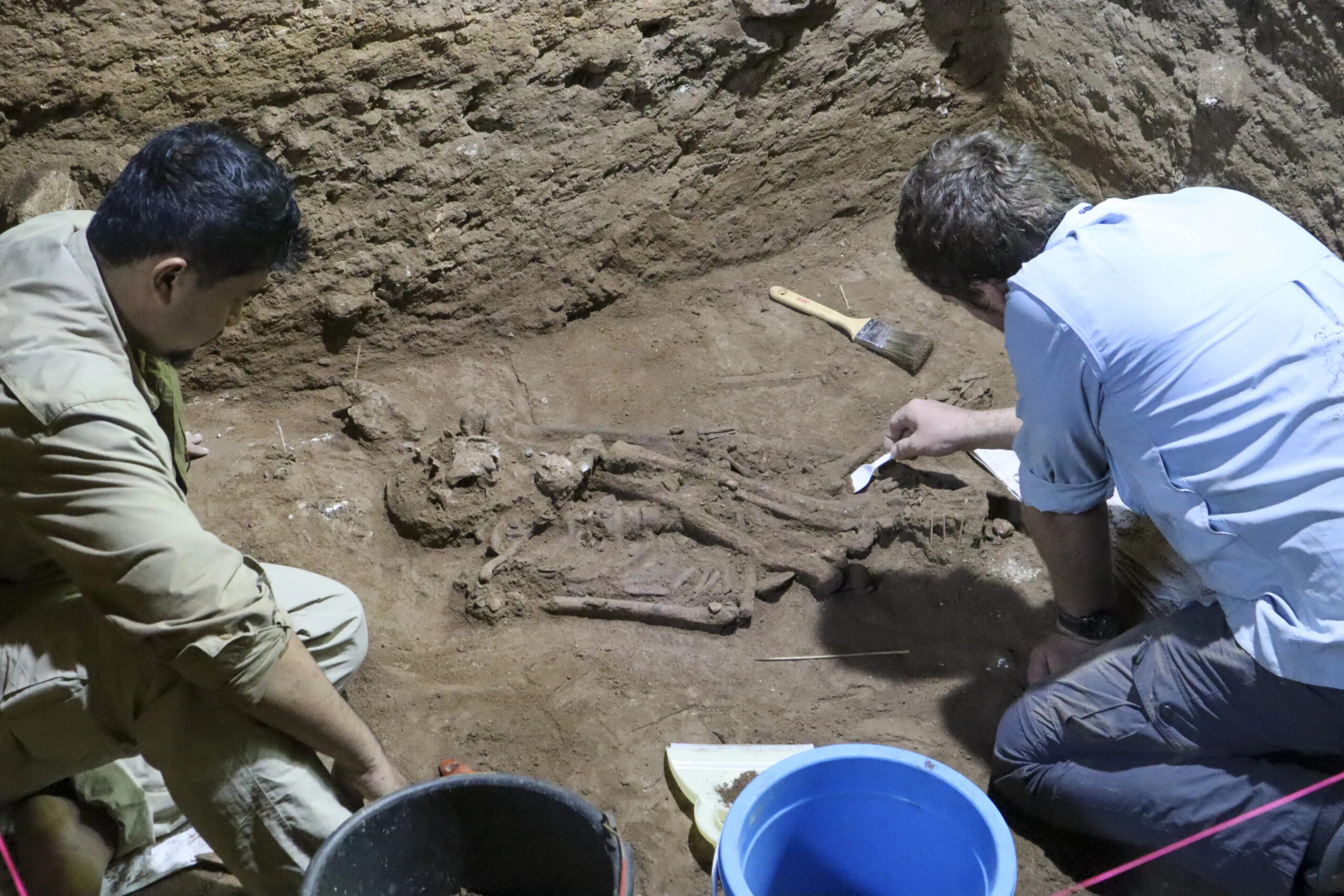
31,000-Year-Old Skeleton in Borneo Reveals Successful Surgical Amputation, Showing Humans Mastered Complex Medicine Long Before Previously Thought.
In 2022, an international team of researchers announced in the scientific journal Nature the discovery of a human skeleton found in the Liang Tebo cave in Borneo, Southeast Asia, with unequivocal evidence of a surgical amputation performed about 31,000 years ago. The finding significantly repositioned the timeline of prehistoric medicine by indicating that human groups of the period already mastered complex techniques much earlier than previously assumed.
The study was conducted by scientists from institutions such as Griffith University and involved detailed analyses of the skeleton, identified as a young individual who had the lower part of the left leg removed likely during childhood. According to the authors, signs of bone remodeling and healing indicate that the procedure was not the result of an accident or animal attack, but of a deliberate and technically precise intervention.
The most impressive aspect was not just the amputation itself, but the fact that the person survived for an additional 6 to 9 years after the procedure, something considered extraordinary for that period. This detail reinforces the interpretation that advanced knowledge of anatomy, hemorrhage control, and postoperative care existed in that region long before the so-called Neolithic revolution.
-
After 200 years, blue and yellow macaws return to Rio with the release of 4 birds in Tijuca Park.

-
The glaciers of the Himalayas are melting faster than any previous forecasts indicated, and scientists warn that changes in the monsoons could leave millions of people without drinking water, irrigation, and energy in India, Nepal, and Bangladesh.

-
Every day, before the sun rises, tractors go out to clear a road that the desert tries to swallow throughout the night, because in the United Arab Emirates there is a highway that cuts through the largest continuous sand sea on the planet, passing alongside dunes 300 meters high and melting the soles of any shoe that touches the asphalt in the summer.

-
In León, potholes become craters and burst tires and suspensions, but the city hall blames the drivers, saying that the road was marked and that at 30 km/h it was possible to swerve, and they only cover at most half of the repair costs.
Bone Evidence Shows Deliberate Amputation, Not Result of Trauma
The analysis of the bones revealed characteristics that completely rule out the hypothesis of an accident or animal attack.
The cut on the leg shows regular edges and the absence of irregular fractures, indicating a controlled removal of the limb. Furthermore, there are no signs of crushing or fragmentation that would be expected from natural trauma.

The researchers concluded that it was a deliberate amputation, performed with sufficient technique to preserve the patient’s life. This level of precision implies practical knowledge of where to cut and how to avoid fatal damage.
Survival for Years Proves Hemorrhage Control and Infection Management
One of the most striking points of the study is the evidence that the individual lived between 6 and 9 years after the amputation. This was possible due to the analysis of bone growth and healing observed at the site of the cut.
For this to occur, it would be necessary to control bleeding during the procedure and avoid severe infections in the postoperative period.
Without antibiotics, modern anesthesia, or a sterilized environment, prolonged survival suggests a level of medical knowledge far more advanced than previously thought. This fact alone would be enough to challenge the traditional view of prehistoric medicine.
Procedure Requires Anatomical Knowledge and Surgical Planning
The amputation was performed below the knee, in a region that allows for a greater chance of survival if executed correctly.
This type of choice does not seem random, but rather the result of observation and accumulated learning. Additionally, the absence of damage to adjacent bones indicates that the procedure was done with control.
This suggests that those responsible had a basic understanding of anatomy, blood circulation, and the consequences of the cut. Even without formal scientific language, there was a functional understanding of the human body.
Tools Were Probably Stone, But Used with Surprising Precision
During the period in which the individual lived, the available tools were made of chipped stone. Still, researchers believe that these tools were used with extreme precision.

The surface of the cut suggests scraping or progressive cutting rather than a sudden impact. The controlled execution with rudimentary instruments reinforces the idea that technique and knowledge can compensate for technological limitations. This aspect makes the discovery even more impressive.
Case Indicates Existence of Post-Operative Care and Community Support
The survival of the individual after the amputation also implies the existence of continuous care. After losing part of the leg at a young age, the person would have faced significant mobility challenges.
This suggests that the community provided support, whether through food, protection, or assistance. The discovery reveals not only technical skill but also social organization and collective care. This factor is essential to understanding how survival was possible.
The discovery site in Borneo has a humid tropical climate, with a high presence of bacteria and a high risk of infection. Such an environment makes any open wound potentially fatal.
Still, the individual survived for years after the surgery. This indicates that there was some form of infection control, whether through wound cleaning, the use of medicinal plants, or other unknown practices.
This detail further amplifies the impact of the discovery.
Discovery Predicts Complex Surgery Thousands of Years Ago
Before this finding, it was believed that complex surgical procedures emerged only with agricultural societies, around 10,000 years ago. The amputation in Borneo pushes this capability back to a much earlier period.
This means that hunter-gatherer humans were already capable of performing sophisticated medical interventions long before the development of complex civilizations. The shift in timeline is one of the most important points of the study.
There are other records of trepanation and ancient medical interventions, but few with this level of complexity and evidence of success. Amputation involves greater risks than cranial perforations, especially due to bleeding.
Moreover, prolonged survival makes the case even rarer. The combination of complex surgery, precise execution, and successful recovery places the finding in a unique position in the history of medicine.
Finding Suggests Accumulated Knowledge, Not Isolated Event
The researchers consider it unlikely that a surgery of this level was performed without prior experience.

This raises the hypothesis that similar practices were already known within that group. The procedure may have been the result of trial and error over generations.
This suggests that prehistoric medical knowledge may have been more widespread and structured than previously imagined. This point opens new lines of investigation.
The Discovery Redefines What “Primitive Medicine” Means
Traditionally, the term “primitive medicine” is associated with rudimentary and ineffective practices. However, the amputation in Borneo shows that some of these practices were highly effective.
The ability to save a life after such a risky surgery demonstrates a significant level of competence. This requires a profound revision of how prehistoric medicine is described and understood. The term “primitive” may not reflect the reality of this knowledge.
The discovery raises a central question: how many other advanced techniques may have existed before the emergence of the first cities and have yet to be identified?
The lack of written records makes it difficult to fully reconstruct this knowledge. However, evidence like this indicates that the human capacity to innovate in medicine is much older.
Each new finding suggests that the history of medicine may be underestimating the actual level of sophistication of ancient societies.
In light of this, an inevitable reflection arises: how many practices considered modern today were already partially mastered tens of thousands of years ago but have been lost over time?







Seja o primeiro a reagir!