





 Portuguese
  English
  Spanish
  4 min of reading
  0 comments


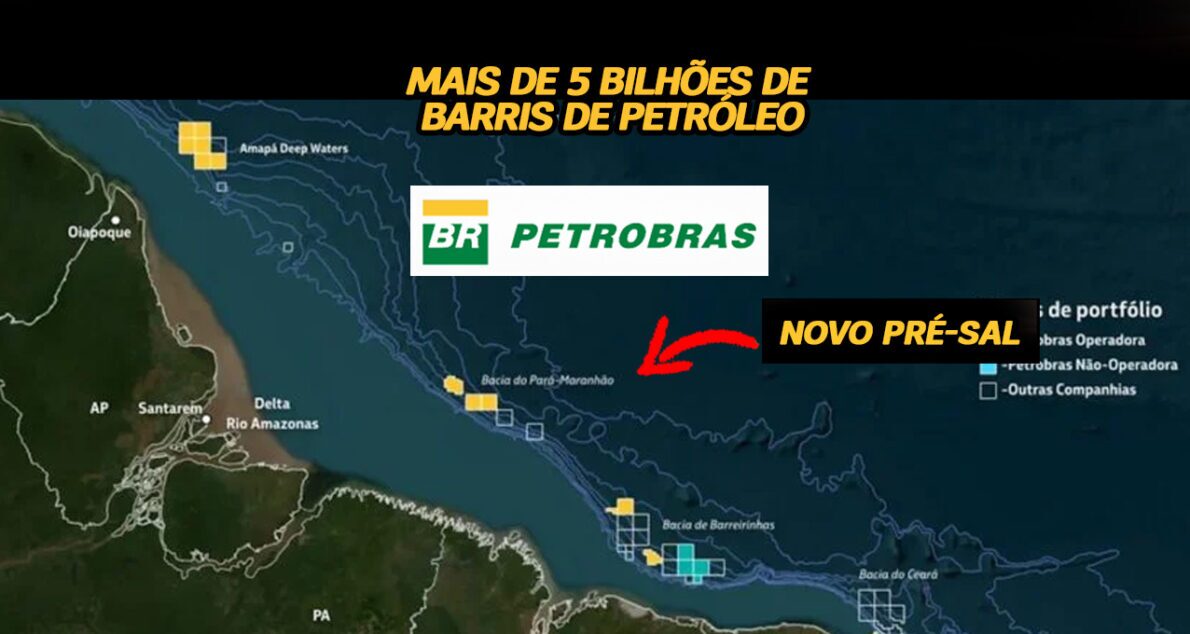
The Equatorial Margin Is the New Promise of Oil Growth in Brazil, With Potential to Rival the Pre-Salt and Bring Billions to the Country.
It seems that a new era is about to arise in Brazil’s oil and gas sector, one that could even surpass the powerful pre-salt.
With expectations of generating 350 thousand jobs and investments exceeding R$ 280 billion, the exploration of the Equatorial Margin has the potential to transform the country’s economy.
However, what few know is that this transformation will come from a region still little explored.
-
Lula responds directly to Trump and says that Pix is from Brazil and will not change under pressure from anyone, after a report from the United States pointed out the Brazilian payment system as an American trade barrier.

-
Amazon has just announced a new fee on all deliveries, and your online purchases will become more expensive starting April 17, including for those buying from the United States here in Brazil.

-
He sold his share for R$ 4 thousand, saw the company become a giant worth R$ 19 trillion, and missed the opportunity of a lifetime.

-
Elon Musk’s Starship megafrocket puts $8 billion at risk, raises alarms in the market, and could affect technology, mining, and space internet startups in the coming years.


But what makes this new frontier so promising and at the same time challenging? The answer lies in an area that stretches from the coast of Amapá to Rio Grande do Norte: the Brazilian Equatorial Margin.
According to estimates, this region holds an impressive potential of up to 30 billion barrels of oil equivalent.
If this materializes, Brazil could witness a new boom in the oil sector, similar to the revolution that the pre-salt brought a few years ago.
No wonder, major companies in the sector, such as Petrobras, PRIO, Shell, and Brava Energia, are already eyeing the opportunities that this new territory may offer.
The Comparison with the Pre-Salt
Many comparisons have been made between the Equatorial Margin and the pre-salt, which elevated Brazil to a prominent position in the global oil market.
However, although expectations are high, there are significant challenges in this new frontier. The Equatorial Margin, still little explored, shares geological similarities with neighboring regions, such as Guyana and Suriname.
These countries have experienced meteoric economic growth following their oil discoveries, as in the case of Guyana, whose GDP grew an incredible 44.1% in 2023.
According to the National Agency of Petroleum (ANP), if everything goes as planned, the Equatorial Margin could add up to 1.1 million barrels per day to Brazil’s oil production by 2029, which would represent about one-third of current production.
This is a projection that makes oil companies dream big and promise large investments, but it also raises environmental concerns that need to be addressed.
Environmental and Economic Challenges
Despite its enormous potential, the Equatorial Margin is located in a sensitive environmental region.
The Amazon River Delta, for example, is known for its rich biodiversity, and any oil exploration must be conducted with extreme caution.
This became clear in 2023 when the Brazilian Institute of the Environment (Ibama) denied a drilling request from Petrobras, citing the need for more rigorous environmental assessments.
Minister Alexandre Silveira, however, highlighted that Petrobras is committed to sustainability standards and that the government seeks to create a balance between economic development and environmental protection.
The future scenario will depend on how this balance is achieved, especially considering the potential for economic growth that this exploration may bring.
The creation of jobs and the generation of tax revenues are two of the direct benefits that exploring the Equatorial Margin can provide to Brazil.
According to the Brazilian Institute of Oil and Gas (IBP), full exploitation of this area could generate around 350 thousand new direct and indirect jobs.
Moreover, the increase in royalty and tax revenues will allow states and municipalities to invest more in infrastructure and improvements for their populations.
Billion-Dollar Investments and the Oil Companies’ Strategy
Petrobras is already positioning itself as one of the main beneficiaries of the exploration in the Equatorial Margin.
The state-owned company allocated US$ 3.1 billion for this region between 2024 and 2028, demonstrating its commitment to developing this new frontier.
The company has already conducted over 700 drillings in the area, gaining experience in offshore operations that could be crucial for future success.
Other companies, such as Brava Energia and PRIO, are also eyeing the opportunities.
Brava, the result of a merger between Enauta and 3R Petroleum, has shown agility in acquiring undervalued assets and sees the Equatorial Margin as a chance to expand its portfolio.
This new offshore frontier could bring a leap in the proven reserves of these companies, boosting their results and solidifying Brazil as one of the world’s largest oil producers.
A Promising Yet Uncertain Future
Although the economic potential of the Equatorial Margin is undeniable, the coming years will be crucial to determine whether the region can truly rival the pre-salt.
The government is working to balance economic interests and environmental demands, while the oil companies adjust their strategies to maximize their gains and mitigate risks.
Beyond the economic aspect, there is also the debate about the role that the Equatorial Margin will play in Brazil’s energy transition.
The country, known for its relatively clean energy matrix, could use the profits from oil exploration to invest in renewable energies, such as solar and wind.
In this way, the Equatorial Margin could not only ensure Brazil’s energy sovereignty but also support the development of more sustainable energy sources.
With so many challenges and opportunities ahead, the question remains: Will the Equatorial Margin be able to deliver everything it promises and become a new revolution for Brazil, just like the pre-salt?






Seja o primeiro a reagir!