





 Portuguese
  English
  Spanish
  4 min of reading
  0 comments


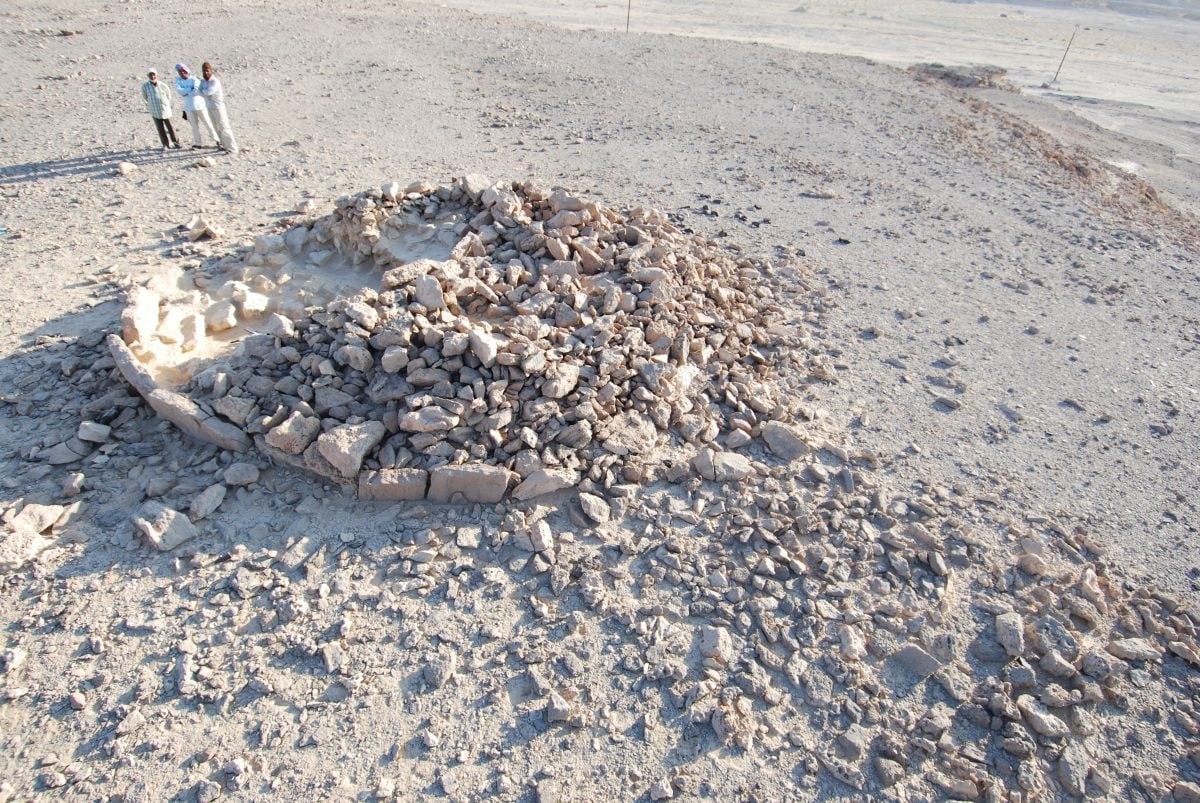
Researchers Reveal How 7,000-Year-Old Monuments in Southern Arabia Helped Herders Maintain Social Ties Amid Desertification.
In southern Arabia, new research has revealed surprising details about how ancient herders adapted their monument-building practices over thousands of years.
Based on a study published in the journal PLOS One, archaeologists analyzed 371 stone monuments in the Dhofar region of Oman, discovering how these structures reflected human resilience in the face of environmental and social changes.
Adaptation to Climate Change
7,000 years ago, southern Arabia was very different from today. During the Holocene Wet Period, the region received more rainfall and could support large groups of people and their herds. The earliest monuments date back to 7,500 to 6,200 years ago. At that time, conditions allowed for large gatherings, and the monuments were built in a single episode by numerous groups.
-
At the bottom of the sea, scientists have found a true underwater cathedral measuring 62 meters at the base, 31 meters at the top, and 1,347 square meters of giant coral in the Maug Islands, estimated to be 2,050 years old.

-
Surrounded by the sea, the airport will have a system to prevent airplanes from falling into the water; technology will be installed in Ilhéus (BA), with an investment of R$ 70 million.

-
With a cost per shot close to zero, the DragonFire laser could change naval warfare in 2027 and provide British ships with nearly unlimited defense against drones.

-
A British startup creates tires that generate electricity in electric vehicles when passing over potholes, speed bumps, and cracks.


However, as the climate became increasingly arid, the region transformed into a desert. The large human groupings dispersed, and monuments began to be constructed by small groups in multiple phases, often over the course of years.
Flexible Technology and Social Resilience
According to the lead author of the study, Joy McCorriston, an anthropology professor at Ohio State University, the monuments demonstrate the technological flexibility of these desert herders. Even in the face of climate changes, the role of the monuments as symbols of social identity remained constant.
“These monuments are landmarks of human social belonging,” McCorriston stated. “As these groups became smaller and more dispersed across the desert, people’s interactions with the monuments reinforced a sense of being part of a larger society.”
A Broad View of Thousands of Years
Unlike previous research that only analyzed specific periods or locations, the new study presented a holistic view, connecting changes in the monuments to transformations in people’s lives over millennia.
The model developed by the researchers can even be adapted to study social resilience in other regions, such as the Sahara, Mongolia, or the high Andes.
The Weight of Stones Tells the Story
One of the central aspects of the study was the analysis of the volume and size of the stones used in construction. In the earliest Neolithic monuments, the platforms contained large stones, requiring significant collective labor. According to McCorriston, at least seven strong men would be needed to raise these stones. Since these monuments were erected in a single event, they could only be built at a time when large groups could gather.
Additionally, these large monuments served as meeting places. During these gatherings, communities could bring together their herds, conduct animal sacrifices, and hold festivities, strengthening social and cultural ties.
Transformation to Smaller Groups
With the ongoing desertification, large gatherings became unfeasible. Groups began to move constantly in search of water and pasture for their animals. Even so, the tradition of building monuments continued, adapting to the new reality.
In this phase, the monuments became smaller, using stones of more modest dimensions. They were still constructed in a single episode, primarily for burials, but on a reduced scale, reflecting the decrease in available working groups.
Accretive Trilithons Gain Space
As aridity worsened, accretive monuments became more common. Unlike the single constructions of the past, these structures were built gradually, in multiple stages over many years. An example of this type is the accretive trilithons, characterized by smaller stone volumes and fewer large stones.
These constructions allowed herders to continue to strengthen their social ties, even with the limitations imposed by the environment. Each new visit to the monument represented an opportunity to add a new layer to the structure, keeping the connection to the community alive.
Monuments as Social Records
According to McCorriston, these monuments functioned as memory points. “They come to a monument and add their part, which is a replicated element of the whole. This helped people maintain a community, even with those they rarely see,” she explained.
Although it is not possible to determine exactly what messages were conveyed by these monuments, it is clear that they carried meanings understood by people sharing the same cultural context. Furthermore, some of these structures may have served as indicators of important environmental information that would be useful to other groups in the future.
Environmental Information and Social Networks
The monuments may have signaled crucial local conditions. “People would need to know if it rained here last year, if the goats ate all the grass, if the herders used this technology to help absorb the risk of being in an inherently variable and risky environment,” McCorriston said.
Moreover, these communities depended on their social networks to exchange valuable resources. The exchanges involved not only livestock but also marriage partners and rare materials, such as shells, carnelian, agate, and metal.
The work highlights how monuments played an essential role in preserving social connections in a constantly changing world. “Our model highlights the dependence on monuments to preserve connections and socially adapt to a transforming world,” concluded McCorriston.







Seja o primeiro a reagir!