





 Portuguese
  English
  Spanish
  5 min of reading
  67 comments


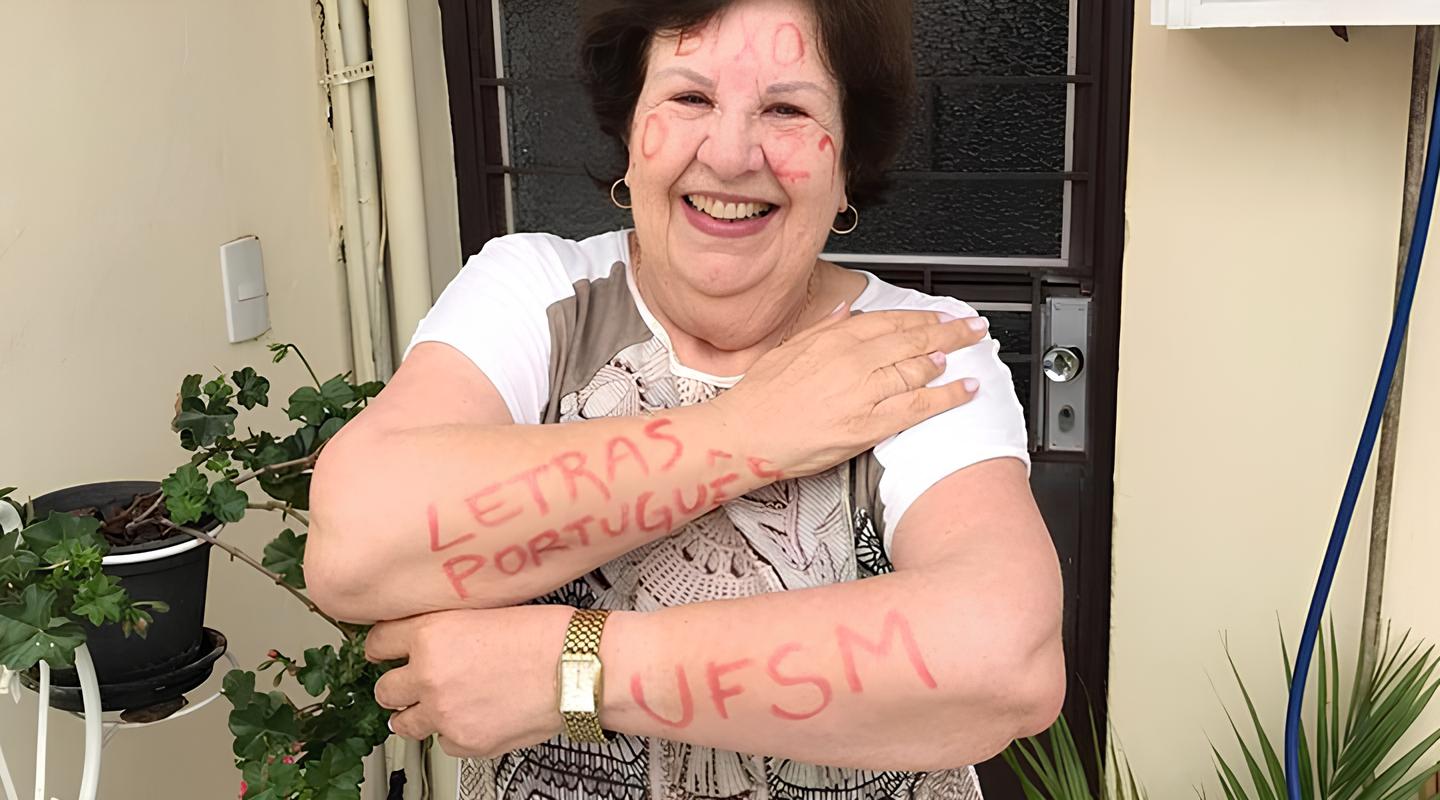


At 72 Years Old, Elderly Woman Approved in 2nd Place at Federal University After Completing High School at 66 Shows That It’s Never Too Late to Start Over and Transform One’s Story.
In April 2024, a news story released by CNN Brasil caught attention across the country and spread rapidly on social media. The journey of Edicléia de Arruda Zanini, now 72 years old, became a symbol of late overcoming by revealing that, after completing high school at just 66 years old, she not only returned to study but also achieved a rare feat even among youth: she was approved in 2nd place for a spot at a federal university.
The achievement became one of the most inspiring stories ever recorded by the recent press, precisely because it breaks one of the greatest myths of Brazilian education, that there is a “right age” to study, compete, or succeed in a high-level selection process. The approval was not by chance; it was the result of years of silent dedication, intense reading routines, and an unwavering desire to regain a dream that had been abandoned in youth. CNN highlighted that Edicléia lived her entire life with the feeling of having left something behind. Children, work, family responsibilities, and daily obligations always came before formal education. Only at 66 did she decide that she would not accept finishing life with that personal debt. The result, six years later, shows that the decision completely changed her fate.
The Turning Point at 66 Years: From Late High School to Academic Rebirth
Edicléia’s story is not linear. On the contrary, it is marked by gaps, interruptions, and long periods during which the idea of completing her studies seemed impossible. The decision to resume high school at 66 years represented much more than a return to school; it was a reconciliation with her own history. For the first time, she began to occupy a space she believed no longer belonged to her.
-
Meta’s new smart glasses are not just for seeing; they use artificial intelligence, analyze your food, summarize messages, and can even change the way you work in professions like engineering.

-
According to an analysis by NASA, only one human-made structure is visible from space, and it is not the Great Wall of China or the Pyramids of Egypt.

-
After 377 years of history, the Brazilian Army will have its first female general: Colonel Claudia Cacho has been promoted to brigadier general by Lula and will receive the sword and command baton this Wednesday in Brasília.

-
A Mercado Livre customer opened their package and found 32 resumes of people looking for jobs crumpled as protective paper inside the box, exposing names, addresses, documents, and phone numbers of dozens of candidates.


Completing high school in the Youth and Adult Education (EJA) program required discipline and emotional resilience. The routine included long journeys to school, subjects she hadn’t seen in decades, and the need to rebuild her foundational skills in reading, writing, and interpretation. The effort bore fruit: upon finishing the course, she rediscovered her passion for learning and realized that, contrary to her expectations, she possessed great academic potential.
According to reports from CNN, it was during this stage that teachers and classmates began to encourage her to attempt an entrance exam. At the time, Edicléia thought it was impossible to compete with young candidates who were familiar with technology and had continuous schooling. But, as the report describes, “the desire to start over spoke louder,” and she decided to face one of the greatest challenges of her life.
The Intense and Silent Preparation That Led to the Result
The preparation process for the entrance exam was long, solitary, and required a level of organization that surprised even experienced educators. At 70, while many are stepping back from tasks that require intellectual effort, Edicléia set up her own study routine.
She reviewed online classes, reworked interpretation exercises, and delved into topics she hadn’t studied since adolescence.

According to CNN, she studied at home using free materials, educational videos, and content offered by community courses. Her determination was such that even when she faced the natural difficulties of age — fatigued vision, slower reading pace, and fatigue, she persisted. Instead of competing with young candidates, she decided to compete only with herself.
The turning point occurred when she took the entrance exam and saw that she had not only been approved within the number of available slots but had also achieved 2nd place, surpassing hundreds of younger competitors. The final result was confirmed by the Federal University and became a milestone for the institution, which rarely records such high approvals among candidates over 70 years old.
The Emotional and Social Impact of the Approval
The consolidation of the university spot not only changed Edicléia’s life. It became a point of reflection for teachers, educators, and students throughout Brazil. CNN highlighted that the repercussions of her story sparked debates about active aging, academic inclusion, and the underestimation of elderly people in the educational environment.
The case highlights that barriers stronger than age are fear, lack of encouragement, and the mistaken idea that education has an expiration date. Edicléia proved just the opposite. In interviews, she shared that the approval brought her not just personal pride but also the feeling that she was finally living a dream that had been interrupted for social, economic, and cultural reasons.

Education specialists consulted by the channel stated that elderly people tend to exhibit focus, consistency, and maturity above average, three essential characteristics for good performance in high-complexity exams.
This explains why stories like Edicléia’s, although rare, have the potential to inspire tens of thousands of Brazilians who never believed it was possible to return to their studies.
The Representativity and What This Story Signals for the Future
Edicléia’s approval occurs at a time when Brazil discusses population aging and needs to rethink public policies to integrate people over 60 into educational and productive activities. Her journey reinforces the idea that learning is an act that does not expire with age. On the contrary, it can become even more significant in maturity.
Her presence in a federal university at 72 years old shows that higher education institutions need to be prepared to welcome older students, with different paces, robust life experiences, and a great capacity to enrich academic coexistence. Edicléia is not just a student; she is a symbol of transformation.
Final Reflection to the Reader
Edicléia de Arruda Zanini’s journey proves that deferred dreams can be resumed when courage and discipline meet.
She overcame educational gaps, emotional barriers, and social prejudices to achieve one of the country’s most difficult accomplishments: a spot at a federal university. Her story shows that education does not belong only to the young, but to all who still believe they can write new chapters for themselves.
And you, reader: do you believe that stories like Edicléia’s should encourage policies to support elderly individuals who wish to enter university or complete delayed educational stages?









Maravilhosa notícia ,nada se torna impossível quando existe uma pessoa determinada.sucesso sempre a essa merecedora maravilhosa isso é mérito.parabens pela conquista.😘😘
Eu tenho 66 anos e estou indo para o 5° período na Universidade Federal de Alfenas, em pedagogia, tenho enfrentado algumas barreiras mas sigo firme!
Falou-se muito, mas não informaram o curso em que ela passou!