





 Portuguese
  English
  Spanish
  5 min of reading
  3 comments


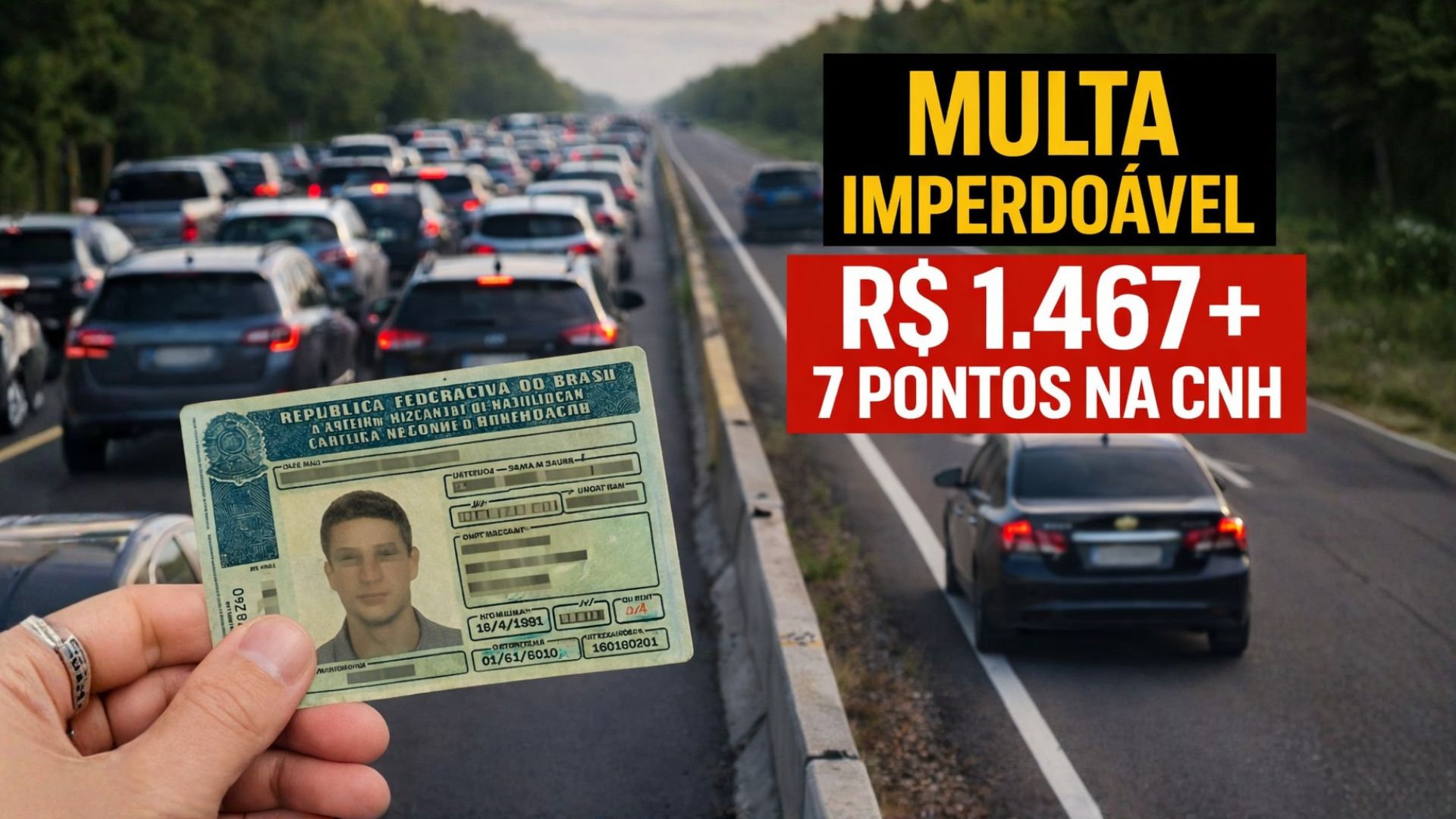


Daily Practice in Traffic Jams, Misuse of the Shoulder Can Lead to High Fines, Loss of Points on the Driving License and Intensified Monitoring with the Support of Technology, Especially in Periods of Heavy Traffic on Brazilian Highways.
During periods of heavy traffic on Brazilian highways, especially during holidays and long weekends, a recurring violation draws the attention of traffic authorities: the misuse of the shoulder to try to get ahead in traffic jams.
This conduct is classified as severe by the Brazilian Traffic Code (CTB), generates 7 points on the National Driver’s License (CNH) and can result in a fine ranging from R$ 880.41 to R$ 1,467.35, depending on the classification applied by the traffic officer.
In addition to administrative penalties, regulatory bodies warn that irregular circulation on the shoulder is associated with an increased risk of accidents and can compromise emergency assistance.
-
The institute that trained the greatest aerospace engineers in Brazil has just opened its first campus outside São Paulo after 75 years: ITA Ceará will have R$ 445 million, new courses in energy and systems, and classes are expected to start in 2027.

-
Luciano Hang, owner of Havan, goes to Juiz de Fora after the tragedy in February, brings R$ 1 million, hands out R$ 2,000 cards, and donates up to R$ 15,000 to victims in the region.

-
The Brazilian passport allows legal residence in dozens of countries without the need for a prior visa, and most Brazilians are unaware that they can apply for residency directly upon arriving in nations in South America, Africa, and even Europe.
-
Petrobras sends a message to Brazilian truck drivers after fuel collapse and reveals plan to have 100% domestic diesel.

For this reason, monitoring operations are often intensified during periods of higher flow, with support from the concessionaires responsible for the highways and the use of image monitoring systems at strategic points.
Difference Between Traveling and Overtaking on the Shoulder
The traffic legislation distinguishes between actions that, for many drivers, seem similar.
One of them is “traveling” on the shoulder, characterized when the vehicle moves along the side lane for a certain distance as if it were in a regular lane.
In this situation, the CTB stipulates a severe infraction, with a multiplying fine that reaches R$ 880.41, in addition to the application of 7 points on the CNH.

There is also a more severe classification for those who perform “overtaking on the shoulder.”
Article 202 of the CTB specifically addresses this maneuver and establishes a severe fine with a higher multiplying factor, raising the value to R$ 1,467.35, also accompanied by the loss of 7 points.
In practice, the distinction between one classification and another depends on the analysis of the traffic officer or the record made by monitoring equipment.
In both cases, the regulation makes it clear that the shoulder should not be used as an alternative to relieve traffic jams.
Function of the Shoulder and Risks to Road Safety
Designed as a safety area, the shoulder is primarily intended for emergency stops, the movement of rescue vehicles, and support for operations on the road.
Traffic safety specialists emphasize that the occupation of this space by moving vehicles reduces the safety margin and creates unexpected conflict situations.
According to technicians in the field, the risk increases because the shoulder can concentrate vehicles that are stationary due to mechanical failure, highway workers, and people outside their cars waiting for assistance.
Moreover, sudden entries and exits from this section tend to cause side collisions, especially on roads with slow and irregular traffic.
Even in prolonged traffic jams, the CTB maintains the function of the shoulder as a safety space.
The recurrent use of this lane for circulation, according to technical analyses, compromises the capacity of the road to absorb unforeseen situations.
When the Use of the Shoulder is Allowed by Law

The legislation provides specific exceptions for the use of the shoulder, which do not include delays, urgency, or attempts to reduce travel time.
Among the allowed cases are the movement of emergency vehicles, such as ambulances, police cars, and fire trucks.
There may also be temporary releases when the traffic authority signals the use due to construction, accidents, or special operations.
Additionally, in the absence of a designated space, bicycles and, in certain circumstances, pedestrians may use the shoulder as permitted by the CTB.
These exceptions, according to traffic authorities, reinforce the need to keep the side lane unobstructed, as it serves more vulnerable users and essential services.
Monitoring by the PRF and Use of Cameras on Highways
With the increase in vehicle volume on specific dates, monitoring tends to be directed toward critical sections and peak hours.
In an operation conducted on the Presidente Dutra Highway (BR-116), near Nova Iguaçu, in Rio de Janeiro, the Federal Highway Police reported having fined 95 drivers for various infractions in a single morning, including the irregular use of the shoulder.
Some of the vehicles stopped were removed for safety or documentation-related issues.
In other states, the PRF and highway concessionaires have already announced the use of monitoring cameras to identify vehicles that travel on the shoulder.
According to authorities, the images allow real-time monitoring of traffic flow and support fines when the infraction is established.
The use of visual records as a basis for fines is provided for in the legislation, as long as it is possible to identify the vehicle and the procedure follows legal criteria.
As a result, the likelihood of being fined does not depend solely on the physical presence of officers at the location.


Impacts Beyond the Fine and Points on the CNH
Although fines and points on the CNH are the most immediate effects of the infraction, mobility specialists point out that the misuse of the shoulder can have broader impacts on traffic.
In traffic jams, the occupation of the side lane hinders the response to incidents and can cause additional delays when vehicles need to stop due to breakdowns or emergencies.
There is also an effect observed by traffic behavior researchers: when some drivers use the shoulder, others tend to replicate the behavior, which undermines the lane’s function and increases conflict points.
The result is often an even more unstable flow, with vehicles abruptly switching between the lane and the shoulder.
On toll roads with constant monitoring, the identification of an offender may occur later, even if entering the shoulder was not immediately flagged.
Thus, any time gained becomes uncertain, while the penalty remains prescribed by law.
With increased monitoring and the growing use of technology on roads, the infraction continues to attract the attention of authorities.
In a scenario of heavy traffic, the discussion about road safety inevitably involves respect for the rules that organize the use of road space — but why does this practice continue among some drivers?







As leis precisam ser cumpridas com justiça nesse país. Caso contrário, pagamos com o bolso ou com a vida. Quem anda no acostamento, a grosso modo, está furando fila. Desrespeitando todos que são honesto e cumpre a lei . Acho que tem que multar e deixar o **** mofar enquanto todos passam.
A região em que moro, que vai de Unamar (distrito de Cabo Frio), passa por Barra de São João, até Rio das Ostras, o uso do acostamento é pouco, inclusive para avançar o sinal. Passam com velocidade, como se estivessem na faixa regulamentar, e não é só lotada não. Ônibus e veículos comuns também. Se ouvesse uma fiscalização séria, ou o tráfego ficaria mais seguro, ou o DETRAN ia ficar rico, pois são muitos motoristas fazendo isso, e nem precisa estar o trânsito congestionado…
Fui multado na BR101 pela PRF por, segundo o policial, trafegar pelo acostamento em um trânsito com retenção.
Eu me dirigia ao posto de gasolina e eu solicitei para a autoridade verificar o medidor de combustível de meu veículo. Ele iria verificar que eu estava na reserva.
Bom, na época, era a PRF do Silviney.
Será que agora eles estão agindo com mais bom senso?