





 Portuguese
  English
  Spanish
 5 min of reading
  7 comments


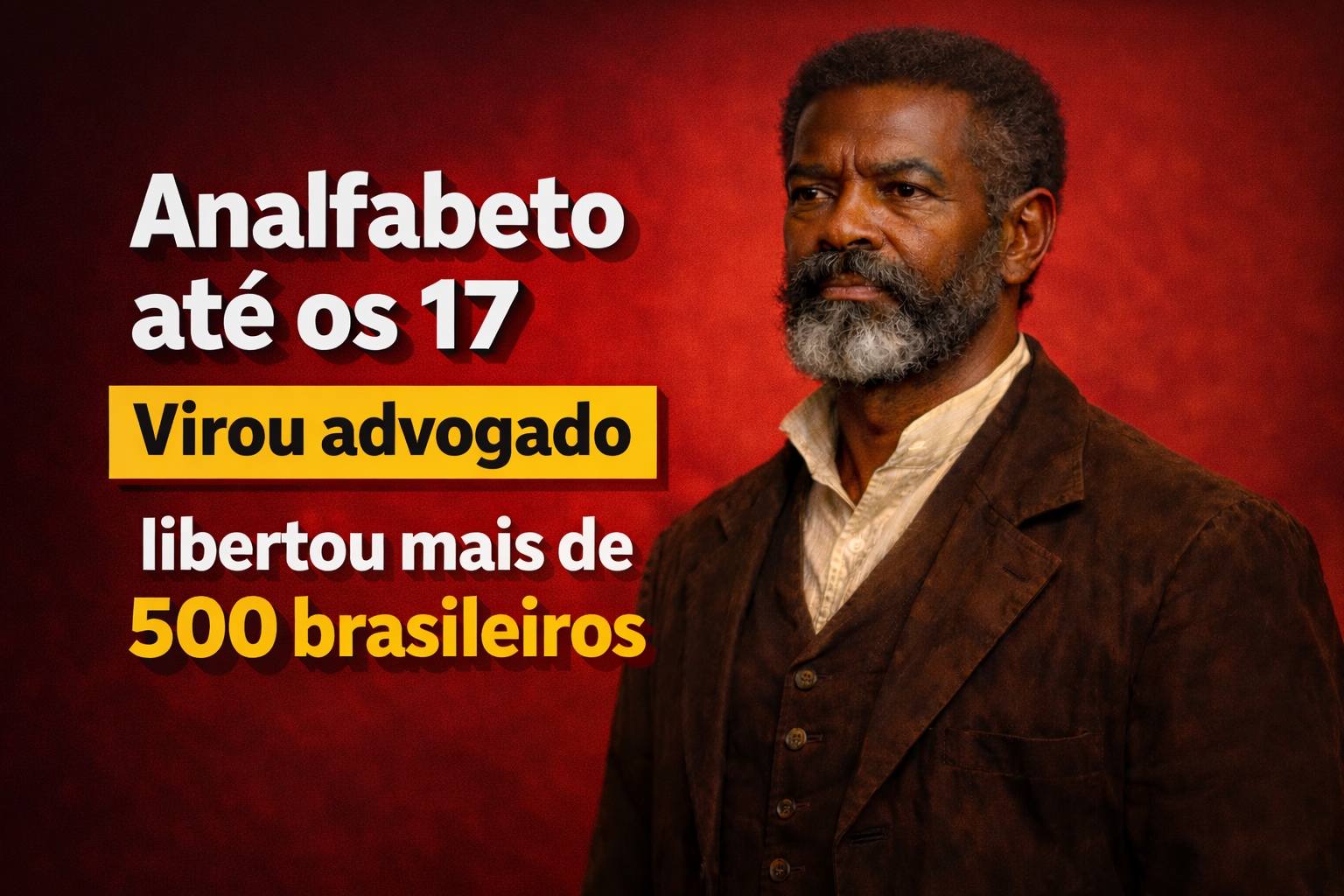


He Was Illiterate Until 17. Then, He Studied Law Even Though He Was Prevented From Attending University Due to Being Black, Became a Lawyer, and Freed Hundreds of Brazilians Based on the Law.
Imagine discovering that your life was “stolen” on paper — and that the very law could prove it. Now imagine taking that same system, full of traps, and turning it into a weapon to free real people, in court, with a judge present. That’s what Luiz Gama did. And he did it without a diploma, without an invitation, without open doors. He did it because he needed to and because he decided he would not accept the place that Brazil’s slaveholding society reserved for him.
From Bahia to São Paulo: A Boy Sold by His Own Father at 10 Years Old and a Country That Pretended Not to See
Luiz Gonzaga Pinto da Gama was born in Salvador, Bahia, on June 21, 1830. Later, still a child, he was sold as a slave by his own father and was taken to São Paulo.
Some institutions register his age as 9 years; others as 10. USP states that he was sold at 10 years old, and points out the reason given by his father: gambling debts.
-
Tourists on Everest were poisoned by guides who mixed substances in food to provoke false symptoms of altitude sickness while helicopter operators and hospitals charged inflated rescue fees to insurance companies.

-
Few people know this, but Neil Armstrong, one of the most famous NASA astronauts in history, survived the Korean War after jumping from the plane during his seventh combat mission aboard the USS Essex aircraft carrier of the United States.

-
Diving with a camera in Lake Furnas reveals a submerged city with an entire street, almost intact houses, a preserved bridge, a wood stove, a Kombi, and even a bus at the bottom of the largest lake in the Southeast.

-
Iceland accidentally drilled into a magma pocket at 2,100 meters and revealed that the extreme heat beneath the crust could pave the way for a new source of continuous energy.


“I Was Illiterate”: The Turning Point at 17 That Changed Everything
Until the age of 17, Luiz Gama was illiterate. When he finally learned to read and write, the turning point occurred.
The STF, while presenting a documentary series about him on TV Justiça, summarizes this point clearly: “literate at 17 years old, he studied law on his own and… freed more than 500 enslaved people.”
Reading opened the way for something even bigger: understanding that his own enslavement was illegal — and that it was possible to fight for freedom based on the legislation.
The Law Course They Tried to Deny and the Persistence That No One Could Hold Back
Luiz Gama attempted to attend the law course at Largo de São Francisco (now the Faculty of Law of USP). USP records that he was “prohibited from studying Law regularly” and that he was eventually accepted as a listener, continuing on his own.
Institutions linked to Luiz Gama’s memory record that he faced hostility and persisted as a listener in classes. In other words: they tried to block his official entry, but he pursued the content nonetheless.
In other words: he studied without the formal path, but he was not excluded from the legal debate.
He Learned Law on His Own and Became a “Rábula” in Practice, a Lawyer for the Brazilian People
Without a university diploma, Gama established himself as a rábula (practical lawyer), studying in libraries and using legal arguments with precision.
And he didn’t study “for hobby”. He studied to use the law as a real lever, in the real world, within the courtroom.
The Genius Strategy: Use the Law Against Slavery
Here lies the heart of the story. Luiz Gama based actions on laws that Brazil had, but often pretended not to comply with. For example:
- Law of November 7, 1831: it stated that “All enslaved people… coming from outside, are free.” This is in the official text of the time, available on the Planalto website.
This law is known for being ignored in practice for years, but Gama treated it as what it was: a direct legal argument. - Free Womb Law (1871): Law No. 2,040, from September 28, 1871, declared the children of enslaved women born from that date on to be free, also in the official text of the Planalto.
His logic was simple and powerful: if slavery was sustained by “paper,” then the law of paper could also dismantle slavery.
“More Than 500”: The Number That Is Not a Legend in Brazil
Many people repeat this figure and think it is an exaggeration. It is not. The STF explicitly records that Luiz Gama, as a lawyer, freed more than 500 enslaved people. This illustrates the impact: it was not just rhetoric but based on legal study. It was a result.
Newspaper, Poetry, Street, and Politics: He Did Not Fight Just in Court
Luiz Gama was also a journalist, writer, and poet. He attacked slavery in the press, based on the law, criticized the system, and advocated a vision of the country connected to the republic because, in practice, the monarchy coexisted with slavery as “normal.”
This public action helped shape opinion, pressure institutions, and give a face to a cause that many preferred to push aside.
Official Recognition by Law in Brazil: It Took Time, But Came With Strength
Throughout his life, he did not receive the institutional status he deserved. Today, the country recognizes (by law) the greatness of what he accomplished.
Patron of the Abolition
On January 16, 2018, Law No. 13,629/2018 declared Luiz Gama Patron of the Abolition of Slavery in Brazil.
National Hero (Book of Heroes and Heroines of the Fatherland)
On the same day, Law No. 13,628/2018 mandated the inscription of his name in the Book of Heroes of the Fatherland, in the Pantheon of the Fatherland, in Brasília.
Doctor Honoris Causa by USP
On June 29, 2021, the University Council of USP unanimously approved the posthumous title of Doctor Honoris Causa for Luiz Gama.
Why Talk About Him Now and Not Just in Black Consciousness Month


The story of Luiz Gama is a lesson about power and access: who writes, who interprets, and who applies the law.
He showed that Law can be a tool of oppression, yes. But it can become a tool of repair when someone masters the rules and laws and decides not to play to please the powerful.
And that is why he remains relevant in Brazil: because there are still many people being consumed by bureaucracies, inequalities, and closed doors, and there are still people who learn the rules to pave the way.
So, what impresses you the most in the story of Luiz Gama — the turning point from illiteracy at 17, the self-taught law education, or the courage to confront judges and elites to free people? Leave a comment below and, if this text helped you, share it with someone who needs to know this story.








É fundamental que se dê publicidade a história de Luiz gama para que o povo negro lute pela educação para abrir portas e libertar pessoas.
A coragem de encarar quem se acha grande demais pela cor, pela posição jurídica ou financeira. Seja por qualquer dos feitos, tenho certeza que ele será lembrado como esta sendo por séculos na história do Brasil, mas especialmente por Deus, porque grandes pessoas não merecerem reconhecimento humano apenas porque um dia também de desvanecem.
Parabéns pela matéria, excelente, morria e não conhecia essa história de um ser tão iluminado de Luiz Gama linndaa !!! Inclusive moro próximo a rua Luiz Gama a mais de 40 anos e não tinha conhecimento desta história extraordinária. Parabéns também que levantou está matéria.