Portuguese
  Spanish


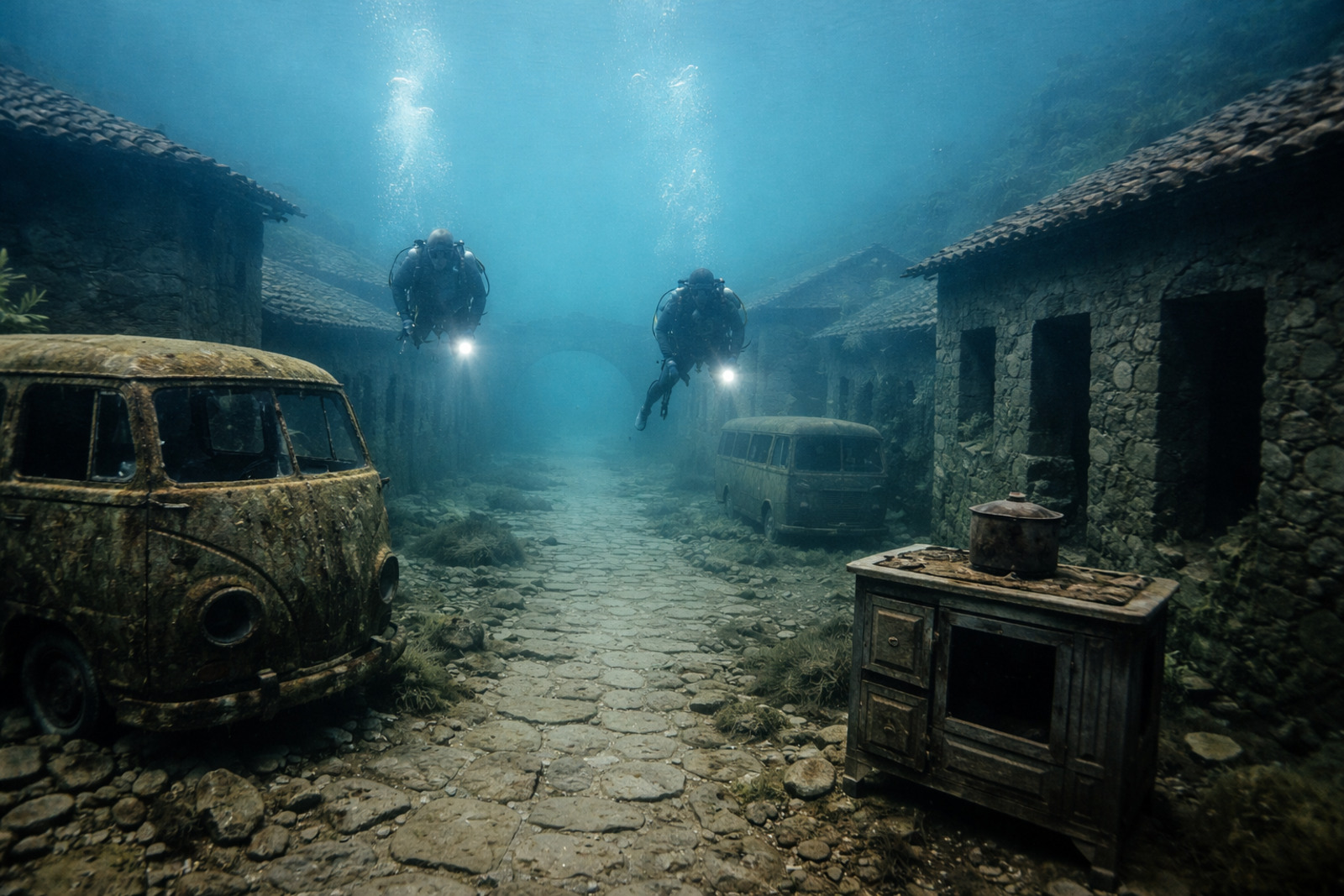

Divers reveal streets, houses, bridge, and preserved objects in Lake Furnas, while residents recall losses, rescues, and reconstruction after 1963
The ruins of Lake Furnas, in southern Minas, preserve streets, houses, a bridge, and objects since the flooding caused by the dam in 1963, while divers document heritage and residents recall reconstruction.
Ruins at the bottom of the lake
The waters of Lake Furnas hide tourist landscapes. At dozens of meters deep, partially submerged towns remain preserved since the formation of the dam.
Diving instructor Roberto Obvioslo began this search about ten years ago. His connection to the lake came from childhood, when he accompanied his father in the construction of the power plant.
-
Simple Aluminum Foil Trick Can Easily Remove Excess Ice from Freezer and Simplify Cleaning

-
College Dropout Turned Window Cleaner Builds $1 Million Cleaning Business with Subscription Model After 18 Years of Door-to-Door Work

-
North Korean Soldier Risks Crossing One of the World’s Most Dangerous Borders, Detained in South Korea

-
Stingless Bee Honey from Brazil Can Cost Up to $120 a Liter, Surprises with Flavors of Wood, Citrus, and Even Cheese


The search for the old communities was guided by residents’ accounts. First, a corral still standing appeared. Then came isolated ruins. Next, an entire submerged street emerged.

Mapping and preservation
After locating the street, Roberto and the team began mapping the found points. The locations were marked, but not always explored immediately, allowing for detailed investigation.
With the advancement of exploration, wood stoves, floors, house structures, and practically intact buildings emerged.
According to Roberto, there are entire houses, with only part of the roof down, but still identifiable.
The work at Lake Furnas is focused on preservation. What is at the bottom remains there, and documentation is done with photography. The removal of objects is only considered for a possible museum.
Among the items already rescued is a chamber pot, undergoing conservation to prevent rust. The future proposal includes also displaying a tile, a brick, and a piece of wood from the old Barra.
Bridge, vehicles, and extreme dives in the submerged city
One of the most surprising discoveries was a preserved bridge. It was found by chance during the search for a car that had fallen into the lake.
In addition to urban ruins, the expeditions revealed a sunken schooner, a Kombi, a bus, and equipment lost over the years. The explorations require advanced technical preparation.
Dives reach depths of 80 meters and, under certain conditions, can reach almost 90 meters.
The shallowest areas are around 40 meters, and from 15 meters down, the light decreases rapidly.
Therefore, flashlights become necessary. Mandi, tilapia, peacock bass, and pike appear at higher levels but practically disappear in the deeper areas visited by divers.

Cemetery and memories of the flood
In a severe drought, the level of Lake Furnas dropped so much that an old cemetery emerged, with visible graves before the area was dismantled by the city hall.
The formation of the lake in 1963 left deep memories. Abrão Alves Andrade, 86, recalls that his father asked him to warn the neighbors that the water was coming, but many people did not believe it.
Father José Ronaldo Rocha, who lived in Guapé, was 12 years old when it all happened. He remembers that as the water rose, residents were taken from their homes and brought to the school group.
In rural areas, rescues were made with boats, rafts, and helicopters. José Ronaldo recalls the demolition of buildings before the complete flooding.
Losses, disbelief, and reconstruction
The economic impact was immediate. Fertile lands and entire crops were lost. José Ronaldo remembers that there was corn and rice, but the water came and covered everything.
He recounts that he improvised a raft from banana trees to fetch corn and make pamonha. The adventures were dangerous, and his mother scolded him because he would enter the water up to his chest to fish.
José Dalton Barbosa, 77, remembers the waterfall that disappeared under the waters in Guapé. At first, few believed that the flooding would happen and thought of Noah’s flood.
The disbelief began to fade when surveyors started measuring the lands and marking the flood levels.
Even so, many losses were inevitable, with roads surrounded by water and animals left behind.
José Dalton also reports that many rattlesnakes would be coiled on the surface, with their heads sticking out. Despite the chaotic period, he assesses that the region gained from tourism, more productive agriculture, and development.
For him, without the dam, the city would have remained stagnant. José Ronaldo states that the benefits came over time, but at the cost of a painful period. The population resisted to rebuild the city.