





 Portuguese
  English
  Spanish
  5 min of reading
  0 comments



Scientists Reveal That A Single Cloud Can Weigh More Than 1 Million Tons And Yet Floats Thanks To The Air Currents That Balance The Invisible Weight Of The Sky.
The sky, which is usually associated with lightness and freedom, harbors one of nature’s most surprising phenomena: clouds are incredibly heavy. According to calculations from NASA and the scientific magazine Science Focus, an average cumulus cloud—those fluffy and white ones that usually form on sunny days—can contain the equivalent of 1 million tons of water suspended in the air. Still, it floats serenely over cities and mountains, defying common sense and revealing one of the greatest curiosities of the Earth’s atmosphere.
This estimate, which impresses with its scale, was made based on physical and meteorological observations. Science proves that, although water vapor is invisible and less dense than air, the tiny droplets that make up a cloud have real mass—and when combined, create a colossal weight that only doesn’t crash down on us because it is distributed in billions of microscopic particles held up by rising air currents.
The Calculation That Even Surprised Meteorologists
To understand the weight of a cloud, one must first comprehend its structure. A typical cumulus cloud has about 1 cubic kilometer of volume (1 km high by 1 km wide and 1 km deep) and contains, on average, 0.5 grams of water per cubic meter of air.
-
Why did the sky turn blood red in the west of Australia and it wasn’t sunset? Discover what is behind the change that took over the horizon for miles.

-
The most feared warplane of the United States is over 70 years old, carries 32 tons of explosives, flies 14,000 kilometers nonstop, and has just been sent to the United Kingdom amid escalating tensions with Iran.

-
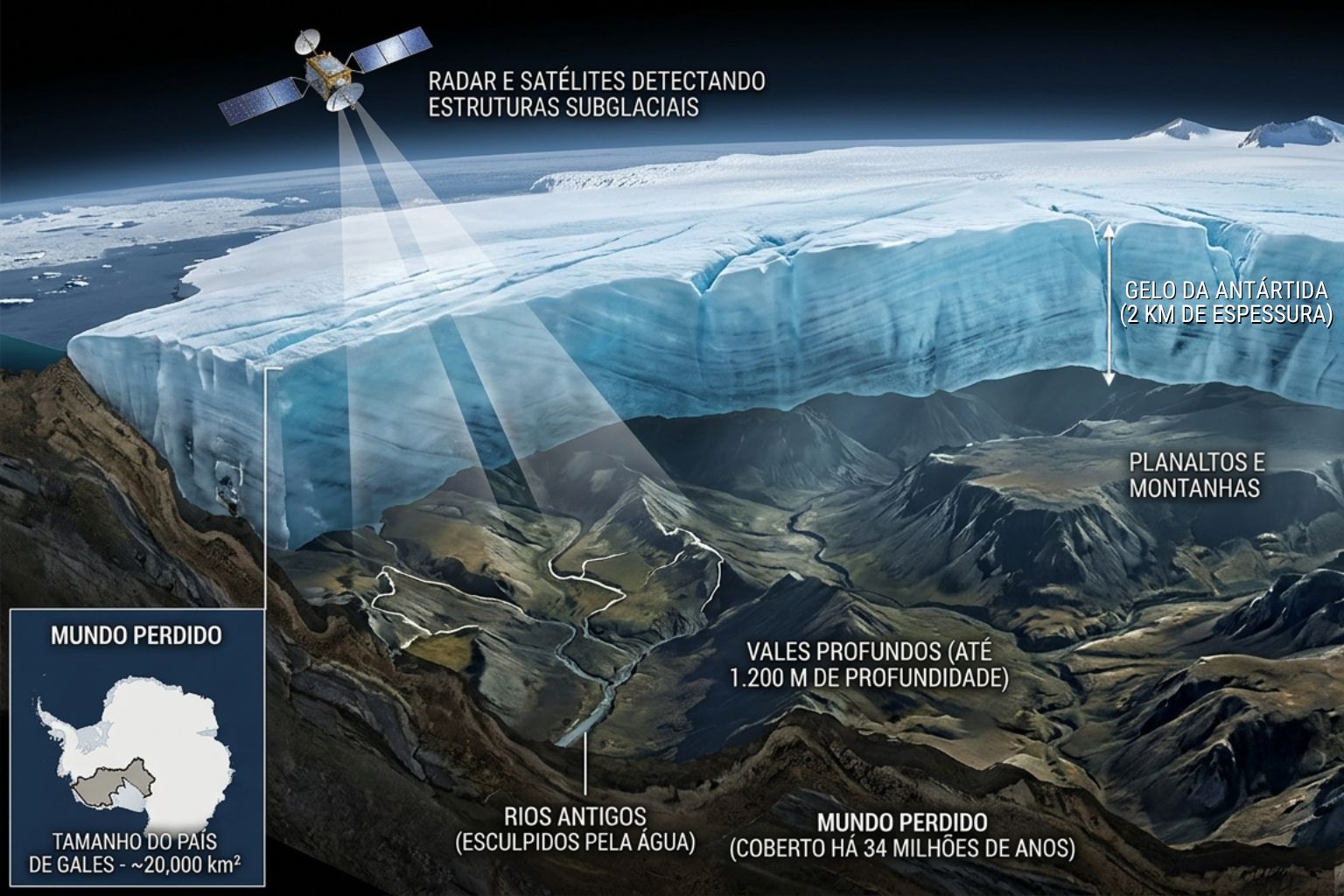
Satellites and radars revealed, beneath 2 kilometers of ice in Antarctica, a lost world the size of Wales, with rivers, valleys 1,200 meters deep, and plateaus sculpted by water, frozen for 34 million years, when the continent had temperate forests and was part of a supercontinent that included South America.
-
A 2 kg exoskeleton with an 800-watt motor and artificial intelligence that predicts movements in 2 milliseconds reduces the load on the legs by up to 30 kg, increases strength by 40%, and allowed an 84-year-old woman to climb mountains without falling behind.


This means that, within this gigantic volume, there are 500 million grams of water for every million cubic meters of air, which is equivalent to about 500 thousand kilograms of liquid water per billion cubic meters. Translating to total scale: something between 500 thousand and 1 million tons, depending on density and humidity.


Meteorologist Margaret LeMone from the National Center for Atmospheric Research (NCAR) was one of the first to make this calculation accessible. According to her, the average weight of a cumulus cloud is about 1.1 million pounds, which is the same as about 100 adult African elephants.
In contrast, larger and denser clouds, such as cumulonimbus clouds (responsible for storms and thunder), can weigh up to 10 million tons.
Why Don’t They Fall From The Sky?
The secret to tons of water remaining suspended in the air lies in the updrafts and air density. The water droplets that make up clouds are tiny, usually only 0.02 millimeters in diameter, and form around microscopic particles of dust, sea salt, or pollution, known as condensation nuclei.
These droplets are so small that air resistance is enough to keep them floating, especially since the updrafts within the atmosphere push the moist air upward, compensating for the weight of the water.
Thus, what we see as a dense white mass is, in fact, an immense collection of microdroplets in motion, constantly being formed and evaporated.

According to meteorologist Michael Reeder from Monash University (Australia), the air around clouds is not a passive space: “It is in constant motion, and it is these updrafts that support the droplets. The balance between gravity and air flow creates a stable structure, like an invisible ballet of atmospheric physics.”
Light As Air? Not Really
The contrast between the ethereal appearance and the real weight is one of the reasons why clouds have fascinated scientists for centuries. If an ordinary cloud were taken from the sky and had all its water condensed, it would be able to fill more than 400 Olympic-sized swimming pools. But, dispersed in billions of droplets, this dense mass behaves like an extremely light mist.
Physics explains: hot air rises and cold air descends, generating currents that keep the vapor suspended. When the water vapor cools, it condenses into small droplets, but because the atmosphere is dynamic, these particles keep floating until they grow large enough to fall as rain. Each raindrop, by the way, can contain thousands of those tiny droplets that were previously isolated within the cloud.
The Weight Of The Sky And Its Impact On Climate
The weight of a cloud is not just a scientific curiosity. It has direct implications for rain formation, storms, and global climate balance.
Overloaded clouds, that is, with too much condensation, become unstable, and when updrafts can no longer support them, precipitation occurs. This process is fundamental to the water cycle on Earth, which keeps rivers, lakes, and aquifers supplied.

According to the World Meteorological Organization (WMO), the planet holds about 1.3 billion trillion liters of water in the form of atmospheric vapor, which means there is an almost unimaginable amount of mass floating above us at all times. Without this delicate balance between weight, heat, and air movement, the climate system would collapse.
The Cloud As Symbol And As Science
In addition to its scientific role, clouds have always held symbolic fascination for civilizations. They have been seen as the dwelling of gods, messengers of rain, and metaphors for the ephemeral. Today, science understands that, far from being just “light vapor,” they are complex and dynamic structures, composed of billions of particles that form an invisible ecosystem above the Earth.
The study of clouds has become even more important with research on climate change. Scientists from the IPCC (Intergovernmental Panel on Climate Change) state that small variations in cloud density and altitude can significantly alter the planet’s thermal balance, influencing how much solar energy is reflected or retained in the atmosphere.
A Mountain That Floats
It is curious to think that, at this very moment, millions of tons of water are suspended in the air, forming an “invisible mountain” above our heads. Yet, it does not collapse, and when it does, it is in a controlled manner, giving rise to the rain that sustains life on the planet.
Clouds are, therefore, the perfect reminder that nature challenges our perceptions. What seems light can be dense, and what seems distant is, in fact, an essential gear of the Earth. Between weight and lightness, between the invisible and the tangible, they float silently, carrying the weight of the world in imperceptible droplets.





-

-

-

4 pessoas reagiram a isso.