Portuguese
  Spanish


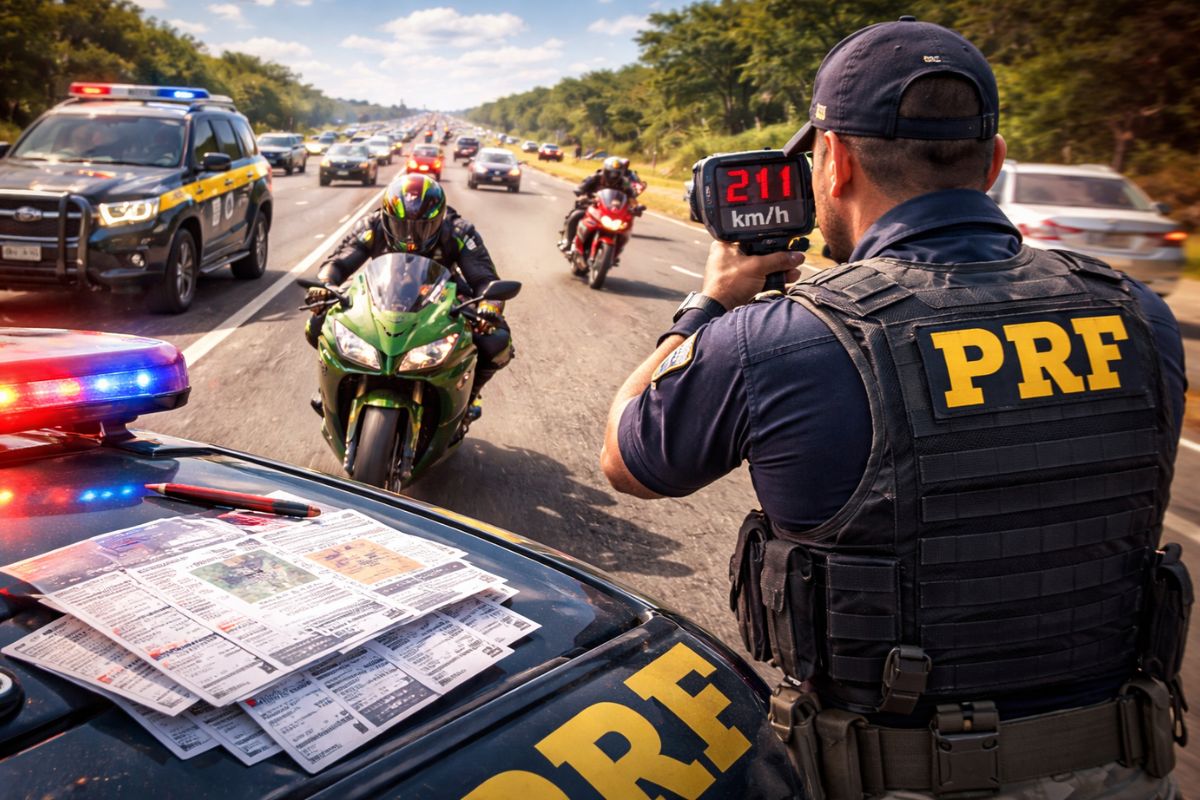

Fines applied by the PRF on BR-060 during the MotoGP expose extreme speeding, air support in enforcement, and high risk of serious accidents on the Anápolis highway
The fines recorded on BR-060 during the MotoGP period revealed an alarming scenario of recklessness on the Goiás highway. According to the report presented, the Federal Highway Police issued more than 3,000 citations for speeding, with motorcycles caught going up to 211 km/h in the Anápolis region.
The number alone is striking, but the situation becomes even more serious when considering the context of the operation. In addition to the high volume of violations, enforcement found behaviors that directly increase the risk of serious accidents, not only for motorcyclists but also for drivers and passengers traveling through the area.
Extreme speed marked the enforcement

The MotoGP period was accompanied by a true festival of recklessness on BR-060. The fines issued by the PRF show that speeding dominated the violations on the highway, turning a moment of high traffic into a high-risk scenario.
-
Neon Blue Glow in Brazilian Waters Captivates Locals and Goes Viral, Unveiling Rare “Sea Fire” Phenomenon

-
Forgotten Map Leads Diver to Shipwreck with Gold, Rare Jewels, and Secrets Hidden for Nearly 350 Years
-
Furong: The 2,000-Year-Old Chinese City Built on a 60-Meter Waterfall Becomes a Global Tourist Phenomenon

-
YouTube Inventor Dubbed “Real-Life Tony Stark” Builds Robotic Legs for Father’s Day, Creating a Wheelchair That Conquers Stairs and Rough Terrain




Among the most serious records, there were motorcyclists caught at 211 km/h, 200 km/h, and 172 km/h. These are extremely high speeds for any highway, especially in a context of intense circulation and the need for heightened attention.
More than 3,000 fines expose a pattern of recklessness
The total of more than 3,000 fines does not point to isolated cases, but to a pattern of dangerous behavior throughout the operation.
The volume of citations reinforces that recklessness was not limited to a few drivers, but appeared repeatedly during the enforcement.
This data carries even more weight because high speed is treated as one of the main factors associated with very serious accidents.
When speed increases too much, reaction time decreases and the severity of the impact grows, which increases the chance of deaths and injuries in incidents on the road.
Air support was used to monitor the highway
To monitor the situation on BR-060, the operation even included air support. The use of a helicopter helped monitor traffic and identify violations along the enforced stretch.
The presence of this resource shows the extent of concern regarding driver behavior during the event.
The fines applied with expanded enforcement indicate that the PRF sought to act more intensively precisely to curb dangerous practices during a time of high traffic.
Speeding increases risk for everyone


The PRF reinforced that the objective of the action was to curb this type of behavior and enhance road safety. This is because recklessness does not only threaten those who are driving at excessive speeds.
On a busy highway, the risk spreads to other drivers, passengers, and other road users.
A driver at extremely high speed compromises the entire traffic dynamic, reduces safety margins, and makes any mistake much more serious.
Speed is among the most dangerous causes
Speeding was highlighted as one of the factors most associated with very serious accidents with fatalities, alongside behaviors such as drunkenness and improper overtaking.
In this scenario, the fines serve not only as punishment but as a tool to contain a highly dangerous practice.
The problem is that when the violations involve speeds like 211 km/h, the debate shifts from mere infraction to extreme risk. At such speeds, any loss of control can have devastating consequences.
BR-060 became a portrait of recklessness during the MotoGP
The operation’s report shows that BR-060, in the Anápolis region, became a concerning portrait of recklessness during the MotoGP.
The mass fines and instances of extreme speeding laid bare the challenge of maintaining safety during periods of increased traffic and exposure.
More than just numbers, the records show how risky behaviors continue to be present even in the face of reinforced enforcement.
And in such cases, prevention directly involves control, police presence, and individual responsibility of those on the road.
Do you think that harsher punishments and more intense enforcement can reduce this type of recklessness on highways?