





 Portuguese
  English
  Spanish
  5 min of reading
  1 comment


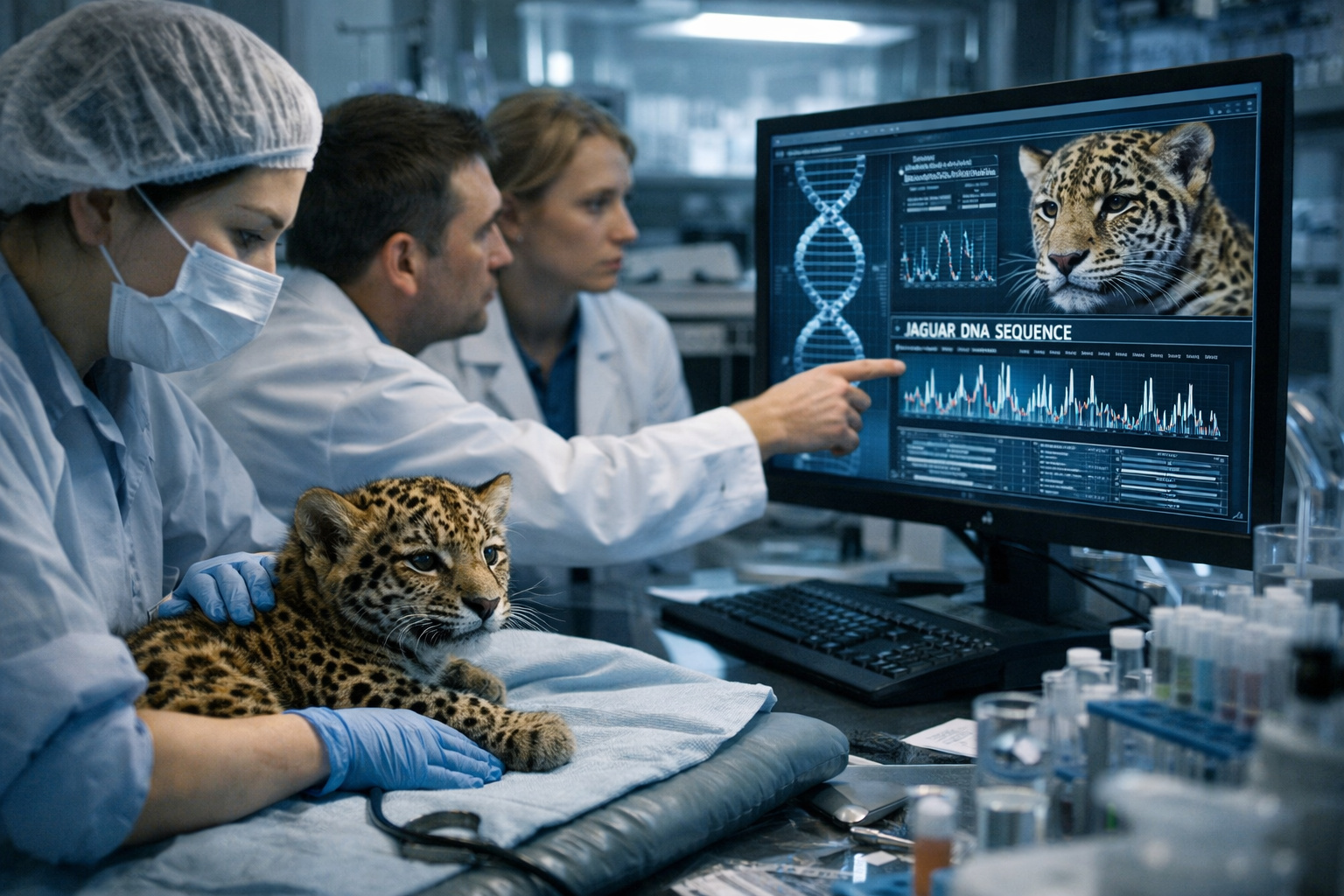


After Almost Completely Disappearing From The Planet, The Jaguar Began To Have Cloned Cells In The Laboratory, Embryos Formed Outside The Womb And Became A Scientific Bet To Prevent A Silent Extinction
Imagine following a hunt that doesn’t end with the animal’s death, but with an attempt to save it from permanent disappearance. This was exactly the scenario that unfolded at Fazenda Bodoquena, in Miranda, Mato Grosso do Sul, where scientists spent days trying to capture a jaguar to collect something more valuable than blood or semen: cells capable of keeping the species’ genetics alive.
The information was disclosed in a report signed by Xavier Bartaburu, with data obtained directly in the field alongside Brazilian researchers specialized in assisted reproduction of wild animals. According to the gathered material, science has begun to bet on a sensitive frontier between ethics, technology, and the survival of biodiversity.
The Capture That Changed The Course Of Research With Jaguars
Initially, the team arrived at Fazenda Bodoquena in the evening, after identifying a bovine carcass. Since jaguars tend to return to the area for several days, the strategy seemed safe. However, the capture would not be simple. In two consecutive attempts, the animal managed to disarm the trap and escape.
-
6 sources of free fertilizer that you are throwing away every day and can transform your garden without spending anything.
-
With a water crisis on the radar, Sabesp invests in reclaimed water for data centers and transforms sewage treatment into a solution that saves millions of liters and protects public supply.

-
Foresea achieves 100% offshore waste reuse in 2025, eliminates landfill disposal, and consolidates sustainable strategy with 1,500 tons recycled.
-
With earth, bamboo, straw, and lime mortar, a specialist builds a house for just over $460 and draws attention for its cost being much lower than traditional construction.

Only on the third day, at 9:10 PM, an adult male was recorded by the camera and ended up trapped. A three-hour operation then began. The animal was anesthetized, weighed — 113 kg — and underwent a series of biological samples collection. Among them were blood, fur, ticks, semen, and a small fragment of the ear.
This detail, seemingly simple, became the focal point of the research. Although the collected semen was unviable, likely due to the low temperatures of the night, the ear tissue held an unexpected alternative: somatic cells capable of generating embryos through cloning.
The animal, named Leonço, was about eight years old. In the wild, males typically live up to 13 years, often with marks from territorial fights. After the procedure, he awoke from anesthesia and returned to the forest, while his genetic material was sent to a laboratory.
From Pantanal To The Laboratory: How Jaguar Cloning Works

The next day, the researchers returned to Campo Grande, where the Reprocon laboratory operates, a research group linked to the central breeding facility of the Federal University of Mato Grosso do Sul (UFMS). There, a new stage began: the culturing of the cells taken from the ear.
These samples release fibroblasts, somatic cells of the same family as stem cells. In just one month, two centimeters of tissue can generate between 20 and 30 million cells, each with the potential to produce a cloned embryo.
The process involves removing the genetic material from an egg — called an oocyte — and inserting the fibroblast. Next, an electrofusion occurs, which activates embryonic development. Subsequently, the embryo needs to be transferred to a female to complete gestation.
In 2023, the group managed to advance to the morula stage, three days after fertilization. For 2025, the expectation is to start the first attempts at embryonic transfer.
This progress was only possible because Reprocon maintains the largest biobank of jaguars in the world, with:
- blood from around 160 individuals;
- tissue from 60 jaguars;
- semen from 30 males.
All material remains stored in liquid nitrogen containers, ensuring long-term genetic preservation.
The Reality Of Jaguars In Brazil And The Risk Of Silent Extinction
The jaguar is the largest feline in the Americas and inhabits almost all Brazilian biomes, except for the Pampas. However, the situation varies drastically by region.
Recent studies indicate:
- between 10,000 and 21,000 individuals in the Amazon;
- up to 5,000 in the Pantanal;
- around 1,000 in the Cerrado;
- fewer than 250 adults in the Atlantic Forest and Caatinga, where the species is critically endangered.
Moreover, habitat fragmentation has reduced the natural dispersal of males, who typically roam large areas. Depending on prey availability, a jaguar’s territory can range from 5 to 400 km². In the Pantanal, some individuals exceed 130 kg, while in the Caatinga they may weigh only 50 kg.
However, highways, agricultural expansion, and conflicts with humans have intensified deaths from retaliation and vehicular collision. Between 2016 and 2023, for instance, 19 jaguars died alone on the BR-262 road, between Miranda and Corumbá.
In this context, cloning does not emerge as the sole solution, but as a complementary tool. It allows for the preservation of genetic material from isolated populations, reduces inbreeding, and maintains future options for reintroduction.
Why Cloning Does Not Replace Traditional Conservation
Despite The Scientific Impact, the researchers themselves warn: cloning does not save species alone. Above all, it is essential to preserve natural areas, create ecological corridors, and reduce conflicts with local communities.
Still, in fragmented biomes like the Atlantic Forest, where connecting areas has become unfeasible, assisted reproduction emerges as a strategic alternative. Techniques like artificial insemination, in vitro fertilization, and cloning allow for the transfer of genetics from one region to another without moving adult animals.
Additionally, new technologies broaden possibilities. Microfluidic devices developed in Brazil, costing about 15 dollars, replace expensive laboratory equipment and can be used directly in the field. Each unit can be reused up to nine times, facilitating the collection and selection of viable cells.
Therefore, the cloning of the jaguar does not represent an isolated experiment but is part of a larger effort to prevent the species from disappearing without the world noticing.
The Future Of The Species Among Science, Ethics, And Survival
As technology advances, ethical and scientific questions also arise. It is still unclear whether a cloned animal will live less, whether it can reproduce, or whether it will be fit to return to nature. Therefore, each step requires rigorous monitoring.
Even so, researchers argue that failing to act would be riskier. In a scenario of accelerated changes, storing genetics today may be the only chance for recovery tomorrow.
In the end, the story of the jaguar reveals more than a scientific advancement. It exposes the line between loss and hope, showing that when nature can no longer save itself, science can — and perhaps should — try to help.
How far should science go to prevent the extinction of a species that has already lost almost all its space in nature?










Tem quer muito alienado pra achar que Onça Pintada quase extinguiu… Isso só prova que não se conhece o Brasil….