





 Portuguese
  English
  Spanish
  6 min of reading
  4 comments


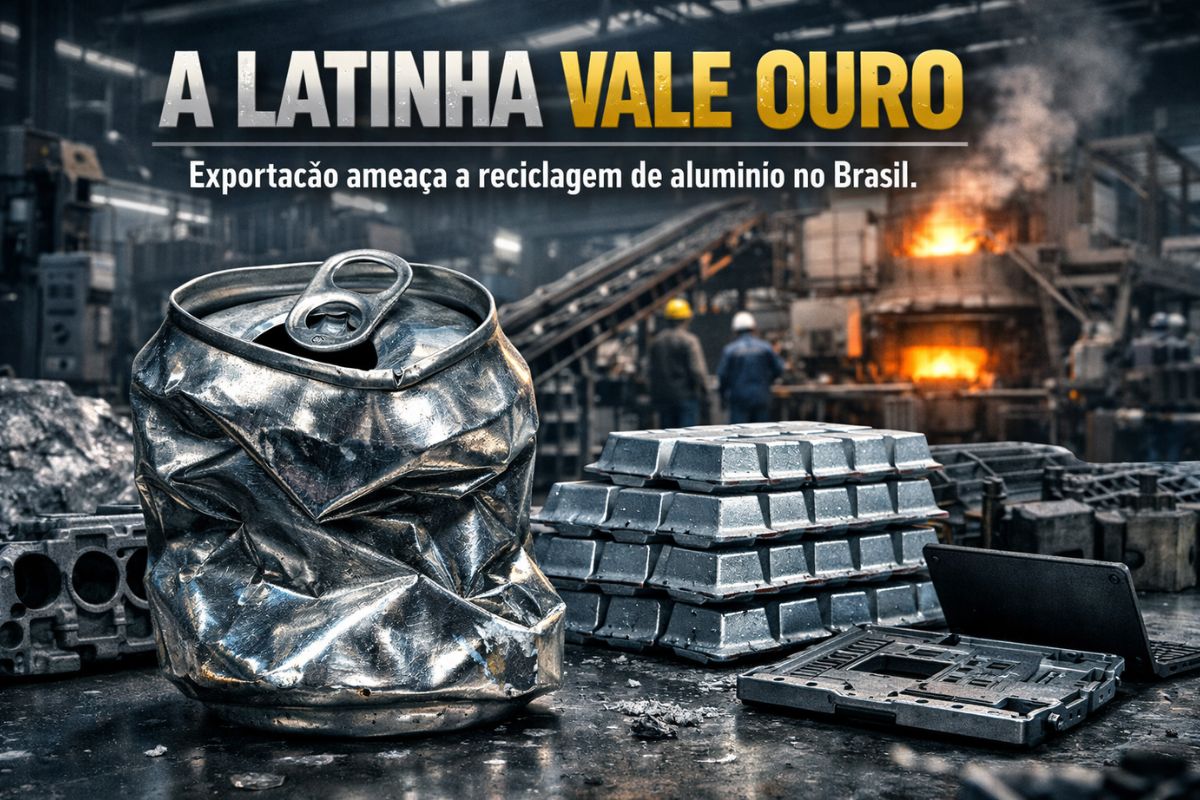


Can That Be Turned Into An Engine, Airplane, Or Laptop Shows How Brazil Leads Aluminum Recycling With 60 Percent Of The Metal Coming From Scrap, But The International Race And US Tariffs Could Turn This Advantage Into Risk For The National Industry
The aluminum that today is in a soda can may, tomorrow, reappear in an engine block, in a laptop casing, in an airplane flap, or even in a flute. In the case of this metal, recycling is not an act of goodwill toward the environment, it is part of the business model itself. A crushed can can return to the production chain with the same purity as aluminum extracted from bauxite ore, but with much lower energy and financial costs. It is in this context that Brazil leads aluminum recycling, with 60 percent of the metal entering the market coming from recycled material.
However, behind this success story, there is a silent threat. Aluminum scrap has become a global commodity, contested by major powers, especially China, while US tariffs distort international trade and increasingly push Brazilian cans out of the country.
While Brazil leads aluminum recycling in installed capacity and efficiency, the outflow of scrap puts national plants and a resource considered strategic for decarbonizing the economy at risk.
-
India announces a plan of $3.06 billion to bring aviation to forgotten regions: 100 new airports, $1.07 billion in subsidies, and regional routes guaranteed for 10 years, from 2026 to 2036, away from the centers.
-
Brazil blocked a proposal from the United States at the WTO that would make the exemption from tariffs on digital products like streaming and ebooks permanent, favoring American tech giants at the expense of developing countries.
-
IPTU exemption for seniors in 2026: see how to secure the benefit.

-
The institute that trained the greatest aerospace engineers in Brazil has just opened its first campus outside São Paulo after 75 years: ITA Ceará will have R$ 445 million, new courses in energy and systems, and classes are expected to start in 2027.


From Can to Engine, Airplane, or Laptop
The great strength of aluminum lies in its ability to be reborn. The same molecule can circulate for decades among different products, without losing quality.
The cycle starts with bauxite, an ore full of impurities like iron, silicon, and titanium. After a heavy refining process, alumina remains, and that’s where things get expensive.
Separating aluminum from oxygen requires an intense electric current, to the extent that the electricity bill accounts for almost half the cost of producing primary metal.
When using scrap, the story is completely different. The aluminum from the can has already undergone this energy baptism. It is free, light, ready to melt and be transformed once again.
Producing ingots and sheets from used cans consumes about 95 percent less energy than producing new aluminum from bauxite, making recycling a much more environmentally and economically attractive business.
Why Aluminum Scrap Has Become A Global Commodity


This difference in cost explains why aluminum scrap is now worth almost as much as finished aluminum.
In the international market, the price per ton of scrap hovers around values close to that of finished metal, placing the material at a level of commodity contested by dozens of countries.
In 2023, the export of crushed aluminum scrap involved 121 countries and moved nearly 20 billion dollars, surpassing even the trade of alumina and leaving bauxite even further behind in relevance.
This global scenario makes it clear that used cans are not just waste. They are a strategic asset in a world that needs to reduce emissions and cut energy costs in heavy industry.
In the aluminum sector, scrap has already assumed the leading role that previously belonged to ore, a movement similar to that seen in steel, where a large part of production in developed countries also depends on scrap.
Brazil Leads Aluminum Recycling, but Imports Scrap
At first glance, Brazil’s performance is impressive. For every ten tons of aluminum that enter the domestic market, six come from recycled material.
This reality supports the claim that Brazil leads aluminum recycling in scrap participation in production, backed by a robust industrial park capable of recycling over 1 million tons per year.
However, there is a problem. The recycling structure has grown faster than the volume of scrap available in the country. Today, Brazil has more recycling plants than scrap to feed them.
To keep the factories operating at full capacity, the industry needs to import crushed cans, which makes the country a net importer of aluminum scrap, despite being a global reference in reusing it.
In 2024, about 157 thousand tons of aluminum scrap entered Brazil and 53 thousand tons went out. In a country with a strong transformation industry, it is not absurd to import part of the raw material.
The real risk appears when the export of scrap grows faster than domestic production, reducing the supply for those who recycle here and eroding just the base that makes Brazil lead aluminum recycling.
China Drives Demand and Changes The Energy Game
China is one of the engines of this global race for scrap. Producing aluminum from scrap consumes 95 percent less energy than using alumina, which makes a significant difference in a country where the electricity matrix is still largely based on coal-fired thermoelectric plants, responsible for about 60 percent of generation.
Replacing part of primary aluminum with scrap means cutting carbon emissions directly and on a large scale.
That’s why the Chinese goal is ambitious. The country aims to increase aluminum recycling capacity from 22 million to 37 million tons by 2028.
Today, it already imports about 1 million tons of scrap per year, an amount that equals Brazil’s own installed recycling capacity.
In a scenario where China expands this demand, the tendency is for the competition for used cans to intensify and further pressure the availability of scrap in markets like Brazil.
US Tariffs Distort The Scrap Market
On the other side, the United States is also manipulating this chessboard. The country applies a 50 percent tariff on imported aluminum in general.
However, aluminum scrap finds itself in a particular situation. For most of the world, it falls under the basic tariff of 10 percent, which makes it more appealing to export scrap to the American market rather than finished aluminum.
In the Brazilian case, the situation is even more delicate. Aluminum scrap leaving Brazil faces an extra tariff of 40 percent. Even so, the global logic works like a magnet.
As European countries, for example, send more scrap to the United States, they make room in their own domestic markets to receive scrap from other suppliers, including Brazil.
The result is a flight of raw material that weakens the local industry, despite Brazil leading aluminum recycling in capacity and know-how.
The export of Brazilian scrap is growing rapidly. From 2023 to 2024, it increased by about 60 percent, and since 2021, the jump is approximately 135 percent, a movement that worries the sector.
For the industry, this represents a loss of strategic resource and a direct risk to the sustainability of national recycling plants.
Responses From Europe and Warning To Brazil
The European Union has already felt the impact of this dispute. With a strong recycling structure, the bloc has also seen scrap escape to other markets, driven by the combination of Chinese demand and US tariff distortions.
The response came in the form of announcement: from 2026, the trend is to create some type of restriction or export tax to avoid the excessive outflow of aluminum scrap.
In Brazil, the discussion follows a similar path. The recycling industry advocates measures to keep part of this material within the country, preserving jobs, investment, and the very logic that allows Brazil to lead aluminum recycling.
Without some form of protection for scrap, the risk is to ship cheap cans abroad while losing added value and competitiveness here at home.
What Is At Stake For Industry, Climate, And Society
Keeping aluminum scrap accessible to domestic plants is not just a corporate issue. Recycling reduces energy consumption, lessens pressure on hydroelectric plants, and avoids the need for new bauxite mines.
In a country that has already built a recycling park capable of processing over 1 million tons per year, giving up this differential would mean regressing in environmental and economic efficiency.
At the same time, ensuring that Brazil leads aluminum recycling based on internally available scrap is a way to protect jobs, strengthen picker cooperatives, and keep the country relevant in a global economy that needs to be less carbon-intensive.
The competition for crushed cans may seem small, but it is an important chapter in the energy transition and the new geopolitics of materials.
In the end, a simple question summarizes the crossroads: is it worth letting aluminum scrap go while Brazil tries to maintain itself as a reference and wants to prove, in practice, that it leads aluminum recycling in an increasingly competitive world?
So, do you think Brazil should limit the export of aluminum scrap to protect the national industry, or should the market decide the fate of each can on its own?









O reciclavel do Brasil deve ficar no Brasil e ser transformado pela indústria brasileira, o país precisa incentivar a indústria nacional, o que e nosso, para que o país possa crescer. Ocorre com o aluminio reciclavel o mesmo que ocorre com as plantas medicinais da nossa flora, que sao levadas para o exterior, onde países que investem em pesquisa as transformam em medicamentos, voltando para o Brasil, remédios com preços inacessiveis para a população. O Brasil deve investir e incentivar a pesquisa de medicamentos ao invés de vender nossa matéria prima para o exterior, o mesmo deve ser feito qto aos nossos recicláveis, gerando divisas para o Brasil, fabricarmos e vendermos para o exterior. Como está, estamos entregando o ouro nas maos do inimigo e sempre seremos o país subdesenvolvido que enriquece cada dia mais as grandes potencias mundiais.
Tem que fazer oque é melhor pro Brasil. Vender se estiver sobrando.
Sim, o Brasil tem q limitar a saída da nossa sucata de aluminio. Temos q fortalecer a indústria nacional para garantir empregos.