





 Portuguese
  English
  Spanish
  5 min of reading
  0 comments


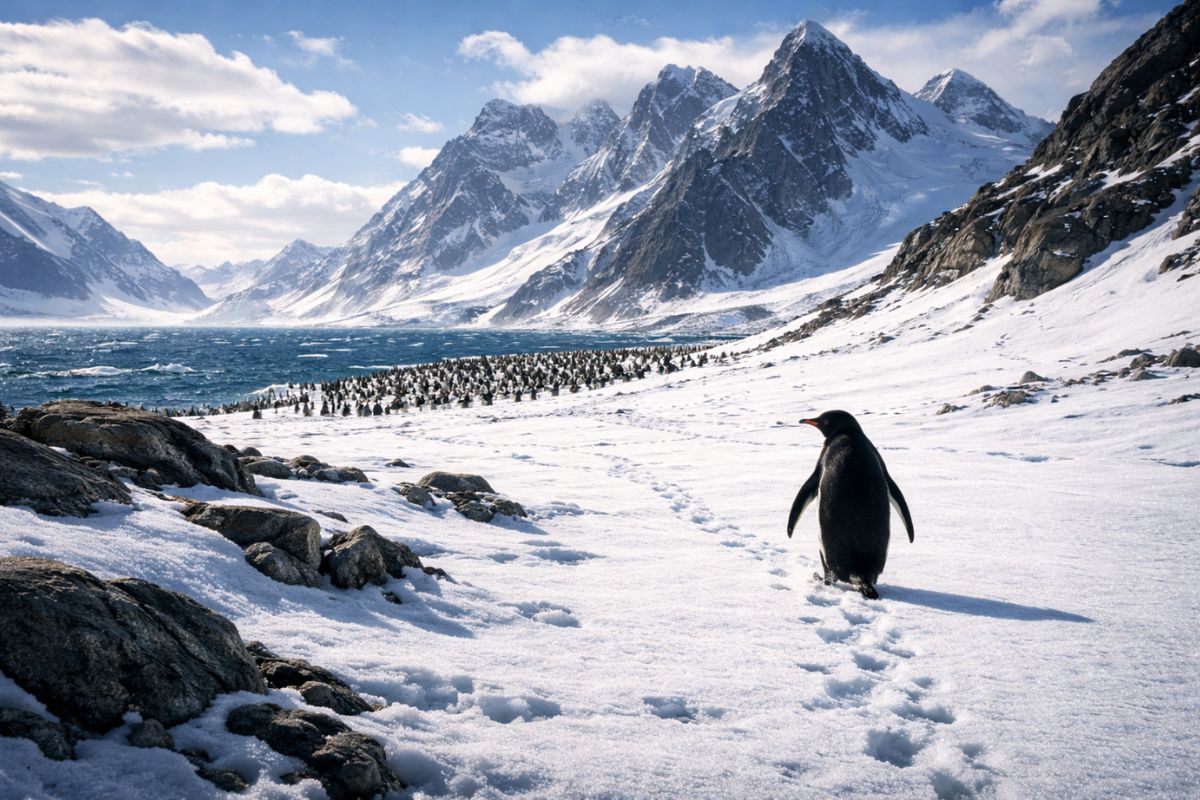
A Lonely Penguin, Real Adélie Penguin Filmed by Werner Herzog, Reappears on the Internet and Becomes the Meme of the Penguin That Dominates 2026.
A single penguin moves away from its colony, turns its back on the sea, and begins to walk towards the icy mountains in the middle of Antarctica. The scene is old, recorded in 2007 by Werner Herzog. But it was only in 2026 that this clip reappeared, took over the internet, and gained the caption that transformed it into a symbol: “But why?”
Since then, this penguin has been seen as much more than a disoriented animal. It has become a projection: a break from the script of life, solitude, courage, purpose, a desire to go “somewhere else,” even if no one knows where. While science speaks of disorientation, the human mind sees manifesto.
The Lonely Penguin That Walks in the Wrong Direction

In the documentary “Encounters at the End of the World,” we follow an Adélie penguin that suddenly breaks the expected pattern.
-
A Brazilian millionaire couple restores a farm over 150 years old in the interior of São Paulo and transforms the historic property with Portuguese tiles, antique furniture, and new spaces into a refuge that blends tradition, comfort, and sophistication.

-
Submerged city in a lake in Minas reveals intact streets, preserved vehicles, and houses after more than 60 years, impressing divers.

-
Yellowstone has started to rise again in an area of the caldera, and the movement rekindles fears surrounding the U.S. supervolcano, as scientists monitor the deformation and try to understand what is happening underground.

-
Woman arrested after receiving $1.2 million due to banking error and not returning the amount.


Instead of walking with the group towards the sea, where food and the colony are, this penguin turns to the opposite side.
It leaves the usual coastal route and goes alone, walking about 70 kilometers towards the mountains inland in Antarctica.
While all the other penguins do what they need to survive, this individual seems to ignore the logic of its own instinct. It is precisely this silent decision that makes the scene so striking.
Where the Video of the Penguin That Dominated the Internet Comes From
Many people got to know the penguin through the clip that went viral on the feed, but the origin is well before today’s internet.
The excerpt comes from the documentary released in 2007, “Encounters at the End of the World,” by German filmmaker Werner Herzog.
In other words, this video has been circulating in culture for almost 20 years, but only in January 2026 did it resurface strongly.
In the version that went viral, we see the penguin moving away from the colony while the narration explains that it is heading towards certain death.
The current audience took this piece, cut it, remixed it, added captions and music, and transformed it into something that is no longer just a documentary scene, but a shared symbol.
What Science Says About the Disoriented Penguin
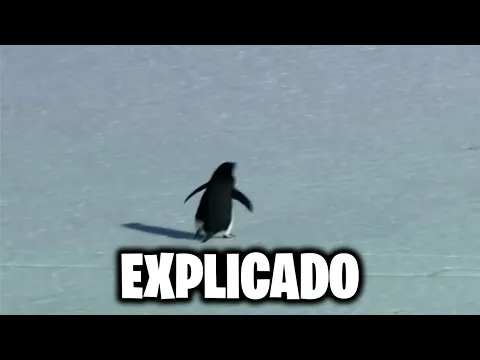

In the documentary itself, marine ecologist Dr. David Ainley, a specialist in penguins for decades, comments on the scene.
He says he has never seen a penguin throw itself against a rock but confirms that some individuals can become disoriented.
While the entire group heads towards the ocean to survive and to the colony to reproduce, this penguin stops, looks around, and chooses the opposite path.
From a scientific point of view, there is no romance: it is an unusual behavior, probably resulting from disorientation, a “malfunctioning internal GPS.”
Herzog, true to his style, narrates the moment reinforcing the idea that that penguin is walking towards certain death. The camera doesn’t need to explain anything further. It simply follows, from a distance, an animal that insists on going where it doesn’t make sense to go.
Why This Penguin Touched So Many People
For science, it is a disoriented penguin. For the public, it is not.
On the internet, it has been seen as someone who breaks nature’s programming, even if this leads to destruction, in search of something greater or simply different. Many began to see in the penguin a metaphor for breaking free from the “autopilot” of life.
Quotes like “while other penguins merely survived, he lived” spread through comments and captions.
The video became wallpaper, status updates, references in motivational texts, inside jokes among groups of friends, all at once.
What captivates so many people is not just the image of the penguin walking away, but the fact that no one knows why.
The question “But why?” hangs not only over the animal but also over those watching. It’s not just “why does he do this?”, but “for what reason would I do something like this in my life?”.
Penguin, Opium Bird 2027, and the Bird of the Future

In the layer of interpretations and internet theories, the penguin has ended up connected to another figure: the Opium Bird 2027, the “bird of the future” that, according to these narratives, would live in the Arctic mountains.
In the jokes and symbolic readings, some say that the penguin is going to meet this bird.
Others say that it is becoming this being, as if the walk were a rite of passage, a metaphor for overcoming, transcendence, or even “breaking out of the matrix.”
None of this has scientific confirmation, of course. But it doesn’t need to. Here, what matters is the collective imagination, not the technical data. Each person chooses the interpretation that best fits their own story:
- some see courage
- some see escape
- some see self-sabotage
- some see awakening
The same penguin serves, at the same time, as a hero, martyr, madman, or visionary, depending on who is looking.
The Role of Music in the Penguin’s Journey
Another element that solidified the force of this video was the soundtrack. The music associated with the penguin moving away from the colony is “L’Amour Toujours”, by Italian DJ Gigi D’Agostino, released in 1999.
However, the version used in the viralization is not the original dance track. It comes from a reinterpretation made by German musician Andreas Gärtner, which softens and at the same time intensifies the feeling of melancholic contemplation.
The silent walk of the penguin meets a soundtrack that seems tailor-made for a character breaking their own cycle.
Without this combination of image, narration, and music, the video might have just been another curious clip from a documentary. With everything together, the penguin became a symbol.
In the End, the Penguin Doesn’t Change. We Do.
When we return to the starting point, the science is simple: the penguin was not “seeking meaning” or trying to philosophize about existence. It was probably disoriented, with its navigation instinct failing in an extreme environment.
The reason it went viral, however, is not in biology. It is in those watching. Real life rarely offers us closed answers, so we fill in the gaps with imagination.
The scene of the penguin walking towards nothing, with the caption “But why?”, ended up becoming a comfortable mirror to fit personal crises, new beginnings, breakups, courage, resignations, and all the phases in which we feel we are heading in the opposite direction of the rest of the group.
After all, the penguin remains a solitary animal crossing ice in a straight line. The rest is what our minds make of it.
And you, when you see this penguin walking away from everything, do you identify with it or think it is just lost?





-

-

-

-

-

-

40 pessoas reagiram a isso.