





 Portuguese
  English
  Spanish
  4 min of reading
  2 comments


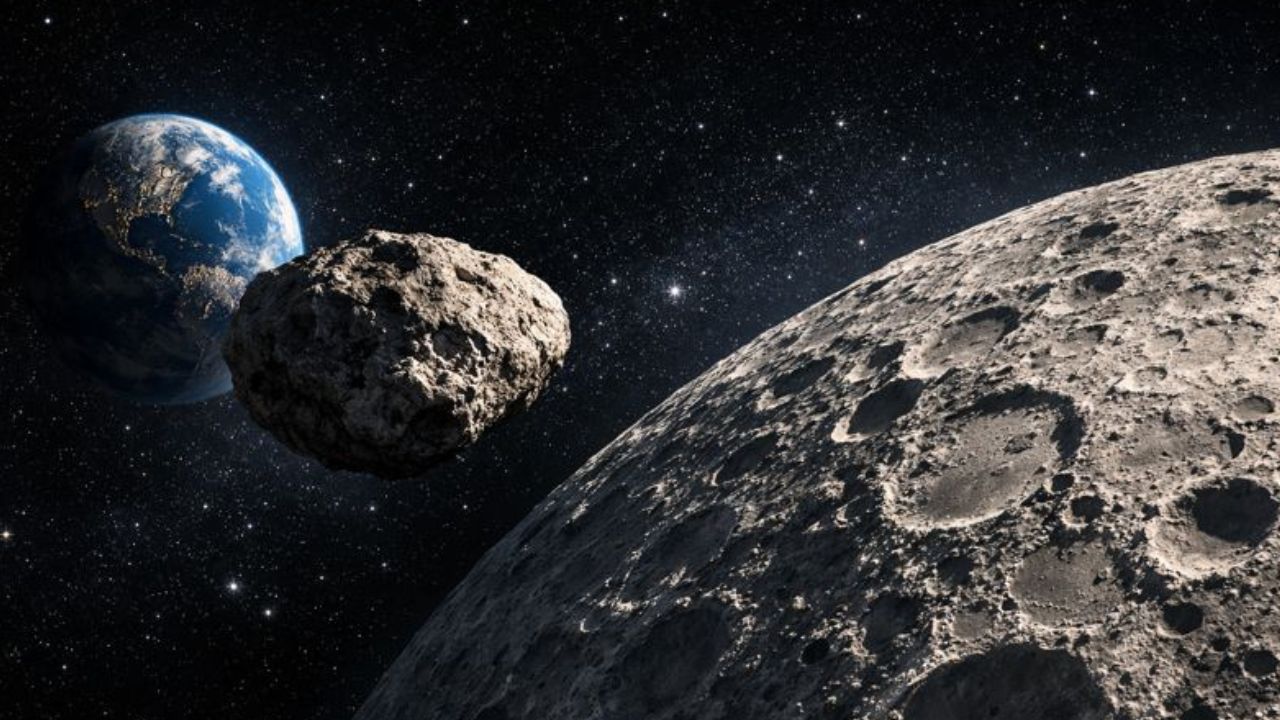


Asteroid 2024 YR4 Has Real Chance of Hitting the Moon in 2032. Astronomy Monitors the Phenomenon and Dismisses Risk to Earth.
A rare event closely watched by the global astronomy community is set to enter scientists’ radar: on December 22, 2032, Asteroid 2024 YR4 will make a close pass to Earth and may collide with the Moon, according to calculations by international space agencies.
The object, discovered in late 2024, has been monitored by ground and space observatories, such as the James Webb Space Telescope, because it has a 3.8% chance of hitting Earth’s natural satellite, although it does not pose a direct risk to our planet.
The potential impact sparks scientific interest because it could provide unprecedented data on space collisions and aid in developing planetary defense technologies.
-
Surrounded by the sea, the airport will have a system to prevent airplanes from falling into the water; technology will be installed in Ilhéus (BA), with an investment of R$ 70 million.

-
With a cost per shot close to zero, the DragonFire laser could change naval warfare in 2027 and provide British ships with nearly unlimited defense against drones.

-
A British startup creates tires that generate electricity in electric vehicles when passing over potholes, speed bumps, and cracks.

-
Scientists have created robots made with living cells that have their own nervous system, swim on their own, explore the environment, and self-organize without any genetic engineering, and now they want to do the same with human cells.


What Is Asteroid 2024 YR4 and Why Is It Noteworthy
Asteroid 2024 YR4 belongs to the group of celestial bodies that cross regions near Earth’s orbit.
It was identified in late 2024 and quickly began to be monitored by specialized centers for near-Earth objects.
According to current estimates, the asteroid has a diameter between 53 and 67 meters, a size comparable to a 10- to 15-story building.
Although not considered giant in astronomical terms, it is large enough to cause significant impacts on celestial bodies like the Moon.
See More: Medical Cannabis: What Changes with the New Anvisa Rules in Brazil
See More: Storm in Sicily Causes Landslide Threatening the City of Niscemi
Real Chances of Impact with the Moon in 2032
According to experts from NASA’s Near Earth Object Studies Center, the latest calculations indicate a 3.8% probability that Asteroid 2024 YR4 will collide with the Moon in December 2032.
This data was obtained from combined observations of the James Webb Space Telescope and ground-based telescopes analyzed up until early April.
The European Space Agency (ESA) estimates that this probability will remain relatively stable until mid-2028, when the asteroid will become more clearly visible for observations from Earth. Only then can more precise calculations confirm or dismiss the risk of collision with the satellite.
See More: LG Whisen Launches AI Air Conditioner with GPT Commands and Humidity Control
Is There Any Risk to Earth?
Despite the alert involving the Moon, scientists are categorical in stating that there is no danger to Earth. The chances of a direct impact from Asteroid 2024 YR4 with our planet are estimated at less than 0.002%, which equates to a possibility of 1 in 59,000.
This means there is a 99.9983% chance of the asteroid safely passing through the region near Earth. Even in an extreme scenario of collision with the Moon, NASA states that the satellite’s orbit would not be altered, discarding any dangerous gravitational effects for our planet.
What Would Happen if the Asteroid Hit the Moon
If the impact with the Moon were to occur, the effect would be impressive but confined to the lunar environment. Scientists estimate that the collision could form a crater up to 1 kilometer wide on the satellite’s surface.
The energy released would be equivalent to millions of tons of explosives, but without direct consequences for Earth. A brief flash could be observed by professional telescopes and possibly by amateur astronomers.
Part of the material ejected by the collision would transform into space dust. A minimal fraction could reach the vicinity of Earth in the form of micrometeorites, which are completely harmless to the population and the atmosphere.
Why This Possible Impact Is So Interesting to Astronomy
Although it does not pose a threat, the potential collision between Asteroid 2024 YR4 and the Moon is seen as a rare scientific opportunity. Today, lunar craters are studied as records of events that occurred millions or billions of years ago.
Observing an impact of this magnitude in real time would allow for better understanding of how these craters form, as well as refining models used to predict collisions with other bodies in the Solar System, including those that may threaten Earth in the future.
Such events are rarely monitored with modern instruments, making the monitoring of the asteroid even more relevant for contemporary astronomy.
History of Similar Impacts in the Solar System
Asteroids with dimensions similar to 2024 YR4 only hit Earth every few thousand years. When this happens, the damage is usually regional but significant.
In 1908, for example, an object about 30 meters in diameter exploded over a forest in Siberia, devastating more than 2,000 km² and knocking down 20 million trees.
Similarly, in 2013, a meteor of approximately 18 meters exploded over the Russian city of Chelyabinsk, releasing energy equivalent to 30 nuclear bombs and injuring around 1,600 people.
Monitoring Continues Until 2032
For now, the most likely scenario is that nothing will happen and that Asteroid 2024 YR4 will pass by the region without hitting the Moon. Nevertheless, astronomers and space agencies will continue to refine calculations in the coming years.
Meanwhile, this episode reinforces the importance of astronomy in monitoring space objects and developing strategies to protect Earth from potential threats from space.










Comentem e ativem o sininho do jornal! Br!
Mt bom! Li td, me interreso nessas coisas! Parabéns pelo tanto esforço pra fazer esse jornal virtual!!