





 Portuguese
  English
  Spanish
  5 min of reading
  0 comments


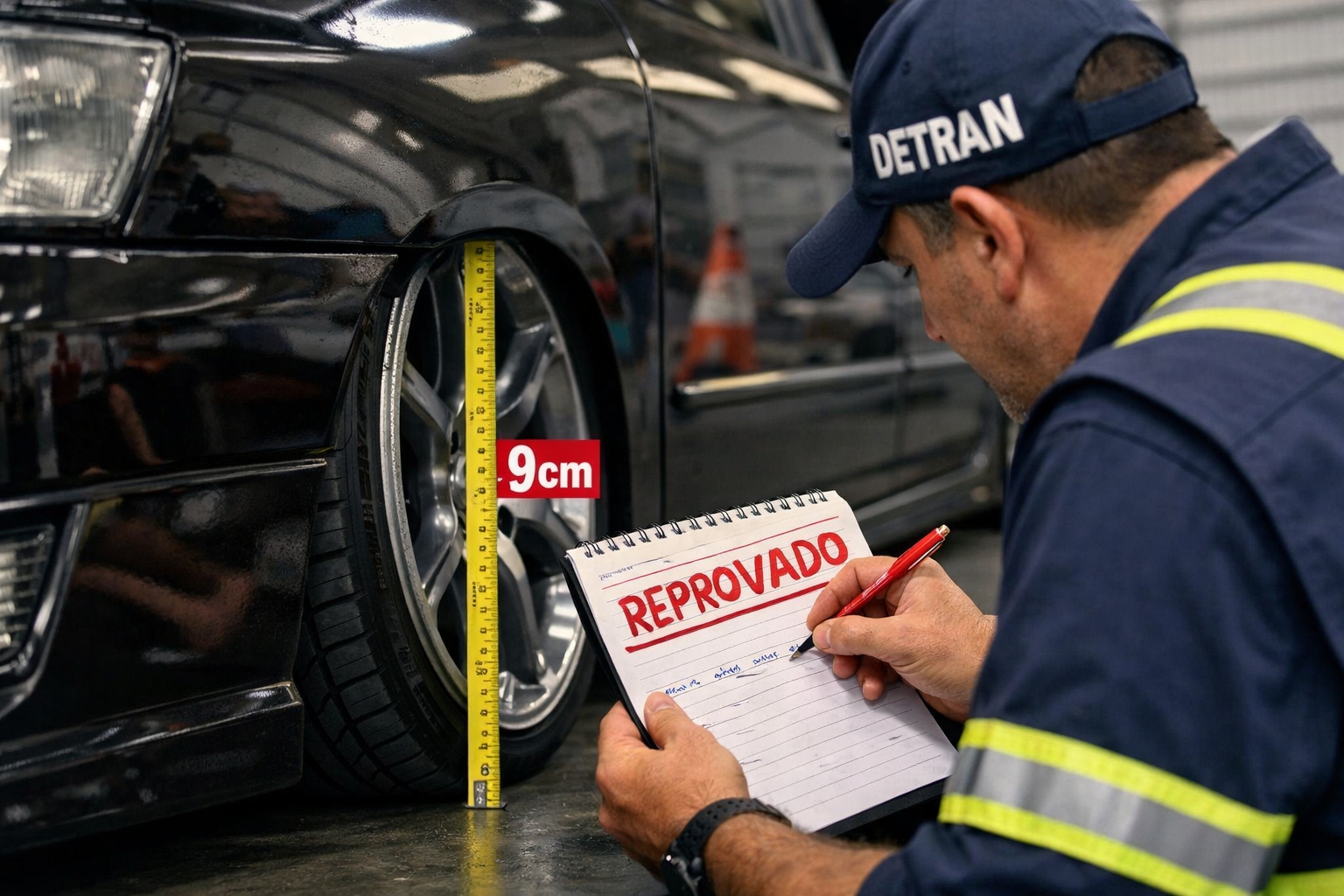
Detran Rule: Inspection of Lowered Cars with the Requirement of 10 cm Minimum Ground Clearance Triggers Rejections During Inspection and Draws Attention from Drivers and Customization Enthusiasts.
The scene is increasingly common on the streets of Brazil: lowered cars circulating with striking visuals and modified suspension. However, there is a detail that many people ignore, which can become a headache during the vehicle inspection.
Detran, responsible for regulating and inspecting vehicles in the country, requires that everything be within the norms to allow circulation safely. And when it comes to lowered cars, ground clearance is at the center of the analysis.
The impact is direct. If the vehicle is too low, the result can be immediate rejection, issues with documents, and even the risk of seizure, depending on the situation.
-
“No one will make us change the Pix,” says Lula after the US report.

-
Lula responds directly to Trump and says that Pix is from Brazil and will not change under pressure from anyone, after a report from the United States pointed out the Brazilian payment system as an American trade barrier.

-
Amazon has just announced a new fee on all deliveries, and your online purchases will become more expensive starting April 17, including for those buying from the United States here in Brazil.

-
He sold his share for R$ 4 thousand, saw the company become a giant worth R$ 19 trillion, and missed the opportunity of a lifetime.


The Minimum Ground Clearance Has Become the Main Point That Leads to Rejections of Lowered Cars During Detran Inspections
Lowered cars must meet specific criteria to be considered fit for circulation. One of the most important is the minimum ground clearance.
If the vehicle has less than 10 cm at any point, it may be rejected during the Detran inspection. It is a type of simple rule, but it changes everything for those who use the car daily.
What seemed like just an aesthetic adjustment can, in practice, become an obstacle to keeping the vehicle registered.
What Detran Checks Beyond Height and Why Suspension Is Under Scrutiny
The inspection does not only look at the distance of the car from the ground. Detran also checks whether the suspension is fixed and if the modification does not interfere with essential systems.
Among the points that may be analyzed are brakes, steering, and lighting. If the modification compromises any of these items, the risk of rejection increases, as the focus of the agency is to ensure safety for drivers and pedestrians.
Another critical point is the authorization. Modifications made without prior authorization may result in fines, vehicle seizure, and difficulties in updating documentation.
Regularizing Suspension Requires Authorization, Specialized Workshop, and the CSV Before Updating the CRLV
To avoid problems, the regularization process follows clear steps. First, it is necessary to request authorization for the suspension modification.
Then comes the modification at a specialized workshop. Next, the vehicle must receive the Vehicle Safety Certificate (CSV), issued by Inmetro or an accredited agency.
With the CSV in hand, the car undergoes a detailed inspection. Only after approval is the report taken to Detran to update the CRLV, officially registering the modified suspension.
This path separates a regular lowered car from a vehicle that can be stopped and penalized.
What Is Checked in the Detailed Inspection and Where the Car Can Automatically Fail
During the inspection, the check goes beyond the visual. Ground clearance and the integrity of the suspension are evaluated, in addition to brakes, chassis, engine, and the functioning of lights and tires.
Errors in modification or in the documentation lead to automatic rejection. This usually happens when the car is below the allowed height or when the modification is not correctly registered.
The detail that stands out the most is that it is not enough for the car to be “pretty.” It must be safe and documented correctly.
Mobile Suspension Only Counts as an Exception and Is Not Valid for Daily Use in Many Cases
Mobile suspensions, like coilover and air, are not allowed for daily use. They are only permitted in exhibition cars.
In other words, even if the modification is technically possible, it may not be accepted for regular circulation. This leads many owners to believe that everything is fine, but they end up surprised during the inspection.
The consequence is usually immediate: rejection and the need for adjustments to return to the accepted standard.
What Is the Law Regulating Lowered Cars in Brazil?
The legislation addressing vehicle modifications, including lowering, is in the Brazilian Traffic Code (Law No. 9,503/1997) and in the Resolutions of the National Traffic Council (CONTRAN).
Article 98 of the CTB states that any modification to the original characteristics of the vehicle requires prior authorization from the traffic authority — meaning, you cannot simply lower the car and circulate without documentation.
CONTRAN Resolution No. 806/2020 (which updates previous norms) and earlier versions like Resolution No. 479/2014 are those that clearly define how suspension modifications must be made and that the modification is only accepted after inspection and issuance of the CSV.
The most cited technical rule regarding minimum height is that the distance from the ground to the lowest part of the bodywork must be at least 100 mm (10 cm) for light vehicles.
What Is the Legal Minimum Height for Lowered Cars?
Passenger cars (up to 3.5 tons) must maintain a minimum distance of 10 cm between the ground and the lowest point of the vehicle.
This measurement is considered during the inspection, and if the car is below that, it can be deemed irregular even if it was lowered for aesthetic or performance reasons.
Fine and Penalty for Circulating with an Irregular Lowered Car
According to Article 230, item VII of the Brazilian Traffic Code, modifying the vehicle without authorization is a traffic violation.
This violation is classified as serious, with the following penalties provided:
- Fine of R$ 293.47 (base value for serious violations — may have value updates according to the fiscal year);
- 7 points on the CNH;
- Possibility of retention, towing, or seizure of the vehicle until regularization;
Other Items That Can Generate Fines Related to Lowering
✔ Wheel or tire touching the body during steering maneuver (turning the steering wheel) can also be considered irregular and cause a violation.
✔ Suspensions with automatic or remote control in motion may be prohibited for circulation and generate fines or rejection.
In the end, the 10 cm rule and the regularization requirements show that a lowered car can indeed operate within the law, but only when it follows the correct process, respects the minimum height, and passes the inspection without issues, something that draws attention due to the risk of fines, blocking the CRLV, and even seizure.









-

Uma pessoa reagiu a isso.