





 Portuguese
  English
  Spanish
  4 min of reading
  0 comments


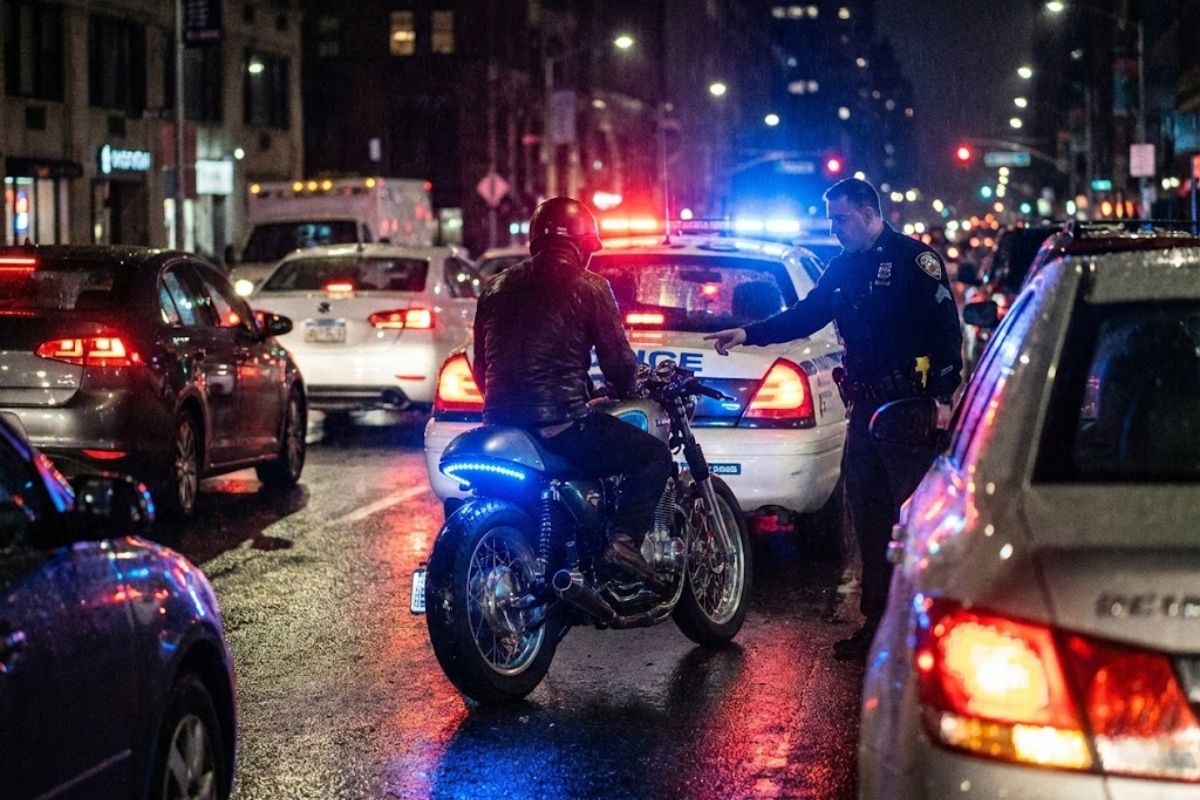
Detail That Appears Next to the Red of the Motorcycle Lantern, the Blue Dots Returned from US Customizations of the 1950s and Gained Strength in Classic Motorcycles, Including Harley Davidson. The Blue Lens Creates a Purple Tone, But the Mixture Can Be Illegal, Simulate Emergency, and Generate Fines in Some Countries.
Anyone who has traveled on highways or busy avenues may have noticed a curious detail in the motorcycle lantern: small blue dots shining alongside the traditional red at the rear. The look grabs attention right away but raises questions about function, safety, and legality.
The effect mixes visual identity and nostalgia; however, it can generate a risk of confusion in traffic and even issues with law enforcement. In some places, the blue and red combination is regarded as irregular and may be interpreted as an attempt to simulate a patrol car or emergency vehicle.
What Are the Blue Dots and Why Did They Become a Fad in the Motorcycle Lantern

The so-called blue dots are small lenses installed in the rear lantern, creating a blue glow within the unit that normally emits red light. In practice, the motorcycle lantern gains a striking detail that stands out, especially at night.
-
Less than a Tera TSI, up to 710 km of range and charging in 9 minutes: the new BYD Song Ultra expands the Chinese brand’s bet on increasingly faster, more technological, and competitively priced electric SUVs.

-
With a 1.0 engine producing 75 hp and costing less than R$ 70,000, Fiat’s car returns to the podium as the cheapest in the country; a temporary promotion for the 2026 Like version reduces the price of the Fiat Mobi.
-
With a mild hybrid system of 48 V, 176 hp and a price of R$ 175,990 in the Sahara version, the new Jeep Renegade changes mostly on the inside, improves slightly in fuel consumption, and remains almost the same car.
-
With a 293.5 cm³ engine and a range of up to 400 km with a 14.1-liter tank, the Honda CB 300F Twister 2026 has up to 24.7 hp, an initial price of R$ 25,150, and already exceeds R$ 29,000 in the Fipe Table.

For many, it is an aesthetic touch, a personal mark that transforms the back of the motorcycle into something immediately recognizable. At the same time, the contrast with red makes drivers and pedestrians wonder whether it is just style or if there is some “hidden function.”
Where the Fashion Came From and Why It Came Back with Force
The trend is not new. It originated in the United States in the 1950s, when customized culture exploded in the post-war era and cars and motorcycles began to receive aesthetic modifications to draw attention on the streets.
Over time, the look lost popularity and fell out of favor, but it has gained strength again, especially in classic motorcycles and vintage Harley Davidson models.
In this resurgence, the motorcycle lantern has become a kind of showcase for retro style, with the blue dots reinforcing the nostalgic appeal.
How Installation Works and the Purple Effect in the Motorcycle Lantern
The installation is described as simple and low-cost: just insert a small blue lens into the rear lantern assembly. These lenses are sold by customization companies and are known as “blue dots.”
When the red light is activated, the blue dot creates a purple tone that stands out especially at night. It is precisely this effect that fuels the craze, because the motorcycle lantern retains the traditional red but gains a different visual signature.
Do the Blue Dots Improve Visibility or Is It Just Aesthetics?
Among supporters of the modification, there is a theory that the blue dots could increase visibility in fog, rain, or low light, since the contrast between blue and red would help other drivers identify the motorcycle more quickly.
On the other hand, specialists point out that the red light is already considered more effective for penetrating fog due to its wavelength.
Therefore, the functional gain of the blue dots in the motorcycle lantern is seen as questionable, and for many motorcyclists, the practical utility takes a back seat. The main thing is the visual identity, compared even to a tattoo: something personal, even without proven technical advantage.
When the Motorcycle Lantern Can Turn Into a Problem and Generate Fines
Despite the striking appearance, there is a legal risk. In the United States, federal legislation dictates that rear lanterns must emit only red light. In this interpretation, the presence of blue, even discreet, may be considered irregular.
Furthermore, the combination of blue and red light is often exclusive to emergency vehicles, which increases the risk of fines for possible confusion.
According to the British newspaper The Sun, the fine in cases involving blue dots in rear lanterns can reach 300 dollars, approximately R$ 1,500. In other words, the retro detail could be expensive.
Enforcement Is Not Always Strict, but the Risk Continues
Some owners claim they have been using blue dots in their motorcycle lanterns for years without being stopped. In practice, many officers prioritize more serious infractions, such as speeding and dangerous driving, and classic or customized motorcycles may go unnoticed.
Even so, specialists warn that tolerance may vary by region, and this does not eliminate the risk of fines. The appearance may even seem harmless, but the legal interpretation can change from one place to another.
Would you put blue dots on your motorcycle lantern for the retro style, even knowing it might attract police attention and result in fines?









-

Uma pessoa reagiu a isso.