





 Portuguese
  English
  Spanish
  3 min of reading
  0 comments


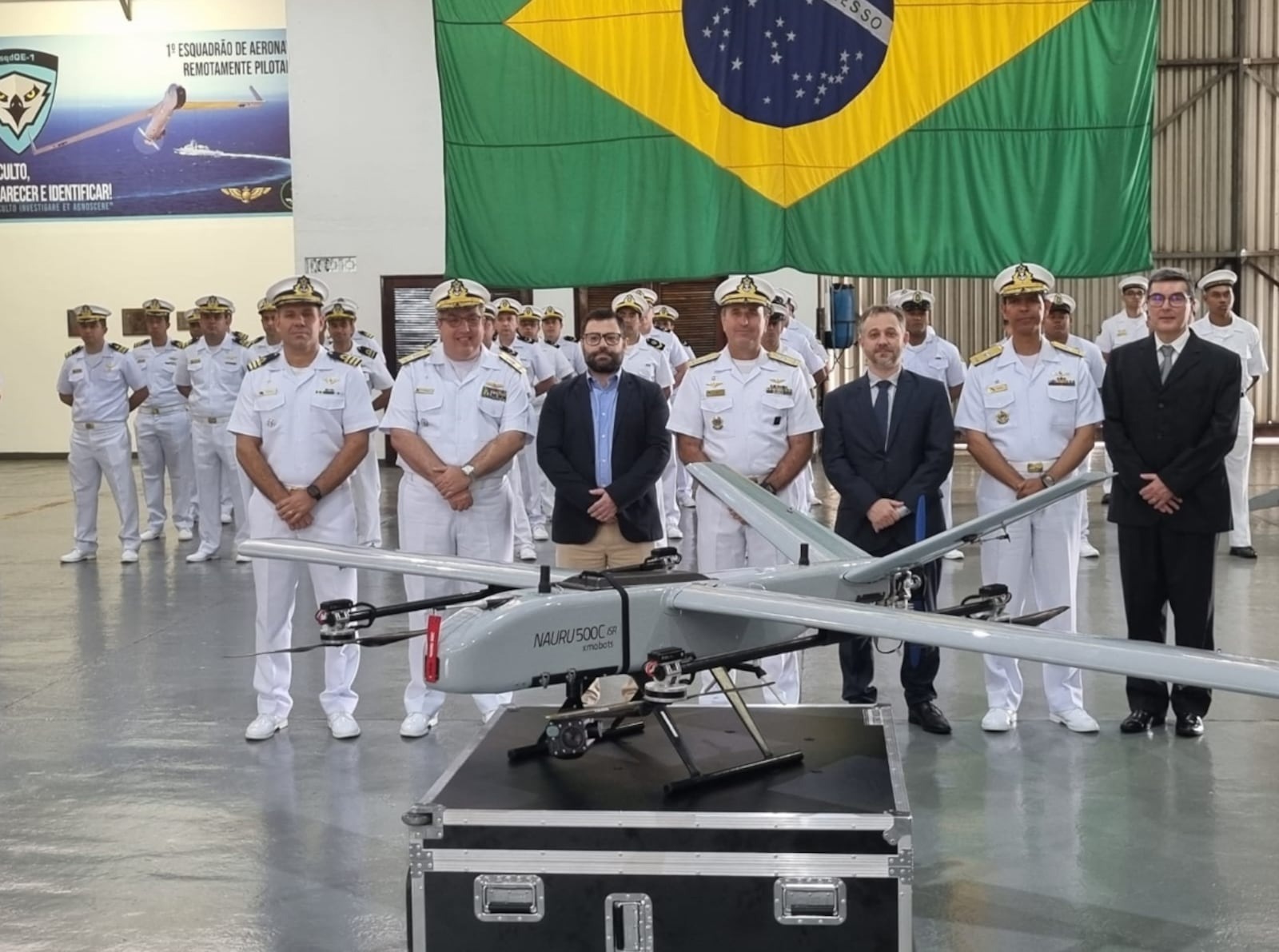
Signed in Rio de Janeiro, the technical cooperation agreement between Xmobots, the Brazilian Navy, and Petrobras is part of the MMRE project, with an investment of R$ 40 million, and provides for the adaptation of Nauru drones for onboard operations, environmental monitoring, maritime defense, search and rescue, and continuous surveillance in Brazilian jurisdictional waters
Xmobots, the largest drone manufacturer in Latin America and the sixth in the world, signed a technical cooperation agreement in Rio de Janeiro with the Brazilian Navy, partially supported by Petrobras, to expand the use of remotely piloted aircraft from the Nauru family in naval, offshore, environmental, and defense operations.
MMRE Project and Investment of R$ 40 Million
The partnership integrates the MMRE project, an initiative of R$ 40 million aimed at developing technologies and drones equipped with advanced sensors to strengthen national maritime monitoring.
The program prioritizes the detection of oil spills, enhances responses to environmental emergencies, and supports search and rescue missions.
-
“No one will make us change the Pix,” says Lula after the US report.

-
Lula responds directly to Trump and says that Pix is from Brazil and will not change under pressure from anyone, after a report from the United States pointed out the Brazilian payment system as an American trade barrier.

-
Amazon has just announced a new fee on all deliveries, and your online purchases will become more expensive starting April 17, including for those buying from the United States here in Brazil.

-
He sold his share for R$ 4 thousand, saw the company become a giant worth R$ 19 trillion, and missed the opportunity of a lifetime.


The MMRE also aims to strengthen the fight against illegal trafficking in Brazilian jurisdictional waters, increasing the capacity for continuous surveillance in extensive and remote areas.
The initiative combines resources from the national industry, the Navy, and Petrobras in a cooperation considered unprecedented in the sector.
Strategic Use of RPAs in Naval and Environmental Operations
In recent years, Petrobras has been expanding the use of remotely piloted aircraft in maritime activities, such as hydrocarbon detection, monitoring of sensitive areas, and light cargo transport. The agreement expands this strategy by incorporating Nauru drones onto ships and offshore platforms.
For the Navy, the cooperation strengthens national surveillance and emergency response capabilities. The incorporation of RPAs into naval resources enhances situational awareness maritime, increases response capabilities to environmental incidents, and modernizes search and rescue operations at sea.
Technological Adaptation for Severe Maritime Conditions
The agreement provides for the adaptation of avionic, power, and propulsion systems of Nauru RPAs to withstand severe maritime conditions, such as high salinity, humidity, sand, and fungi. The integration of satellite communication technologies is also planned.
These solutions extend operational range in remote areas and enable the development of advanced algorithms for takeoffs and landings from moving ships, including frigates and patrol vessels. The goal is to ensure continuous operation in complex naval scenarios.
Operational Tests and Involved Models
The planned tests will be conducted at the Naval Air Base of São Pedro da Aldeia and on Navy vessels, where operational requirements for the continuous deployment of drones in naval and offshore missions will be validated.
The testing phase is central to the consolidation of the agreement.
Among the models involved are the Nauru 1000C, with a ten-hour autonomy and already used by the Army for border monitoring, and the Nauru 500C, the first certified eVTOL by ANAC for BVLOS flights. Both will be adapted for onboard operation.
Industrial Impact, Sovereignty, and National Innovation
For Xmobots, the partnership consolidates a movement with a direct impact on national sovereignty, innovation, and environmental protection.
The company highlights that it is the only one in the country with a complete vertical domination of the drone development chain, from avionics to embedded software.
According to CEO Giovani Amianti, the cooperation highlights the country’s interest in ensuring that internally developed technologies provide benefits in surveillance, maritime security, and environmental protection.
The initiative also signals a structural change in Brazil’s strategy for critical technologies, combining resources and national expertise in autonomous maritime monitoring systems, with direct impacts on naval and environmental operations and the integration between defense, energy, and technological innovation.









-

Uma pessoa reagiu a isso.