





 Portuguese
  English
  Spanish
  7 min of reading
  5 comments


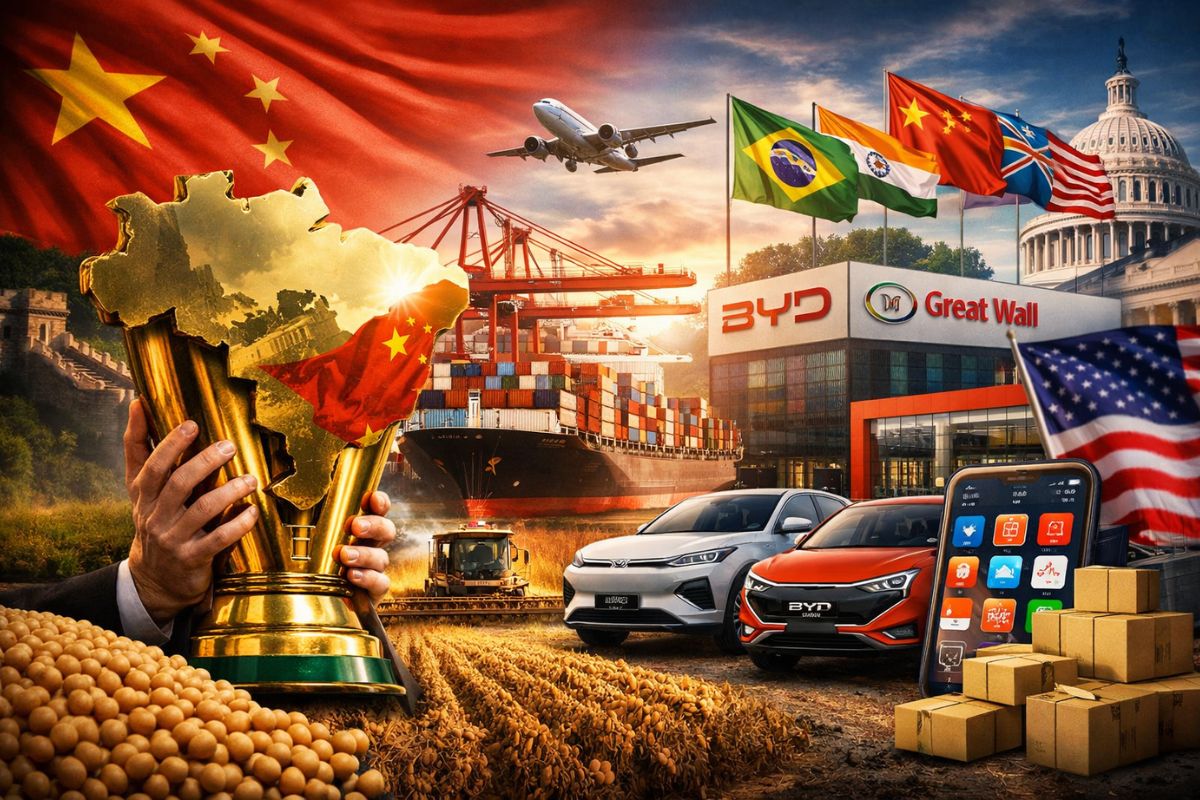


Brazil, Brasília and Rio de Janeiro Have Turned Into Showcase for China in the Americas: Bilateral Trade Reached US$ 171 Billion in 2025, Soybean Advanced, Investments Hit Record US$ 4.2 Billion in 2024 and Brands Like BYD, Great Wall, Temu, Shein, Alibaba and 99 Expanded Their Presence at Accelerated Pace
The advance of China in Brazil has ceased to be merely commercial and has begun to reorganize decisions in Brasília, especially after the United States imposed an additional 40% tariff on Brazilian products in July 2025. The scenario combines China, protectionism, and geopolitical conflict, with productive chains, consumption, and foreign policy being pulled in the same direction.
In parallel, demonstrations on January 5, 2026, in front of the US consulate in Rio de Janeiro, with support for Venezuela and condemnation of US actions, exposed the climate of friction. The combination of tariff, protest, and international repositioning has placed China at the center of the Brazilian chessboard, while banks and protectionism press economic choices.
US Tariff, Bolsonaro’s Arrest and the Immediate Effect on the Streets

The mentioned turning point for the Brazil-US crisis occurred in July 2025 when the United States imposed an additional 40% tariff on Brazilian products. The justification links the decision to the imprisonment of former President Bolsonaro, presented as a Trump ally and a fierce critic of China. The additional tariff added to a base tariff of 10%, raising the entry cost of Brazilian products in the American market.
-
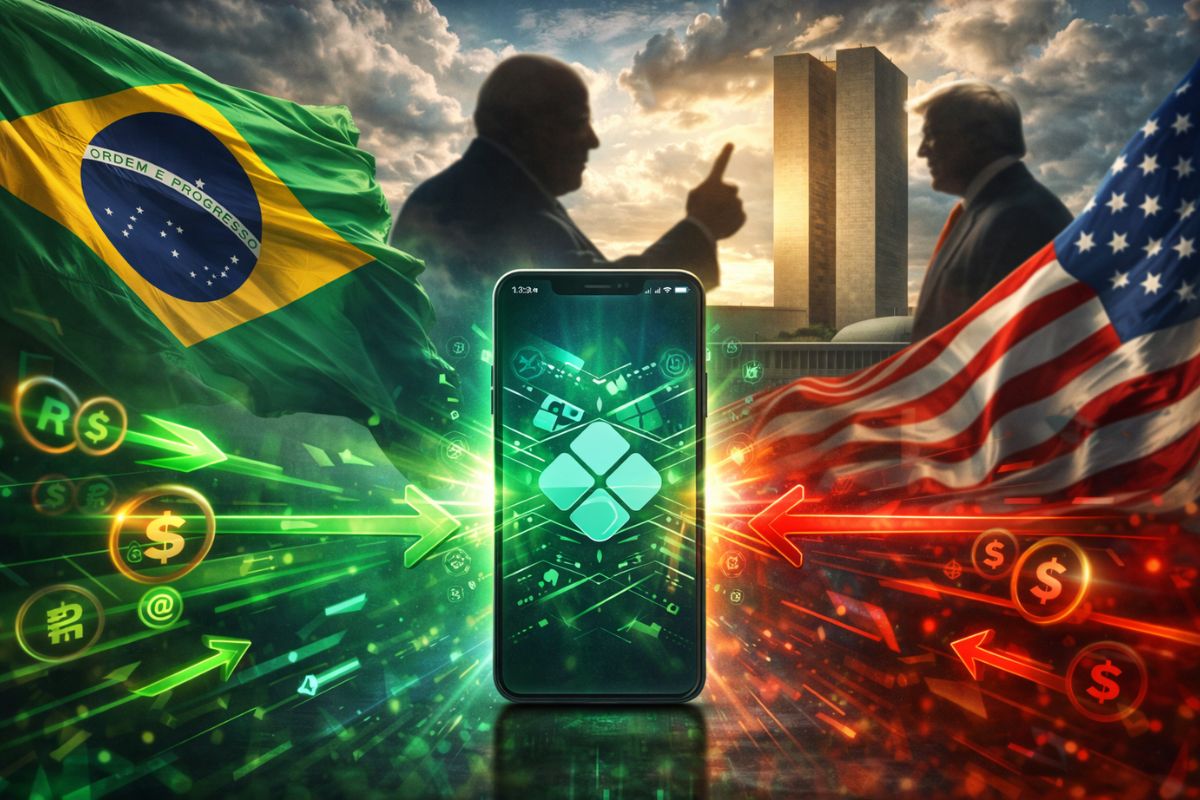
“No one will make us change the Pix,” says Lula after the US report.

-
Lula responds directly to Trump and says that Pix is from Brazil and will not change under pressure from anyone, after a report from the United States pointed out the Brazilian payment system as an American trade barrier.
-
Amazon has just announced a new fee on all deliveries, and your online purchases will become more expensive starting April 17, including for those buying from the United States here in Brazil.

-
He sold his share for R$ 4 thousand, saw the company become a giant worth R$ 19 trillion, and missed the opportunity of a lifetime.


The political impact was seen in anti-US protests in Brazil and demonstrations that gained visibility on January 5, 2026, in Rio de Janeiro, in front of the US consulate. The episode made concrete an effect that was previously abstract for a part of the population: trade measures can become political fuel, and the competition with China began to be perceived as a direct factor in diplomatic everyday life.
BRICS, “Dollar Is King” and the Structural Push Towards China

Brazil is described as a founding member of BRICS, a bloc cited in a speech as an attempt to “degenrate the dollar” and remove the standard of the American currency. In the same set of statements, there is an explicit defense that “dollar is king” and that losing the dollar as a global standard would be equivalent to “losing a war,” reinforcing the confrontational tone.
This backdrop helps to understand why China sees hierarchies of importance in Latin America and places Brazil at the top. It is not only about the export of commodities but also a dispute over economic standards, technology, consumption, and influence, with Brasília being pressured by tariffs, narratives about currency, and alliances that reconfigure choices.
Why Brazil Became a Priority for China in the Americas

Brazil is portrayed as the largest economy in Latin America and is described as a market with over 200 million inhabitants, with 40% of the population under 30 years old. This profile is presented as a consumer base that interests companies seeking new markets amid a growing wave of protectionism.
In the expressed logic, China treats Brazil as its most important economic partner compared to Venezuela, as it combines consumption scale, capacity to absorb technology, demand for vehicles, and strength in e-commerce. The Brazilian priority is described as a mix of volume, youth in the market, and a showcase effect for Chinese brands, even in sectors where American companies once dominated.
Bilateral Trade of US$ 171 Billion and the Gearing of Soy, Minerals, and Oil

Bilateral trade between Brazil and China is described as having reached US$ 171 billion in 2025, with a focus on soybeans, minerals, and oil. This volume appears as a central piece to explain why Brazil occupies the top of the Chinese hierarchy in the region, not only as a supplier but also as a consumer market.
The text points out that soy has become a sensitive point for the Trump administration for an internal political reason: farmers in America’s Midwest states like Illinois, Iowa, Minnesota, Nebraska, and Indiana would heavily depend on China as a market. When China shifts its source of purchases, political pressure appears in chain, and Brazil emerges as an alternative of scale.
Soy in Numbers and the Contrast Brazil Versus US in China’s Supply
The Brazilian government reportedly stated that between January and August 2025, 77 million metric tons of soy were exported to China. During the same period, China reportedly imported 17 million metric tons from the US, according to customs data cited in the material.
The suggested interpretation is that soy ceases to be merely trade and becomes an instrument of power and bargaining. Brazil gains traction as a volume supplier, while China reinforces its ability to reorganize global flows based on its purchases, altering the balance of pressure among Washington, Brasília, and Beijing.
Chinese Investments in Brazil and the Record of 2024
Chinese investments in Brazil are described as abundant and reportedly surged in 2024, reaching a record of US$ 4.2 billion in the country, distributed across 39 projects. This performance reportedly positioned Brazil as the third-largest destination for Chinese investments that year.
The movement does not appear as episodic but as continuous expansion across distinct sectors, with the presence of Chinese brands becoming “household names” and increasing influence in consumer goods, logistics, mobility, and energy. The logic is to occupy multiple fronts simultaneously, reducing reliance on a single sector and accelerating China’s consolidation in the Brazilian market.
BYD and Great Wall Opening Factories and the Dispute for the Automotive Market
Chinese automakers BYD and Great Wall are cited as having recently opened factories in Brazil, in a country described as the sixth-largest automotive market. The narrative points to quick gains for Chinese brands and positive reactions from local politicians, with BYD promising support for job creation beyond its own factory.
An operational detail also appears: BYD claims to be working with local industrial authorities to obtain updated technologies and qualify more than 150 local suppliers to become suppliers. This point is crucial as it connects the factory with the production chain, multiplying the impact beyond the industrial gate, and reinforces why China is seen as a structural presence.
Chinese Apps and E-Commerce Advance in Brazilian Consumption
In the ride-hailing sector, the Chinese giant Didi, known in Brazil as 99, is described as having successfully challenged the American company Uber, becoming a key player in transport and delivery services. The advancement is presented as more than mere commercial competition, as it occupies a daily service and increases dependence on digital infrastructure.
In e-commerce, Chinese companies like Temu, Shein, and Alibaba are described as aggressively expanding. The combination of mobility apps with e-commerce creates an occupation of daily consumption, where China’s presence ceases to be merely about industrial exports and becomes part of everyday buying, delivery, and commuting.
Energy and Billions in Electricity Transmission as a Long-Term Foundation
In the energy sector, the material states that China has invested billions in electricity transmission projects in Brazil. This type of investment is described as different from a short consumption cycle, as it involves infrastructure, long-term timelines, and technical dependency.
When combined with automotive factories and digital platforms, the result is a presence that spans production, logistics, consumption, and energy. China ceases to be merely a buyer of soy and becomes a participant in the functioning of the country, which explains why the debate on geopolitical alignment becomes more sensitive in Brasília.
The Venezuelan Variable, the Mercosur-EU Agreement, and the Search for Protection
The material points out that events in Venezuela complicated Brazil’s calculations and describes that days after Maduro’s capture, Brazil signed the Mercosur-EU trade agreement after 25 years of negotiations. The suggested reading is that Brazil is trying to open markets and expand options for exports, especially for agricultural products, seeking cooperation and partnerships “in accordance with the rules.”
At the same time, there is an assessment that no country in Latin America could withstand the United States on the battlefield, reinforcing that governments are seeking other forms of protection in a “disturbing” world of rivalry between great powers. In this context, China emerges as a real economic alternative, while Brazil tries not to get stuck in a single pole, even under pressure from tariffs and blocs.
What Changes for Brasília When China Becomes the Axis
The set of data points to a practical shift, not merely symbolic. US$ 171 billion in trade, a record investment of US$ 4.2 billion, soy in tens of millions of tons, and a growing presence of brands, factories, and digital platforms form a package that alters internal incentives.
With a 40% US tariff added to a base of 10%, visible protests in Rio de Janeiro, and an open dispute over the dollar and BRICS, Brasília begins to operate under a scenario where China is not a peripheral option, but the axis of economic decisions, with direct impacts on industry, employment, consumption, and infrastructure.
In your view, is Brazil managing to balance interests between the US and China, or has it already entered an irretrievable course toward Beijing?









Ser devorado pelo Dragao nao me parece assim tao vantajoso.
Virou colônia do imperialismo chinês. Kkkkkk não é assim que a eswuedalha podre diz ? A hora que não servir mais descarta.
O governo e o Brasil está cottetos precisamps lutar contra o isolacionismo do protecionismo imposto por medidas do governo Trump
O correto estamos fazendo o de comercializarmos com todos os mercados citando à China, nosso maior mercado. a CEE .Mervosul os BRICS à África Países Árabes etc,