





 Portuguese
  English
  Spanish
  6 min of reading
  0 comments


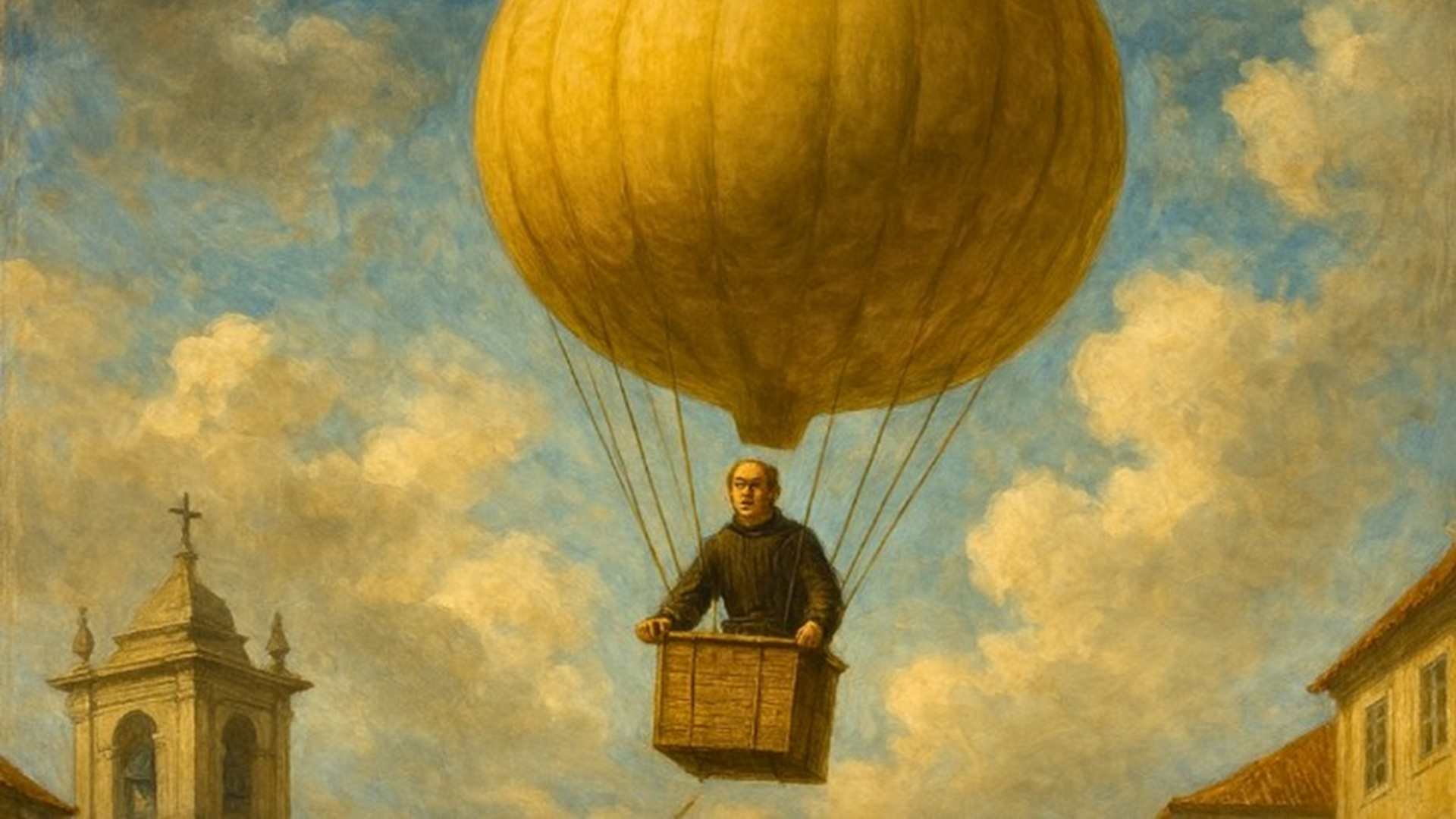
In 1709, in Lisbon, the Brazilian priest Bartolomeu de Gusmão presented to the Portuguese court a functional hot air balloon, conducted public demonstrations decades before the French, promised to travel hundreds of leagues per day, but did not obtain political support, abandoned the project, and died poor, persecuted, and practically forgotten
In August 1709, at the age of 24, Father Bartolomeu Lourenço de Gusmão presented a buoyant device capable of ascending unaided to the Portuguese court in Lisbon, before King Dom João V, demonstrating for the first time that a human-made artifact could overcome gravity.
The experiment took place a few months after Gusmão’s arrival in Portugal from Brazil, where he was already known as an inventor. The presentation marked an unprecedented episode in the history of science by showing an object lighter than air.
According to Araguaryno Cabrero dos Reis, a retired brigadier from the Brazilian Air Force, that moment represented the first time a man-made apparatus was able to glide through the atmosphere without external support.
-
A Brazilian millionaire couple restores a farm over 150 years old in the interior of São Paulo and transforms the historic property with Portuguese tiles, antique furniture, and new spaces into a refuge that blends tradition, comfort, and sophistication.
-
Submerged city in a lake in Minas reveals intact streets, preserved vehicles, and houses after more than 60 years, impressing divers.

-
Yellowstone has started to rise again in an area of the caldera, and the movement rekindles fears surrounding the U.S. supervolcano, as scientists monitor the deformation and try to understand what is happening underground.

-
Woman arrested after receiving $1.2 million due to banking error and not returning the amount.

The Observation of Fire and the Origin of the Aerostat
Years before the public demonstration, Gusmão observed the behavior of a flame and realized that heated air could lift small lightweight objects, like fragments of paper or soot resulting from the burn.
There are no historical documents detailing exactly how this initial discovery occurred, but it’s speculated that the phenomenon was observed when a soap bubble was launched into the air while passing over a candle.
There is also the hypothesis that pieces of paper, when burned and transformed into soot, ascended, revealing to the priest the potential of heated air as a lifting force.
These observations led Gusmão to design a device similar to a São João balloon, using paper and a heat source to warm the air inside.
The Demonstrations at the Palace and the Three Flight Attempts
The announcement of the flying machine caused quite a stir in Lisbon society during the summer of 1709. On August 3, Gusmão presented his invention to the royal family, nobles, and ecclesiastical authorities at the Palace.
In the first attempt, carried out in a hearing room, the small paper balloon was burned by its own flames before it could ascend, frustrating the guests who awaited the result.
Two days later, a second trial took place. This time, the globe, measuring less than half a meter in length, managed to rise just over four meters, causing alarm among the palace servants.
Fearing that the balloon would ignite the curtains, some attendants rushed towards the device before it could reach the ceiling, interrupting the experiment once again.

The Recognition Before King Dom João V
Gusmão’s merit was recognized only on the third attempt, conducted in the palace courtyard, before King Dom João V and Queen Dona Maria Anad. On this occasion, the aerostat finally took to the air.
The balloon rose slowly and, after the flame was extinguished, fell to the courtyard of the royal house. The public witnessed an unprecedented feat, albeit limited in duration and range.
Despite the visual impact, the invention did not achieve even half of the feats promised by Gusmão in his patent requests submitted to the Portuguese monarch.
He claimed that his creation would allow the discovery of new lands and make the Portuguese nation the glory of these discoveries, promising travels of two hundred leagues or more per day.
The Promises and the Indifference of the Portuguese Court
Gusmão’s statements described the aerostat as an instrument capable of moving through the air in the same way as through land and sea, with great speed and efficiency.
However, according to Henrique Lins de Barros, a researcher of the history of aviation, the Portuguese court did not show scientific interest in the invention presented in 1709.
According to him, the members of royalty were more concerned with obtaining wealth from gold and maintaining a lavish lifestyle than with investing in innovative scientific experiments.
This indifference contributed to the project not receiving sufficient support for development, despite the pioneering nature of the demonstration carried out by Gusmão.
The Passarola and the Construction of the Myth
Although it had a limited impact in Portugal, news of the priest who had flown over Lisbon quickly spread throughout Europe, feeding the popular imagination.
The aerostat became known as Passarola, a name associated with an apocryphal drawing that represented the machine in the shape of a bird, with an eagle head and scientific instruments around.
The illustration depicted Gusmão himself aboard the device, as if he had made a manned flight, something that never actually happened.
It is suspected that the drawing was produced by the priest himself, together with his disciple and friend Count of Penaguião, as a strategy to confuse potential imitators.
The Secret of the Heat Source and the Abandonment of the Project
The image of the Passarola did not reveal the heat source responsible for the balloon’s ascent, an essential element for the functioning of the aerostat designed by Gusmão.
According to Lins de Barros, by concealing the heat source and representing himself within the invention, the priest may have tried to hide the technical secrets of his discovery.
This fanciful representation led European and North American historians to classify Gusmão as a precursor without a solid scientific basis, which contributed to the devaluation of his work.
After these speculations, the inventor completely abandoned the balloon project, ending his work in the field of aerostatics prematurely and quietly.
The First Patent and Inventions in Brazil
Bartolomeu de Gusmão was born in Santos in 1685, with the name Bartolomeu Lourenço Santos, but adopted the surname Gusmão throughout his life.
As a child, he moved to the Captaincy of Bahia, where he studied at the Belém Seminary and stood out for his intelligence and memory, which were considered astonishing by his contemporaries. His first notable invention was a lifting pump capable of transporting water from the Paraguaçu River to the priests’ college, located 100 meters above sea level.
This invention reduced the effort and time needed for water supply and made Gusmão the first Brazilian to obtain a recognized patent.
The Career in Portugal and Conflicts with the Inquisition
Between 1708 and 1709, Gusmão left Brazil for Portugal, where, in addition to the aerostat, he dedicated himself to other inventions that did not achieve the same repercussion.
Over time, he also stood out as a speaker, became a member of the Royal Academy of History, and left several sermons, including the one for the Feast of Corpus Christi in 1721.
In the 1720s, despite the privileges at court, he faced issues with the Holy Inquisition, which resulted in persecution and political difficulties.
According to Benedito Calixto and Affonso d’Escragnolle Taunay, the conflicts were not related to aerostatic experiments but rather to personal issues and court intrigues.
Exile, Death, and Scientific Legacy
According to Araguaryno Cabrero dos Reis, intrigues involving a nun known as Trigueirinha would have led Gusmão to flee to the Netherlands, permanently distancing himself from the Portuguese court.
After years of fleeing from the Inquisition, the inventor died at the age of 39, on November 19, 1724, in Toledo, Spain, due to tuberculosis.
Despite his untimely death, Gusmão left other recorded inventions, such as a process for draining water from flooded ships without human labor.
In the Netherlands, he further developed a lens system for roasting meat in the sun, demonstrating continuous interest in innovative technical solutions.
The Belated Confirmation of Aerostatics
Only 74 years after the Brazilian priest’s experiments did a manned balloon achieve verified success in sustained flight.
On June 4, 1783, in the city of Annonay, French brothers Joseph Michel and Jacques Étienne Montgolfier flew two kilometers, reaching a maximum altitude of 2,000 meters.
This feat solidified aerostatics as a scientific field, confirming decades later the validity of the principle observed by Gusmão in his initial experiments, even though they were ignored in his time.
This article was prepared based on historical materials and references indicated in the sources cited throughout the text, including documentary records and analyses by researchers on Bartolomeu de Gusmão and his aerostatic experiments.






-

Uma pessoa reagiu a isso.