





 Portuguese
  English
  Spanish
  5 min of reading
  0 comments


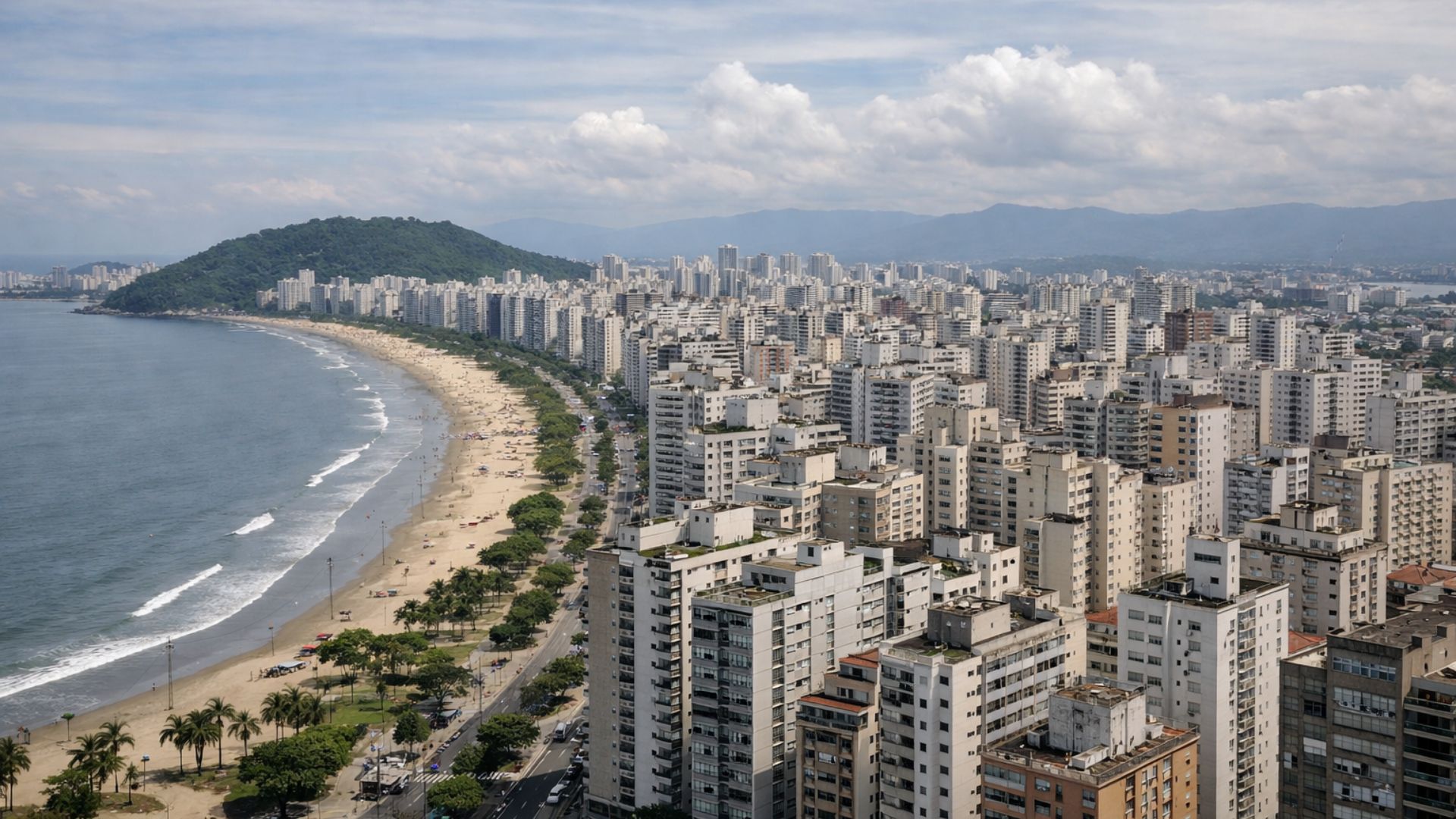
Urban Concentration on the Paulista Coast Transformed Santos into a National Reference for Verticalization, with the Majority of the Population Living in Residential Buildings, a Landscape Dominated by Buildings, and an Urban Dynamics Shaped by Geographic Limits, Census Data, and Decades of Controlled Growth.
Santos, on the coast of São Paulo, leads the national ranking of residents living in apartments, according to data from the 2022 Demographic Census.
The survey by IBGE indicates that 63.4% of the population of the municipality resided in units of this type, the highest proportion among Brazilian cities.
Just walking through neighborhoods near the waterfront makes it clear why the city gained fame as the “capital of buildings.”
-
Tourists on Everest were poisoned by guides who mixed substances in food to provoke false symptoms of altitude sickness while helicopter operators and hospitals charged inflated rescue fees to insurance companies.

-
Few people know this, but Neil Armstrong, one of the most famous NASA astronauts in history, survived the Korean War after jumping from the plane during his seventh combat mission aboard the USS Essex aircraft carrier of the United States.

-
Diving with a camera in Lake Furnas reveals a submerged city with an entire street, almost intact houses, a preserved bridge, a wood stove, a Kombi, and even a bus at the bottom of the largest lake in the Southeast.

-
Iceland accidentally drilled into a magma pocket at 2,100 meters and revealed that the extreme heat beneath the crust could pave the way for a new source of continuous energy.


The landscape is marked by rows of residential buildings that repeat for kilometers, with few interruptions.
While other cities are remembered for the height of their towers, Santos stands out for the concentration of residents and households in apartments.
Census Data Reveals National Leadership
The official data released by IBGE indicates that Santos was the only municipality in the country in 2010 where residents in apartments already predominated.
In comparison with the previous Census, the proportion rose from 57.8% in 2010 to 63.4% in 2022, reinforcing a consolidated urban pattern over decades.
On a national scale, IBGE reported that the predominance of residents in apartments is an exception.
Among Brazilian municipalities, only three recorded more people living in apartments than in houses in the 2022 Census.

In addition to Santos, Balneário Camboriú in Santa Catarina and São Caetano do Sul in São Paulo appear, each with its own urban characteristics.
Another data point that helps explain the perception that “almost everyone lives in a building” is the profile of the households.
In Santos, the 2022 Census also indicates that 67.1% of the homes are classified as apartments.
This distinction often leads to confusion between the number of residents and the total number of residential units.
Geographic Limitations Shaped the Vertical City
The verticalization of Santos is not a recent movement, nor is it limited to a real estate phenomenon of recent years.
The formation of the municipality has always coexisted with clear physical limits.
On one side is the sea.
In other areas, mangroves predominate.
In the background, the Serra do Mar prevents territorial expansion.
With little space to grow horizontally, the city began to develop vertically throughout the 20th century.
The proximity to the São Paulo Metropolitan Region, the economic importance of the Port of Santos, and the appeal of the coast as a permanent address reinforced the demand for housing in already consolidated areas.

Over time, the apartment ceased to be an exception and has become the dominant standard.
The Coast Concentrates Buildings and Neighborhoods Follow the Same Pattern
The beachfront functions as the main showcase of this urban model.
The nearly continuous alignment of residential buildings along the coastal strip is one of the most recognizable traits of the city.
Those arriving in Santos for the first time usually notice this scenery immediately.
Even so, verticalization is not limited to the seafront.
Neighborhoods like Gonzaga, Boqueirão, Aparecida, and Ponta da Praia feature a predominance of residential buildings.
In these areas, single-story houses have become rare, especially in valued areas close to commerce and services.
This pattern differs from much of Brazilian cities.
In other municipalities, the coexistence of extensive horizontal neighborhoods with specific verticalized nuclei is common.
In Santos, the buildings spread more homogeneously, creating the feeling of permanent verticalization.

Living in Apartments Influences Routine and Infrastructure
When most of the population lives in buildings, urban routine reorganizes.
Condos, reception areas, elevators, and common areas become part of the daily lives of most residents.
This affects everything from social interactions to the flow of people during peak times.
The high population density in relatively small areas also puts pressure on urban infrastructure.
Water supply, sewage, electricity, waste collection, and mobility systems must cater to a large concentration of residents.
Along the coast, this demand also experiences seasonal variations associated with tourism.
On the other hand, densification contributes to a more compact municipality.
Services, schools, commerce, and public transport are closer to residential areas.
In many neighborhoods, daily activities can be resolved on foot or with short trips.
Benefits and Limits of a Dense Territory

Verticalization allows Santos to accommodate a substantial population in a limited territory.
This factor helps explain why the city maintains the highest proportion of residents in apartments in the country.
In coastal municipalities where environmental barriers are frequent, this urban strategy is repeated with varying intensities.
At the same time, the model imposes challenges.
The concentration of buildings requires constant attention to maintenance, especially in older structures.
Structural issues, safety, modernization of systems, and condominium management are part of the permanent agenda of the city.
Santos and the Exceptions of Verticalization in Brazil
Balneário Camboriú is often remembered as the symbol of Brazilian verticalization due to the height of its buildings.
Santos differs by another aspect. The emphasis is on the proportion of residents and households in apartments, not just the height of the constructions.
IBGE data shows that, in the country, living in houses still predominates widely. Therefore, the situation in Santos stands out. It is a consolidated and unique case in Brazilian urbanism.





-

-

-

-

8 pessoas reagiram a isso.