





 Portuguese
  English
  Spanish
  5 min of reading
  1 comment


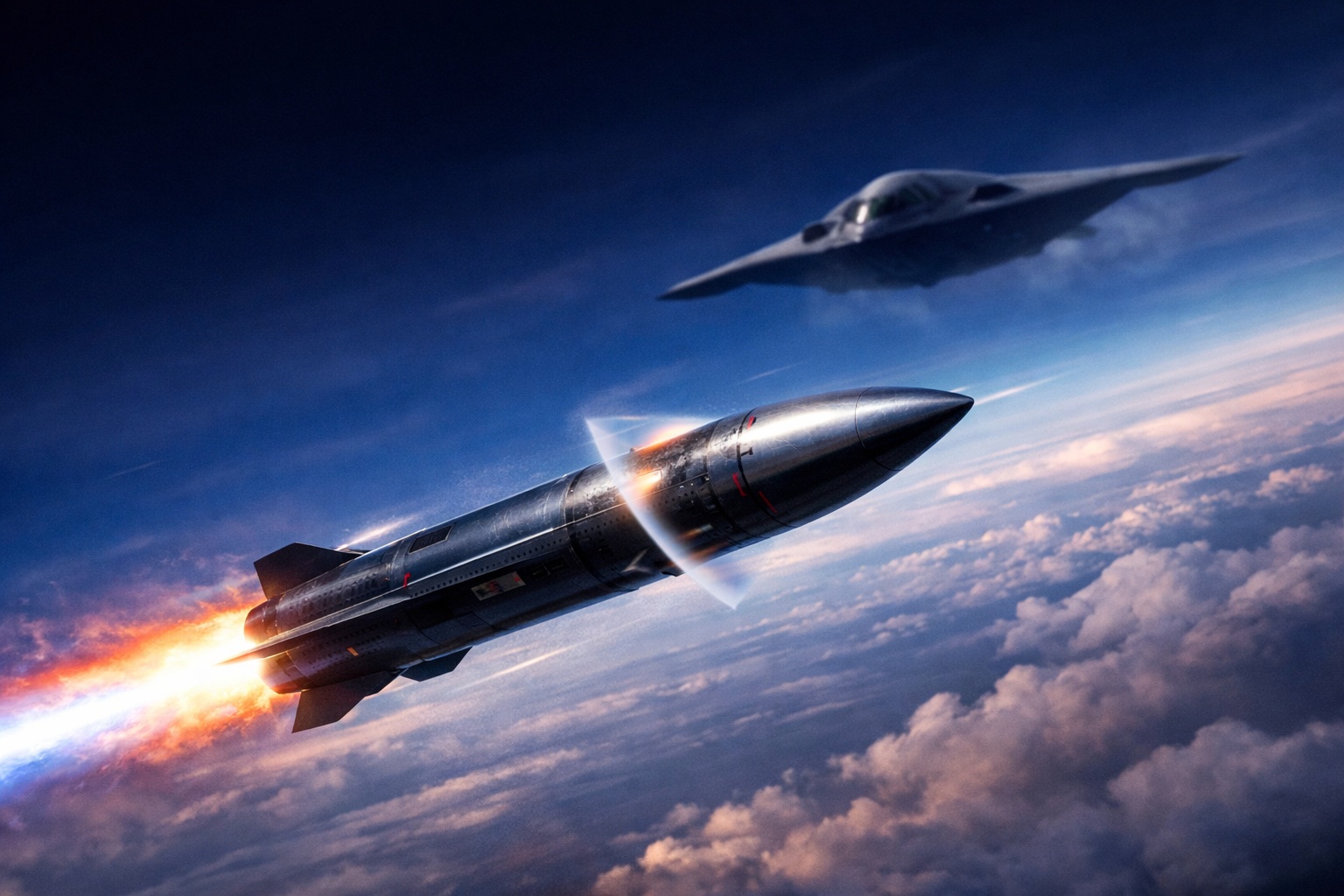


Chinese Hypersonic Air-to-Air Missile With Range of 1,000 km Challenges US, Threatens B-21 Raider and Overcomes Meteor, R-37M and AMRAAM
China has confirmed the development of a hypersonic air-to-air missile with a range exceeding 1,000 kilometers, a capability that surpasses all equivalent systems currently in operation worldwide. The new weapon has been strategically designed to neutralize high-value stealth bombers, such as the B-21 Raider from the United States — a program that represents an estimated investment of 80 billion dollars and is still in the testing phase.
The revelation came after the completion of tests in arc-heated wind tunnels, facilities capable of simulating the extreme thermal conditions faced by projectiles operating at hypersonic speed. This advancement positions China at an unprecedented level in the ultra-long-range air-to-air missile segment.
Speed Above Mach 5 Places Chinese Hypersonic Missile Beyond Range of Conventional Defenses
The missile reaches speeds exceeding Mach 5, equivalent to more than 6,100 km/h, classifying it as hypersonic. This speed drastically reduces the reaction time of adversary defense systems and renders interception by conventional means practically unfeasible.
-
The German “steel monster” weighing 55 tons fires up to 10 projectiles per minute at over 40 km and avoids counterattacks on the battlefield by moving quickly to escape enemy attacks; meet the Panzerhaubitze 2000.
-
USS Gerald R. Ford, the largest aircraft carrier in the world, returns to sea after a fire in the laundry in the Red Sea; repaired in Crete, it resumes missions of Operation Epic Fury against Iran.

-
Military power: South Korea’s new KF-21 fighter jet will be a key component in replacing the aging aircraft of the air force, placing the country on the map of air military powers.
-
With 310 meters, 80 thousand tons, and capable of operating for 45 years, the new nuclear aircraft carrier France Libre will be the largest in France and will enter service in 2038.

Hypersonic kinematics impose severe challenges on missile defense systems, which rely on trajectory predictability and broader engagement windows. At speeds above Mach 5, the time available for detection, calculation of firing solution, and interceptor launch is reduced to seconds.
This performance represents a significant technological leap in the strategic balance of modern air warfare, placing China ahead of the United States, Russia, and Europe in the specific segment of hypersonic air-to-air missiles with extreme range.
Tests in Arc-Heated Wind Tunnel Validate Thermal Resistance Above 2,000 °C
The tests were conducted in arc-heated wind tunnels, scientific infrastructure aimed at simulating extreme aerothermal conditions. In hypersonic flight, atmospheric friction generates temperatures that can exceed 2,000 °C, compromising structure, sensors, and electronic systems.
The validation demonstrated that the projectile withstands:
- Intense aerodynamic heating
- Structural stress in high dynamic pressure conditions
- Continuous operation of guidance systems under extreme heat
The materials used include advanced metal alloys, high-temperature resistant composites, and ablative or active cooling coatings. Overcoming this thermal obstacle is considered one of the greatest challenges in the development of hypersonic weapons.
Experts assess that the validation in the tunnel represents the final stage before real flight testing, indicating the nearness of the operational phase.
Range of 1,000 km Surpasses European Meteor, Russian R-37M and American AIM-120D AMRAAM
The range exceeding 1,000 km establishes a new paradigm in air-to-air missiles. The weapon surpasses the MBDA Meteor‘s range by five times, which reaches about 200 km and is considered the most advanced BVR missile in the West.
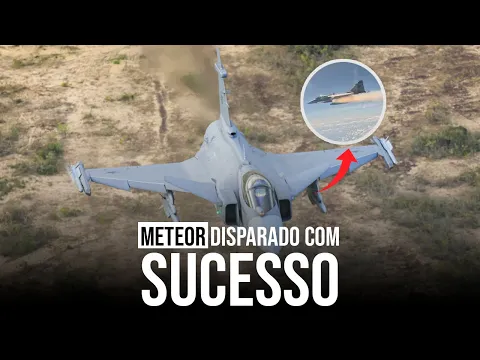

It also exceeds the 400 km range of the R-37M by 2.5 times, currently the longest-range air-to-air missile in operation.
The comparison with the AIM-120 AMRAAM is even more striking: the American model, widely used by F-15, F-16, F-22, and F-35, has an estimated range of 160 to 180 km in the AIM-120D version.
The combination of extreme range + hypersonic speed + coordination by artificial intelligence profoundly alters the air combat doctrine based on BVR superiority established since the 1990s.
B-21 Raider Becomes Priority Target in the New Air Warfare Scenario
The B-21 Raider has been developed to penetrate sophisticated air defenses operating stealthily and, theoretically, without the need for escort. However, a missile with a range of 1,000 km drastically reduces this advantage.
Even with a low radar signature, the bomber can be located by:
- Long-range infrared sensors
- Low-frequency radars
- Integrated distributed sensor networks
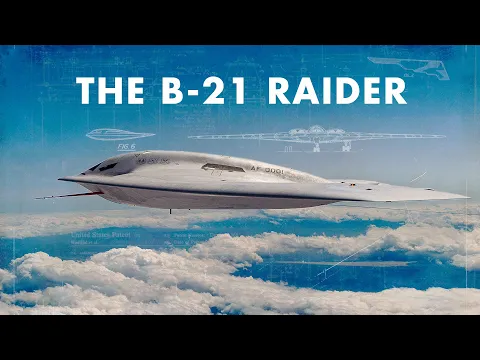
The existence of a system capable of engaging the B-21 before it reaches the strategic weapons launch zone imposes a profound revision of American aerial deterrence concepts.
Patriot, THAAD and Aegis Face Limitations Against Hypersonic Threats
The speeds above Mach 5 create challenges for systems such as:
- MIM-104 Patriot
- THAAD
- Aegis Combat System
The Patriot was designed for subsonic and conventional supersonic threats. THAAD is optimized for predictable ballistic trajectories, not for maneuverable hypersonic vectors. Even with SM-6 missiles, Aegis operates below the full hypersonic range.
The US Navy is working on the SM-6 Block IB and next-generation interceptors, but timelines suggest that they will only enter service after 2027.
Artificial Intelligence Enables Coordinated Attack and Saturation of Defenses
One of the system’s differentiators is the incorporation of embedded artificial intelligence, capable of coordinating multiple missiles simultaneously.
AI enables:
- Real-time data sharing
- Dynamic trajectory adjustment
- Simultaneous attacks from multiple vectors
- Optimization of fuel and kinetic energy
This concept creates a scenario of defensive saturation, increasing the probability of hits through operational redundancy.
The distributed architecture reduces vulnerability to electronic warfare and external interference, enhancing the system’s resilience in a contested environment.
J-20 Emerges as a Likely Platform for Launching the Hypersonic Missile
The stealth fighter Chengdu J-20 stands out as the ideal platform to operate the new weapon. With over 200 units produced, the J-20 features:
- Internal weapons compartments
- Advanced avionics systems
- Integration capability with long-range missiles
The two-seat variant J-20S further expands the concept, allowing coordination of drones and tactical control of multiple armed vectors in a network.
The integration of a 1,000 km hypersonic missile would significantly expand the Chinese air denial radius.
AIM-260 JATM Represents an American Response Still in Development
The United States is developing the AIM-260 JATM as the successor to the AMRAAM and a response to Chinese capabilities.
Although highly classified, it is estimated that the JATM will reach speeds close to Mach 5 and have a range exceeding 200 km. However, its full operational deployment is not expected before the end of the decade.
This interval creates a strategic window in which China can consolidate technological advantage in long-range air-to-air missiles.
Strategic Impact in the Pacific and Implications for Taiwan
The engagement capability at 1,000 km profoundly alters the scenario involving Taiwan. Within China’s A2/AD (Anti-Access/Area Denial) strategy, fighters equipped with this missile could:
- Intercept refueling aircraft
- Neutralize early warning airplanes
- Target reinforcements before they enter the conflict zone
American bases in Okinawa and Guam will begin operating under an expanded threat envelope, forcing a revision of routes, altitudes, and air logistics.
The result is a new phase in the arms race in the Indo-Pacific, with increasing investments in hypersonic interceptors, advanced electronic warfare, and autonomous platforms.









É A CHINA SEMPRE INOVANDO E CRIANDO E AMPLIANDO SUA CAPACIDADE BÉLICA.