





 Portuguese
  English
  Spanish
  3 min of reading
  0 comments


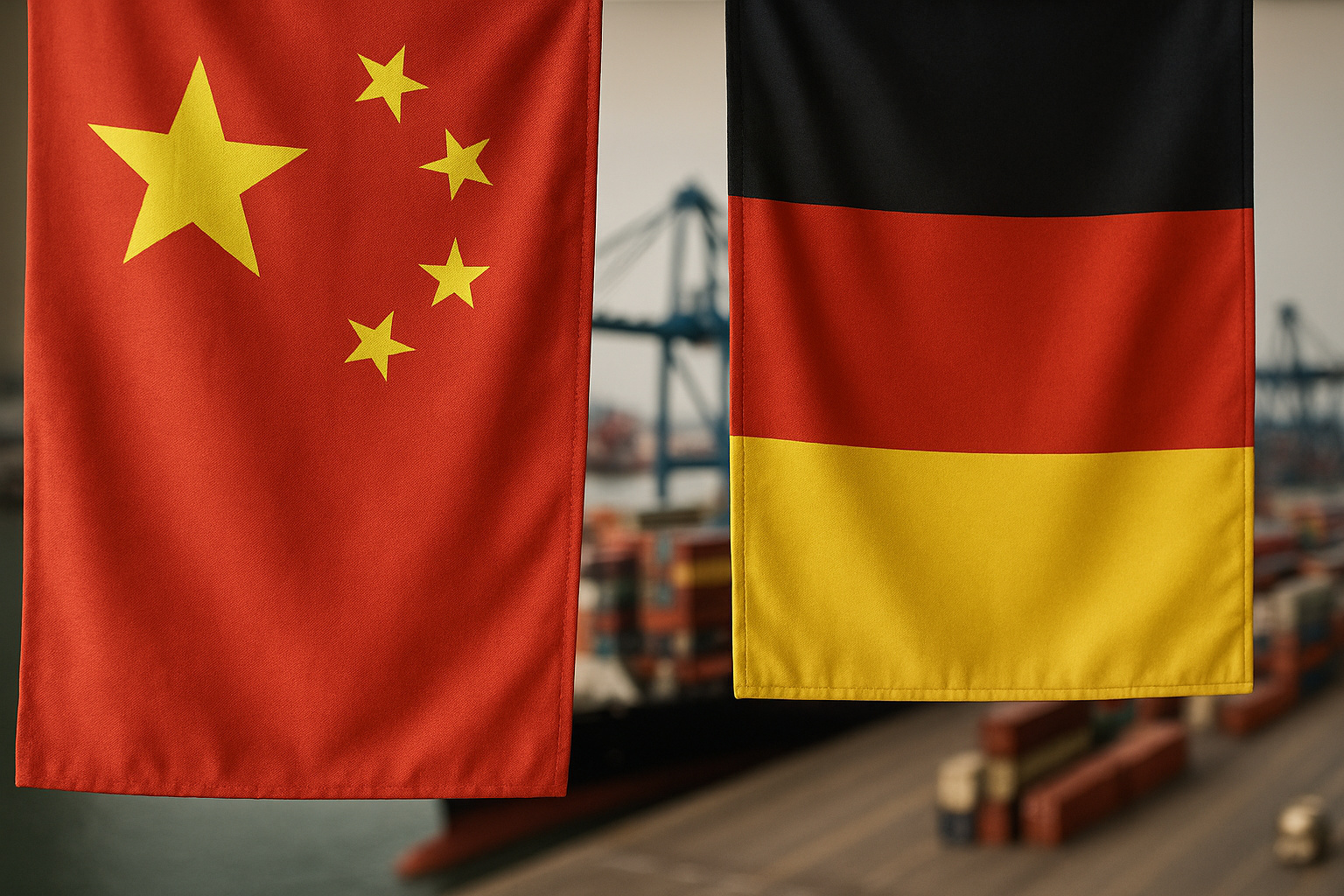
Balance Until August Shows That Beijing Surpassed Washington in Trade with Berlin in 2025
The China has reclaimed its position as Germany’s largest trading partner between January and August 2025. The data was released by the Federal Statistical Office of Germany (Destatis) and analyzed by Reuters.
During the period, trade exchanges between the two countries totaled €163.4 billion, slightly surpassing the volume recorded with the United States, at €162.8 billion.
Decline in Exports to the U.S.
In 2024, the United States had assumed the lead, ending China’s eight-year streak in the top position.
-
Middle East War Hits Fertilizers and Transportation and May Strain Brazilian Wallets
-
Russia Considers Suspending Gas to Europe After Surge in Energy Prices

-
How A War Thousands of Miles From Brazil Started Disrupting Global Shipping Routes, Raising Container Costs, and Putting Up to 40% of Brazilian Beef Exports at Risk

-
Iran-U.S. War Drives Up Oil Prices and Pressures Global Financial Markets

However, the more aggressive tariff policy adopted by the U.S. government in 2025, following Donald Trump’s return to the White House, altered the scenario again.
German exports to the U.S. fell by 7.4% in the first eight months of the year, totaling €99.6 billion.
Just in August, there was a significant drop of 23.5% compared to the same month in 2024.
According to Dirk Jandura, president of the German Federation of Foreign Trade (BGA), “there is no doubt that the U.S. tariff and trade policy is one of the main causes of the decline in sales”.
He explained that the U.S. demand for German cars, machinery, and chemicals has decreased significantly, reflecting the direct effects of the tariffs.
Difficult Recovery and Growing Dependence
According to Carsten Brzeski, global head of macroeconomics at ING, the recovery of German exports to the U.S. is unlikely in the short term.
This is mainly due to a stronger euro and the constant threat of new tariffs.
At the same time, exports to China also decreased, falling 13.5% in the same period, to €54.7 billion.
However, Chinese imports to Germany increased by 8.3%, reaching €108.8 billion, which explains Beijing’s return to the lead.
“The new import boom from China is concerning”, Brzeski warned. “These goods are arriving at dumping prices, which increases Germany’s dependence and pressures strategic sectors where China is a direct competitor.”
Challenges for the German Industry
The German industrial structure, already weakened by low domestic economic dynamism, faces a doubly challenging scenario.
There is contraction in external sales and an increase in import competition.
The economist Salomon Fiedler, from Berenberg Bank, stated that “without robust domestic growth, any fluctuation in global markets generates apprehension and direct impact on the German economy”.
Overview and Geoeconomic Implications
In 2024, total trade between Germany and the United States had reached €252.9 billion, while with China it amounted to €246.2 billion, according to Destatis.
Therefore, the turn of 2025 reflects not only a statistical adjustment but also a significant geoeconomic change.
This change reinforces China’s role as a central link in German production chains.
The combination of high U.S. tariffs, strong flow of Chinese imports and unfavorable exchange rates reveals a deep reconfiguration in Germany’s foreign trade.
The country now needs to balance relations between two global powers, avoiding excessive dependencies.
It must also seek market diversification to protect its industrial base.









Seja o primeiro a reagir!