





 Portuguese
  English
  Spanish
  3 min of reading
  1 comment


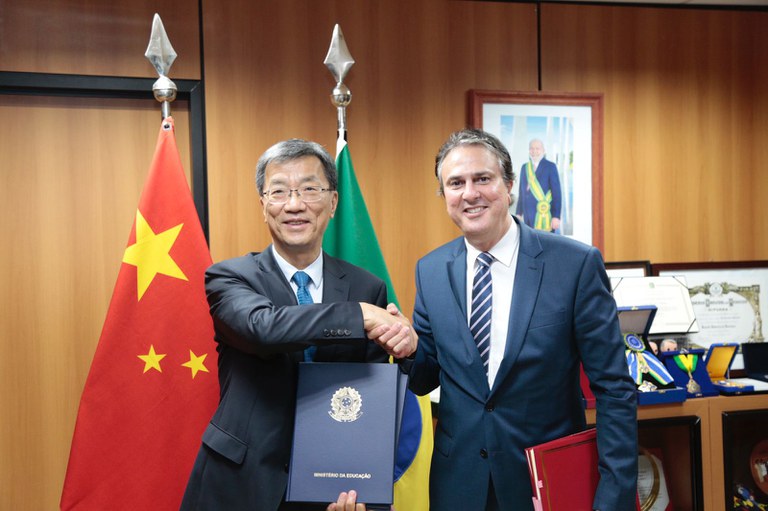


Brazil and China Signed an Educational Partnership Agreement Aiming to Promote Portuguese Teaching in China and Strengthen Cultural and Academic Ties Between the Countries.
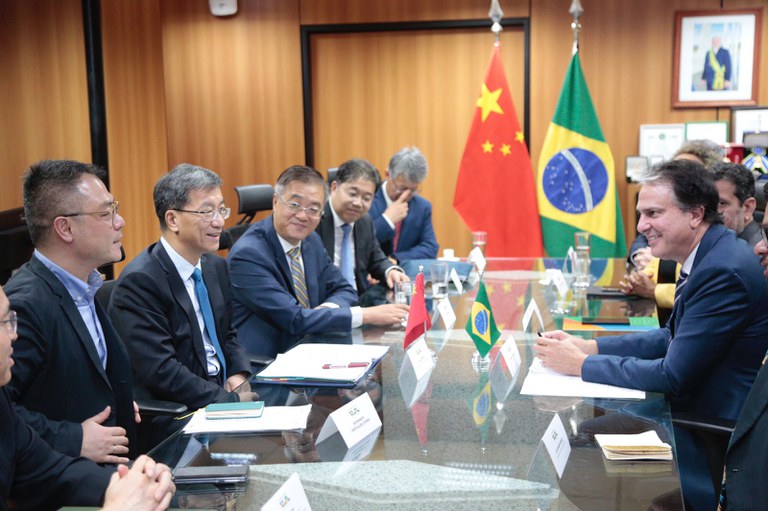
On Tuesday, November 26th, Brazil and China took an important step in expanding their educational partnership, including the teaching of Portuguese. During a meeting in Brasília, the education ministers of both countries, Camilo Santana and Huai Jinpeng, signed two memorandums of understanding that promise to strengthen ties between higher education institutions and promote advances in various strategic areas.
Focus on Portuguese Teaching and Recognition of Degrees
One of the memorandums encourages the teaching of Portuguese as a foreign language in China, highlighting the opening of a new testing center for the Certificate of Proficiency in Portuguese for Foreigners (Celpe-Bras) at the Macau University of Technology. Currently, about 5,000 Chinese students are learning the language at 40 universities across the country.
The second agreement addresses the recognition of certificates and degrees in higher education, facilitating access for Brazilian and Chinese students to educational institutions in both countries. The measure aims to reduce bureaucratic barriers and promote greater academic mobility.
-
USA and China compete for Brazil over resources that could be worth trillions — rare earths put the country at the center of a global dispute

-
Global summit with over 40 countries pressures Iran for a blockade in the Strait of Hormuz and warns of direct impact on oil, food, and the global economy.
-
Russia has broken the U.S. maritime blockade to send oil to Cuba and is now loading a second ship while Trump says that “Cuba is next” in a possible military action against the island.
-
Spain challenges the USA and closes its airspace for operations against Iran, raising global tension and provoking the threat of a trade rupture.


Professional Education
During the meeting, Camilo Santana emphasized the importance of training Brazilian students to meet the growing global demand in the electric vehicle sector. To this end, Brazil will strengthen its partnership with Chinese institutions and BYD, the world’s largest manufacturer of electrified vehicles.
Furthermore, Camilo Santana mentioned the increase in enrollments in technical-professional high school in Brazil, reinforcing the importance of vocational education.
The cooperation between the countries includes initiatives to combat digital exclusion, with support from Huawei, and the exchange of Brazilian teachers awarded in math olympiads in educational centers in China.
New Institutes of Excellence
The signing of the memorandums was accompanied by the announcement of two new bilateral institutions. The China-Brazil Institute of Highlight Engineers, linked to the Federal University of Rio de Janeiro (UFRJ), will seek to promote cutting-edge teaching and research in engineering.
The Brazil-China Institute of Innovation, Science and Technology will work in partnership with Petrobras, the China National Offshore Oil Corporation (Cnooc), and the China University of Petroleum. Following the “2+2” model – with two universities and two companies – the institute will focus on research and development projects in the energy sector.
Ministerial Consultation Mechanism
One of the highlights of the meeting was the proposal to create a mechanism for permanent dialogue between the ministries of education of Brazil and China.
The initiative, advocated by the Chinese minister, will allow for close monitoring of the implementation of agreements and planning of new cooperations. Camilo Santana embraced the idea, emphasizing that the density of educational partnerships needs to match the strength of trade relations between the two countries.
Among the first proposals for this forum is the realization of a Brazil-China Rectors’ Forum, which aims to connect more universities and foster direct collaborations.
Education as a Foundation for Economic Cooperation
Huai Jinpeng, China’s Minister of Education, emphasized that educational cooperation between the two countries is essential to sustain economic growth and promote a sustainable future. “Both Brazil and China share the goals of building a fairer and more sustainable planet, which facilitates interaction between our nations,” he highlighted.
With 155 higher education agreements already in force, involving 39 universities from both countries, the Brazil-China educational partnership solidifies as a key element in strengthening bilateral ties.








MACAO, já fala portugues. É, bom mudar o foco e começarem a confessar essa realidade. A lingua oficial de Macao é o Português.