





 Portuguese
  English
  Spanish
  4 min of reading
  0 comments


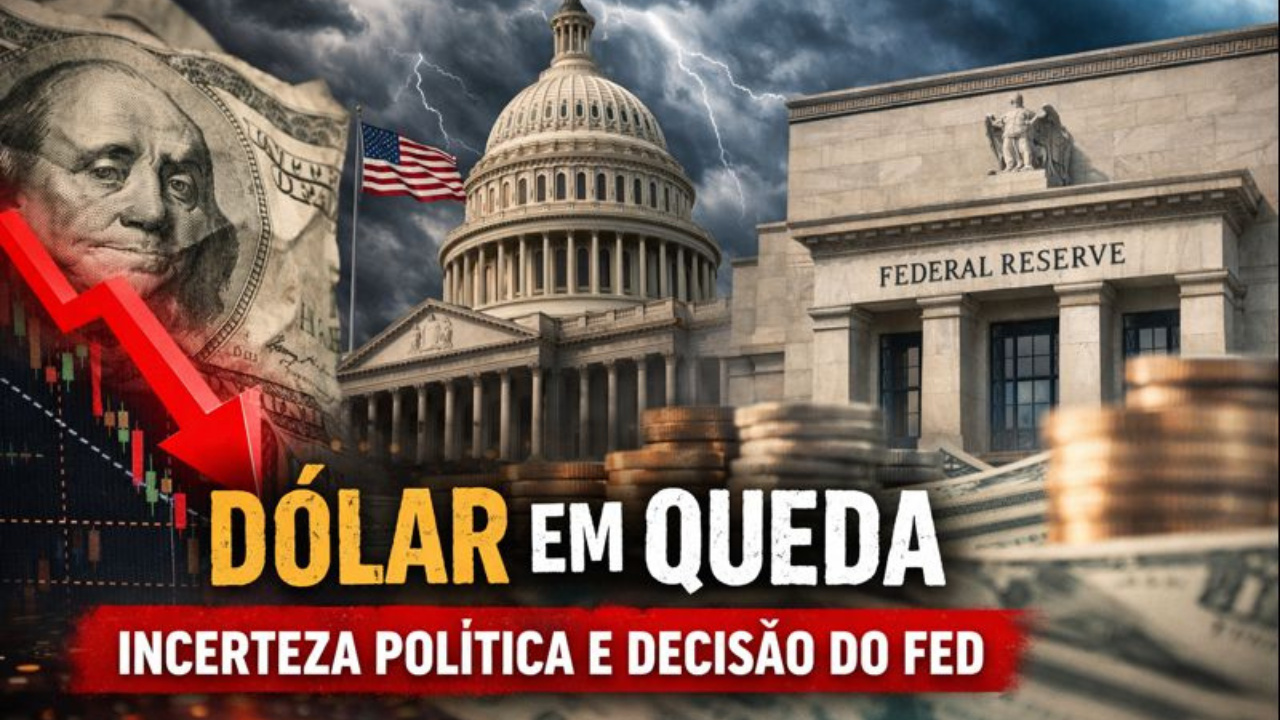
Dollar Fall Reflects Political Uncertainty In The US And Expectations For The Next Monetary Policy Decision Of The Federal Reserve.
The dollar started the final stretch of the week under strong pressure in global markets, heading to register its worst performance since June.
The decline occurs before the next Federal Reserve meeting, scheduled for the following week, in a context of political uncertainty in the United States, abrupt shifts in rhetoric in Washington, and increasing volatility in the international foreign exchange market.
In the United States, investors and traders closely monitored the contradictory signals coming from the White House, combined with cautious expectations about the American monetary policy.
-
“No one will make us change the Pix,” says Lula after the US report.

-
Lula responds directly to Trump and says that Pix is from Brazil and will not change under pressure from anyone, after a report from the United States pointed out the Brazilian payment system as an American trade barrier.

-
Amazon has just announced a new fee on all deliveries, and your online purchases will become more expensive starting April 17, including for those buying from the United States here in Brazil.

-
He sold his share for R$ 4 thousand, saw the company become a giant worth R$ 19 trillion, and missed the opportunity of a lifetime.


The movement of currency devaluation occurs even amid rising Treasury bond yields, reinforcing the view that political factors are overshadowing traditional economic variables.
Dollar Hits Weeks Low And Market Changes Strategy
The Bloomberg Dollar Spot index fell to its lowest level in three weeks on Friday (23).
Over the past five days, the decline reached 0.8%, reflecting a significant shift in investor sentiment.
Furthermore, option traders have begun to pay higher premiums to hedge against new dollar losses over the next month.
This movement marks a clear reversal from the previous week when positive sentiment towards the American currency had reached its highest level since November.
Thus, the behavior of the foreign exchange market has begun to signal greater caution amid the unstable political environment.
Political Uncertainty In Washington Outweighs Monetary Policy
The instability gained traction after statements from US President Donald Trump, who threatened to impose trade tariffs on Europe amid geopolitical discussions involving Greenland.
Shortly after, the rhetoric was abruptly abandoned.
The shift occurred after an agreement with NATO Secretary-General Mark Rutte during the World Economic Forum in Davos.
This back-and-forth raised the perception of political uncertainty, increasing risks for dollar-linked assets.
Meanwhile, even with expectations of interest rate maintenance by the Federal Reserve, the currency continued to decline, indicating that the political factor has been decisive.
Market Projects Interest Rate Cuts But Volatility Increases
In interest markets, investors continue to price in two cuts of 0.25 percentage points in rates throughout 2026.
However, the likelihood of any change at the next Federal Reserve meeting is considered practically nil.
Still, the volatility of a week—which directly incorporates the monetary policy decision by the Fed expected for January 28—has risen to the highest level in over a month.
This reinforces the climate of uncertainty and the search for protection in financial markets.
Analysts Warn Of Negative Bias Of The Dollar
For specialists, the current scenario indicates prolonged risks for the American currency.
In a statement, Brent Donnelly, president of Spectra Markets and former currency trader, was direct in his assessment.
“The distribution of dollar returns in 2026 almost certainly must be heavily skewed to the downside at this time,” he wrote.
“The world is realizing that the nightmare of US politics is not over.”
This view reinforces the perception that political uncertainty will continue to influence the foreign exchange market, regardless of the Federal Reserve’s technical decisions.
Employment Data Relieves But Does Not Sustain The Dollar
Meanwhile, the latest data from the American labor market brought some relief.
According to the Labor Department, initial jobless claims increased by only 1,000 requests, totaling 200,000 for the week ending January 17.
The number was below the median of 209,000 projected by economists surveyed by Bloomberg.
Still, the positive data was not enough to reverse the negative trend of the dollar.
Market Closely Watches Succession At The Federal Reserve
Another factor that has begun to catch the attention of investors was the political signaling surrounding the leadership of the central bank.
Trump stated that he has completed interviews with candidates to assume the presidency of the Federal Reserve and indicated that he already has a name in mind.
This movement adds another layer of political uncertainty to the scenario, increasing the caution of financial players in the coming weeks.
Outlook Remains Challenging For The Foreign Exchange Market
According to JPMorgan, the current environment still does not favor a consistent recovery of the dollar.
“Optimism regarding the US labor market is not yet a threat to our moderately pessimistic view of the dollar,” said Pat Locke, the bank’s currency strategist in New York.
Thus, the combination of cautious monetary policy, instability in Washington, and unpredictable political events continues to put pressure on the dollar, keeping the foreign exchange market on high alert ahead of the Federal Reserve’s decision.
See more at: Dollar Heads For Worst Week In The World Since June With ‘American Nightmare’









-

-

-

3 pessoas reagiram a isso.